

Green Buildings and Urban Development in Toronto. Tweets my own
Joined July 2009
- Tweets3.3K
- Following1.3K
- Followers844
- Likes1.3K




Jeff Ranson retweeted

A significant amount of the charm embodied in the 5000 years of urbanism before WWII exists in the urban form, not the materials
We can recover the urban form even when we have to use modern materials


Great to talk with @donnelly_b about building YZD a neighbourhood (city?) from scratch, and how the hardest part of building something new is often replicating what works so well in the old parts of the city. @globizen

Welcome to the third edition of Global City Builders by @globizen. This month, we sat down with @jeffranson of @northcrestdev to talk about one of the largest redevelopment projects in North America — YZD. Read the Q&A at globizen.com/journal.


Then once you get the roads and blocks right, you still need to address the impacts that vehicles have in our building design, which can undercut what you're trying to achieve at the community level. Loading is a big issue here.
We see 40%, 50%, or even 75% of our ground floor area used solely for vehicles this comes at a huge public cost. @halfclimate @GiaimoArch azuremagazine.com/article/pa…

Instead of east-west pipelines why don’t we build a trans-Canada super conductor transmission network?
That would unlock markets for both renewables and LNG+CCS generation in the Prairies.

BREAKING: Mark Carney says the federal government and the provinces have agreed to create a national trade and energy corridor
Premier Susan Holt tells me there’s “never been better alignment” over a west-east pipeline project. #NB


This is a great approach. Little projects have little public risk and big projects have bigger public risk, so resource appropriately.
(Replace "risk" with impact/service burden/transformative potential/investment value...whatever you want to focus on).

In doing so, I recommend that @CityPlanTO establish a stakeholder advisory committee comprised of planners, architects, developers, financial analysts, lenders, and others to assist in determining the composition of each tier based on what is necessary and achievable. #TOpoli

The rates should go down significantly because the assessed value growth would be WAY higher than the proposed tax rate increase. But on average this would have zero impact on the tax amount paid. It’s just applying a lower rate to a higher value to get to the same total.
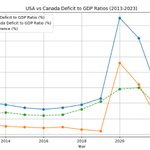
The US has run a significantly higher deficit to GDP ratio than Canada over the last decade. How much does that explain the difference in productivity and what is the risk of a significant period of productivity that doesn't dilute debt at all?


Canada and the United States had equally productive economys from 1995 to 2015.
Trudeau quickly put an end to that.
#Trudeau #TrudeauNationalDisgrace #thursdayvibes


Is Canada "a small part of global emissions"? a) our direct emissions are about 2% b) what we import causes about 2.5% more (mostly in China) when it's made, c) what we export (mostly Oil & Gas) causes another 3%. We touch >7% with .5% of population

GDP does not measure wealth.
environment.yale.edu/news/ar….

You’re unable to view this Post because this account owner limits who can view their Posts. Learn more
TIL that squids have bones.

A sponge made from a fusion of cotton fibre and squid bone could help to clear some of the world's microplastic pollution after a team of Chinese researchers found it can soak up as much as 99.8 per cent of the particles from water samples.
dezeen.com/2024/12/18/squid-…

Canada's GDP per capita is lagging behind the US. But US debt growth per capita is also way higher. Can any economists explain how much the GDP gap is related to deficit spending gap? visualcapitalist.com/governm…

Our tax policies for property try to do too much with a single assessment. As if a formula using just assessed value can fairly recover public costs (without any site specific context), do means testing (without income data), and push development goals.
For example, single-family homes have always been the least efficient properties for cities to service, but property tax doesn't reflect that. When you propose raising taxes on SFH, people worry that families who "need" SFH can afford it. So is the tax a subsidy for families?