

We design, build and run the digital side of your business: a website people trust, an app they keep, and social media that stays active.
Québec
Joined November 2012
- Tweets3.4K
- Following322
- Followers1.1K
- Likes17.1K


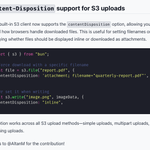





Ever wished there was an easier way to select fields (or nested fields any level deep) from an object in JavaScript or TypeScript? Well I did. So I created an npm package that does just that.
Introducing `pick-object`: A lightweight, zero-dependency utility for selecting fields from complex objects and arrays, inspired by Prisma's select syntax.
Did I mention it's fully type-safe as well? Check it out:
github.com/jgb-solutions/pic…

1
1
61
JGB retweeted

Yab is now open-source.
All of it. Mac, iPhone and Android.
The best Arc alternative out there, every feature included, now built with the community.
github.com/yetanotherbrowser…
Great! Now I can use it as my default browser. Crest is awesome too. It just lacks an Android version.
124
Is this for real? Is zig gonna be dead? Is Bun a toy now? Should I switch back to Node for longevity? So many questions.
1
1,487
JGB retweeted

Finally, @Tan_Stack Start now supports React Server Components!
Start's RSCs are a truly fetchable, cacheable and composable primitive that work with your favorite tools instead of dictating your entire architecture.
Oh, and one more thing... "Composite Components" 😉
🔗⬇️🧵


JGB retweeted

The math on this project should mass-humble every AI lab on the planet.
1 cubic millimeter. One-millionth of a human brain. Harvard and Google spent 10 years mapping it. The imaging alone took 326 days. They sliced the tissue into 5,000 wafers each 30 nanometers thick, ran them through a $6 million electron microscope, then needed Google’s ML models to stitch the 3D reconstruction because no human team could process the output.
The result: 57,000 cells, 150 million synapses, 230 millimeters of blood vessels, compressed into 1.4 petabytes of raw data. For context, 1.4 petabytes is roughly 1.4 million gigabytes. From a speck smaller than a grain of rice.
Now scale that. The full human brain is one million times larger. Mapping the whole thing at this resolution would produce approximately 1.4 zettabytes of data. That’s roughly equal to all the data generated on Earth in a single year. The storage alone would cost an estimated $50 billion and require a 140-acre data center, which would make it the largest on the planet.
And they found things textbooks don’t contain. One neuron had over 5,000 connection points. Some axons had coiled themselves into tight whorls for completely unknown reasons. Pairs of cell clusters grew in mirror images of each other. Jeff Lichtman, the Harvard lead, said there’s “a chasm between what we already know and what we need to know.”
This is why the next step isn’t a human brain. It’s a mouse hippocampus, 10 cubic millimeters, over the next five years. Because even a mouse brain is 1,000x larger than what they just mapped, and the full mouse connectome is the proof of concept before anyone attempts the human one.
We’re building AI systems that loosely mimic neural networks while still unable to fully read the wiring diagram of a single cubic millimeter of the thing we’re trying to imitate. The original is 1.4 petabytes per millionth of its volume. Every AI model on Earth fits in a fraction of that.
The brain runs on 20 watts and fits in your skull. The data center required to merely describe one-millionth of it would span 140 acres.


