

Technical agile coach, senior software crafter
Paris
Joined April 2009
- Tweets12.3K
- Following3.3K
- Followers1.5K
- Likes8.9K
Jean-Louis Rigau retweeted

Uber publicó cómo armó su infraestructura de MCP y hay varias ideas muy buenas acá.
imaginate una empresa con miles de servicios internos y muchos equipos conectando agentes a esos sistemas por su cuenta.
cuando eso empieza a crecer, terminás con tooling fragmentado, infra duplicada, distintas formas de exponer tools y poca consistencia en seguridad, discovery y operación.
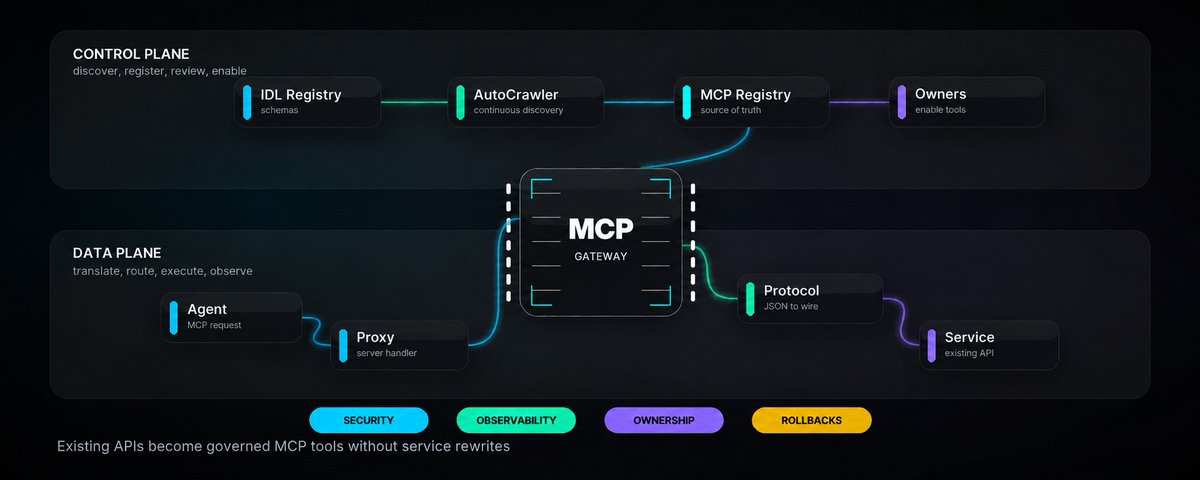
por eso Uber hizo un MCP Gateway: una capa central entre los agentes y sus servicios internos.
el agente habla MCP y el gateway se encarga de routing, permisos, ejecución y de traducir las llamadas a HTTP, gRPC o TChannel según corresponda.
como Uber ya tenía miles de APIs internas, también hicieron AutoCrawler: recorre sus definiciones, detecta métodos y schemas y genera MCP tools automáticamente. incluso usan un LLM para mejorar las descripciones.
hoy tienen +800 MCP servers y +5000 tools. y ahí aparece otro problema: no podés cargar todas esas definiciones en el contexto del modelo.
para eso crearon Omni MCP. en vez de pasarle miles de tools al agente, este va descubriendo qué server necesita, qué tools tiene disponibles, carga el schema de la correcta y recién ahí ejecuta.
me parece un muy buen ejemplo de cómo cambia la arquitectura cuando los agentes pasan de usar unas pocas tools a trabajar con miles.
terminás necesitando algo muy parecido a un API Gateway para agentes.


Jean-Louis Rigau retweeted

holy sh*t . Jev Founder, Diogo Almeida just released a 11-page PDF whole Jev + AI agents loop
this is a 9-step blueprint on how to run your LLM through agents without paying frontier prices for every fork they hit:
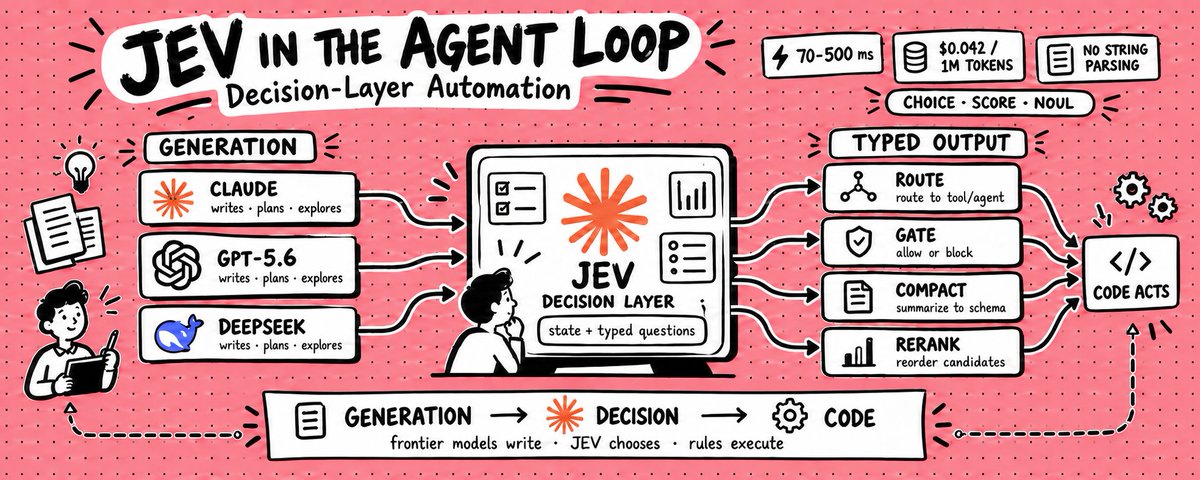
step 1 → split the loop into three kinds of work: generation stays with the LLM, exact rules like action and spend caps stay in code, every fork in between becomes a typed question to Jev
step 2 → start every job with one Noul: is this in scope, or does it need a human before anything runs
step 3 → dispatch with a Choice: research, write or review. act only at confidence 0.85+, everything below goes to review
step 4 → call the LLM only where text has to be written: planning the task and filling tool arguments, nothing else
step 5 → gate every tool call before it runs: allow, confirm or block, plus a destructive check in the same round trip
step 6 → score what comes back: drop, summary or keep. nothing gets rewritten, so nothing is lost to a bad paraphrase
step 7 → close with two checks: Jev says the goal is met above 0.8, then code proves the file actually exists
step 8 → send the risky tail to a human: irreversible, touches money or visible outside the company gets a person whatever the confidence
step 9 → move one fork first and track three numbers for a week: cost per completed task, time per completed task, how often escalation fired and whether it was right




Jean-Louis Rigau retweeted

OMG! I can't believe it happened. Thanks @Java_Champions team! I'm so proud to be part of it now...


Jean-Louis Rigau retweeted

Jev Founder, Diogo Amogo, just released 12-page PDF on building a Jev Harness for coding agents
this is a 10-step blueprint on how to make your coding agents 200× faster and 400× cheaper:
step 1 → meet Jev: the LLM writes, the harness executes, Jev decides what each turn sees, where it routes and whether it runs
step 2 → ask the question that breaks every agent: how would you design one if LLMs had no KV cache?
step 3 → stop routing blind: Opus → Sonnet → Opus costs 6.19 vs 4.15 for pure Opus, because handing back reprocesses the whole context
step 4 → follow the tokens: reading and searching take 56.2% of tool turns and 46.5% of tokens. Writing code is under 10%
step 5 → score every chunk per query: hide, short summary, long summary or full. Compress after the question, not before
step 6 → disclose tools in tiers: one-line snippets for 100s of tools, schema on demand, docs for one-off queries. Batteries stop costing context
step 7 → load instructions by condition: touching *.tsx loads the style guide, billing/ loads its gotchas file, and compaction can't erase either
step 8 → route by trust, not just difficulty: secrets and infra stay on first-party frontier models, public docs go to the cheapest one
step 9 → share one retrieval pass: cross-model review, eval generation, ELI5 explainers and live progress pages all run read-only in the background
step 10 → gate every command: programmable allow / ask / deny policies that read a script before it runs, not just its name
Send this PDF and the article below to your Claude Code or Codex instance and start shipping 200× faster.


Readers added context they thought people might want to know
The post wrongly identifies "Diogo Amogo" as Jev founder; TypeSafe AI (Jev's developer) was founded by Diogo Almeida. The shared PDF is independently compiled and explicitly disclaims any affiliation with or endorsement by TypeSafe.
typesafe.ai/team
typesafe.ai/blog/introduci…
drive.google.com/file/d/17h982x…
pbs.twimg.com/media/HSv6c7rX…
Jean-Louis Rigau retweeted

big AI news
Google just demonstrated a recursive self improvement loop for AI discovery
Google/DeepMind researchers introduced Dream-RSI, a system where an AI agent improves how it explores problems by replaying its past discovery attempts, testing thousands of alternative strategies cheaply, then deploying the better strategy in the next round.
Across algorithm design, mathematical optimization, and GPU kernel engineering, it matched or improved discovery quality while cutting search costs dramatically, in one setting reducing agent calls by up to 162x. 👀
Importantly, it improves the exploration policy, not the underlying model weights.

Jean-Louis Rigau retweeted

Any pursuit of superintelligence has to be grounded in the core principle that if the AI we build is not helping humanity and under human control, it's not worth pursuing.
We also need to accelerate and spread the benefits of AI, such that they are diffused broadly across countries, communities, and companies. This requires a frontier ecosystem in which both closed and open-source models can thrive.
And for firms, it’s imperative that they retain full control over their unique and tacit knowledge. Every organization should be able to build its own continuous learning loop/hill climbing machine, without becoming dependent on any one model provider, and have the ability to embed its own knowledge into models and weights they control.
So, in this context, we welcome the research, focus, and deliberate pacing needed to get alignment right as the design goal. We also welcome ideas like "embedded evaluators" and the broader efforts to develop the mechanisms to make this more than just talk.
The key is that this cannot be controlled by a handful of entities, but must have broad representation across the ecosystem, countries, and fields, including academia.
This is the approach we are taking: broad access and choice at every layer of the AI stack; enterprise control of learning loops and models; and the “Code of Conduct” that underlies our own first party MAI models that we’ll publish tomorrow for public consultation.
Jean-Louis Rigau retweeted

We Must Pace the Frontier: I’ve written a new essay on why the AI industry should slow down, with a three-part plan for doing so.
Anthropic is unilaterally committing to the first of these steps. We’ll provide third-party evaluators with permanent, employee-level access to our systems, so that they can verify adherence to our safety measures, report on incidents, and assess models’ alignment during training.
You can read the full post here: darioamodei.com/post/we-must…

Jean-Louis Rigau retweeted

Hi Astra users. A reset and a quick update on quality issues that have been posted around.
Working with some of you, we have found and fixed the following issues:
- Some skills written for previous models were triggering too often or preventing the model from checking its work.
- An opt-in context management experiment that could cause early stops or replies to older messages. We've disabled it. Our rough estimate is that 4-5k users were affected by this experiment.
- We've also removed some badly configured engines that resulted in a measured quality degradation for a long tail of traffic flowing through them.
We’ve also made some more minor improvements and things should feel significantly better across the board. More consistent follow-through, better tracking of your latest message, and better checks on the work as it’s going through the motions.
The examples posted and all the users who worked directly with us were incredibly useful in helping fix things quickly. Always grateful for this incredible community.
And of course, a reset is also landing by midnight today.
Jean-Louis Rigau retweeted
To make sure our current users have an incredible experience and continued access to Astra, we are going to pause subscriptions to our $200 Pro plan. These put the most strain on our systems and we wanted to take the smallest step that allows us to continue giving the broadest access possible. All other plans and the api remain available.
There is no impact to existing accounts and we are working on adding more capacity as fast as we can. Thanks!

Demand for Astra is really unprecedented. We're pulling all the levers possible to sustain the demand, but I've not seen anything like it until now and we went through very steep growth before. Priority will always be to keep excellent service for existing users, but we might have to pause new Pro subscriptions for a bit if this continues.
Jean-Louis Rigau retweeted

Anthropic’s Economics team is sharing a new model of how AI might affect economic growth, jobs, wages, and more by 2030.
Explore the scenarios, tell us what you think will happen, and see how your answers compare to more than 10,000 Americans. anthropic.com/institute/econ…

Jean-Louis Rigau retweeted

I spent much of the weekend talking with the team who did this work. Seb--and everyone else--acted with integrity and generosity throughout.
Initially we believed the other team had also solved the problem. We wanted to collaborate and do a joint release.
When we learned that they had Euler but not Navier-Stokes, we offered to let them go first, to suggest that they should be the ones to get the prize, and optionally for Tristan to be the lead author on a rewrite of the OpenAI proof. We felt it was challenging to offer the same to Levent (an Anthropic employee), who was not willing to talk or coordinate with us anyway. We were open to other solutions.
We would have greatly preferred coordination. We did not rush to publish even though the other team wasn't communicating with us. The team threatened us with unfounded accusations of plagarism.
Now that we can see their work, the approaches appear to be different. It is also worth noting that our latest model can solve many, many other math problems.
It is true that we tried this because there were rumors on the internet last week that Anthropic's models had solved a millennium problem and we were curious if ours could do it too.

I would like to clarify a few things:
1) The screenshot is my reaching out to Levent to coordinate our releases. I hope it’s clear from the message that we came in with the best possible intentions.
2) I never ever asked for Levent to be removed from authorship of his own work (as indicated by my text). I was surprised to learn during the call with Tristan that they had only solved Euler and not Navier-Stokes; after learning this we brainstormed possible paths forward. One option we discussed was that Tristan could be the lead author on a rewrite of OpenAI’s Navier-Stokes proof. It is in that context that I said “it would be simpler if Levent was not an Anthropic employee” because I felt it would be inappropriate for an Anthropic employee to author OpenAI’s work. Importantly it was admitted that internal Anthropic models had been used in their proof of Euler blowup; I therefore felt I could not consider Levent to be an independent academic. Another option I wanted to propose (but got cut short) is to offer access to our internal model so that they could try to finish their proof and bridge the gap between Euler and NS. Again I did not know how to navigate giving access to internal OpenAI IP to an Anthropic employee.
3) To reiterate it plainly: as my text clearly indicates, and as I said during our call, OpenAI's intention was to do everything possible to celebrate their mathematical achievements and the heroic efforts that they made on Euler. In the call I was immediately met with a litany of slander, including direct threats that if we were to announce Navier-Stokes he would immediately go to the press with a barrage of unfounded accusations. I refuted all these accusations but he replied “there is nothing you can do, I simply do not trust you”. I was confused why one would turn an incredible source for celebration (of their achievements!) into such bickering, which is when I said that I did not understand why one would risk their career [over unfounded accusations]. Genuinely, at that moment, I was trying to care for him and do a last ditch attempt to get a chance to give them all the credits that they deserve. I deeply apologize for this extremely poor choice of words, it is the opposite of what I was trying to convey. (I should say that I retracted them on the spot by the way.)
4) Overall, on a personal level, it was incredibly difficult to have these conversations. Levent refused to attend any of the meetings despite my repeated asking. As Sholto Douglas said, there will need to be coordination between Anthropic and OpenAI in the future; I felt I was doing a proxy negotiation with Anthropic while the Anthropic employee refused to directly participate.

Jean-Louis Rigau retweeted

We’re sharing a solution to the Navier-Stokes Millennium Prize Problem, one of the deepest problems at the frontier of mathematics.
The proof was produced by a group of agents, using an OpenAI next-generation model significantly more capable than GPT-6 Astra.
The problem concerns whether the description of smooth three-dimensional fluid motion modeled by the Navier-Stokes equations can break down. It has remained unresolved for roughly 90 years.

Jean-Louis Rigau retweeted
GPT-6 Astra is here.
We hope it will begin to enable a new generation of entrepreneurship, scientific discovery, and building.
We believe it is the best model in the world for computer use, professional work, science, coding, cybersecurity, and more.
It took us some extra time to ensure that we could meet the safety and alignment standards required for this capability level, but we think you’ll find it worth the wait.
It scores 98% on FrontierMath Tier 4, 99.9% on ARC-AGI 3, and 100% on ExploitBench.

Jean-Louis Rigau retweeted

Starting September 14, we're permanently raising standard weekly limits in Claude Code by 25% for Pro, Max, Team, and seat-based Enterprise plans. Until then, the current 50% increase will be in place.
Readers added context they thought people might want to know
While standard base limits are increasing by 25%, this change represents a net 17% reduction in weekly limits compared to the active 50% promotional limits users currently experience, as confirmed by the official Claude account: x.com/claudedevs/sta…
Jean-Louis Rigau retweeted
New in Claude Code: your sessions can now message each other.
Instead of having to re-explain yourself in another session, you can now tell Claude to do it. It sends a summary (not your history or files), and the other session picks it up mid-task.
Jean-Louis Rigau retweeted
Beginning July 20, Claude Fable 5 will be included in all Max and Team Premium plans, at 50% of limits.
Pro and Team Standard users will continue to have access to Fable via usage credits, and will receive a one-time $100 credit.
Demand for Fable has been challenging to predict, which is why we rolled it out to subscription plans in stages, extending access several times as we secured additional capacity.