

Pattern Recognition, Scientometrics, and Bibliometrics.
São Paulo
Joined May 2011
- Tweets1.1K
- Following306
- Followers547
- Likes687





Jesús P. Mena-Chalco retweeted

This tortoise understood it can go much faster with the help of a vehicle: it also learned how to make effective turns.
[📹 Mh0MLiErcV8E97C]


Jesús P. Mena-Chalco retweeted

A heartfelt thank you to @PaulaPereda8, Fabiana Rocha, @LizMatsunaga , @BrunaPugialli Jesus Mena-Chalco, Renata Narita and @clarabrenck co-authors of the paper. Our collective effort highlights the challenges for women in academia.
doi.org/10.1080/00036846.202…

Jesús P. Mena-Chalco retweeted

This is a stereogram. Adjust your eyes correctly and you will see a new dimension

Jesús P. Mena-Chalco retweeted

Big, big news from Sorbonne University (@Sorbonne_Univ_ )! They have decided to switch to OpenAlex for their publication database and bibliometric analytics, abandoning the use of proprietary products! sorbonne-universite.fr/en/ne…

Jesús P. Mena-Chalco retweeted

Wanna know how to teach students about #AcademicIntegrity? @DrSarahEaton and Rahul Kumar (published by @UCalgary) have got you covered. dx.doi.org/10.11575/PRISM/42…
Book Information
Purpose: The purpose of this Open Educational Resource (OER) is to offer comprehensive lesson plans that focus on instilling skills and values related to academic integrity. The intended audience for this work is educators at elementary, secondary, and higher education levels.
Methods: Contributors were invited to contribute lesson plans with a positive orientation to academic integrity, focusing on building skills and competencies, rather than focusing on consequences for committing academic misconduct. To maintain consistency and clarity, every lesson plan adheres to a standardized format. This format helps identify whether the target audience is elementary and secondary, higher education, or a combination of multiple educational levels. All lesson plans underwent open peer review by the editors and some included additional review by contributors to this edited collection.
Results: This OER contains twenty-four (24) open-access lesson plans contributed by authors across four countries: Canada, the UK, Finland, and Qatar. There are five lessons specific to elementary or secondary levels, 13 for use in higher education, and another five which can be used or adapted at elementary, secondary or higher education levels.
Implications: This work is licensed under a Creative Commons Attribution-NonComercial-ShareAlike 4.0 International License. This work may not be sold or used commercially. This work is freely and publicly available, downloadable, printable, and shareable. The editors and contributors have volunteered their knowledge, expertise, and time to contribute to this work.
Language: English
Additional Materials: Each lesson plan incorporates its respective references for further clarity and for citation purposes.

Jesús P. Mena-Chalco retweeted
We're now indexing full text from publications' PDFs to increase our coverage of full-text search, making searches in OpenAlex even more powerful! 💪💪Learn more (and join the mailing list!) here: groups.google.com/g/openalex…
Jesús P. Mena-Chalco retweeted
We will soon roll out a new author disambiguation system that is more accurate, better aligned with ORCID, and will provide a much better experience overall! As part of this change, all existing OpenAlex Author IDs will disappear and be replaced by new ones.
Jesús P. Mena-Chalco retweeted

NEW: NYC public schools are dropping their ban on ChatGPT
Will encourage educators & students to "learn about and explore this game-changing technology".
This is absolutely the right move. We need to prepare our young people for the new world that's coming.
Jesús P. Mena-Chalco retweeted

🤖 #ChatGPT wrote the ‘Discussion’ section of an @MDPIOpenAccess paper in the 𝘛𝘰𝘹𝘪𝘯𝘴 journal?! The authors may have failed to remove the “Regenerate Response” label of the button when they copy-pasted ChatGPT's output 🤡 #fail Reported on @PubPeer pubpeer.com/publications/DF3…

ALT https://pubpeer.com/publications/DF3D58918B5A0BD5943E6D280ED7E2
Jesús P. Mena-Chalco retweeted

UNESCO has published a clear Quick Start Guide to generative AI in education, including how to get started, safe use, challenges, innovative teaching. In English and Spanish. #ChatGPT #AIED iesalc.unesco.org/wp-content…

Jesús P. Mena-Chalco retweeted

Version 9 of our #BIPDB dataset, offering impact indicators for ~136M DOIs has been released: tinyurl.com/354s3ju8
📢 New feature: beginning from this version we also provide topic-specific impact classes based on 2nd level concepts from OpenAlex.
Jesús P. Mena-Chalco retweeted

Tenho usado a IA desde novembro como auxiliar e minha produtividade aumentou muito. Antes de entrar no pânico moral da nova tecnologia, os acadêmicos deveriam investigar como inserir a IA no seu fluxo de trabalho. Aqui são algumas das maneiras como utilizo o ChatGPT:
Jesús P. Mena-Chalco retweeted

Our article on citations to "predatory journals" is finally published!
Interestingly, non-Western countries are the most often mentioned when articles from so called "predatory journals" are cited!
@zehrataskin @ekulczycki @QSS_ISSI
direct.mit.edu/qss/article/d…

Jesús P. Mena-Chalco retweeted

Just released #openalexnet #beta: a Python library & cli app for processing & obtaining data from the extensive @OpenAlex_org scholarly dataset. Generate citation & coauthorship networks for your #scientometrics & #scienceofscience studies. Check it out: github.com/filipinascimento/…


Jesús P. Mena-Chalco retweeted
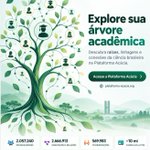
Genealogia Acadêmica com a Plataforma Acácia
youtu.be/HmT2ydXPlso
Jesús P. Mena-Chalco retweeted

“Interdisciplinarity in the making”
This new ethnography of cutting edge research looks friggin’ awesome. Top of the reading list for 2023!
mitpress.mit.edu/97802625446…

Jesús P. Mena-Chalco retweeted
“ChatGPT writes believable scientific abstracts, though with completely generated data.”
biorxiv.org/content/10.1101/…

Jesús P. Mena-Chalco retweeted

Adjusting your paper within the word-limit
teapawt.net/i/status/1608791830560…