

An appreciation of classic films, vintage photography, and gay influences in literature and the arts.
A stool in any dark bar
Joined April 2022
- Tweets5K
- Following789
- Followers7.1K
- Likes15.2K






Pinned Tweet
In late 1929, proto-feminist, lesbian, and photographer Berenice Abbott (b. 17 July 1898) returned to America from Europe where she had been studying and working with Man Ray and set about creating a definitive visual archive of New York City. Over the next 10 years, with unadorned realism, she captured the stark disparities of the city -- from the hardships of the Great Depression to the vibrant street-level energy beneath its iconic skyscraper architecture. Today, we’re celebrating this amazing woman and the time and place she documented with our photographic essay, Tempo of the City: 🏳️🌈
There was this bar on the East side of town in a neighborhood that had a reputation for being a little dicey. The club itself wasn’t much of a draw –– mainly just the regulars lined up for drinks and gossip –– but in the back, there was a small dance floor and a neon-lit juke box glowing through a hovering cloud of cigarette smoke and when we wanted to disappear in the arms of a new beau and do some slow dancing (and not run into a recent ex), that’s where we went. No crowds. No mirror balls. No disco beat. Just songs. Like this one from 1976 –– 🏳️🌈
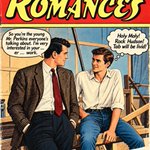
When I was a kid, my mother ran a newsstand, and I spent the better part of my time there, reading comics and movie magazines and leaving behind traces of chocolate and greasy smears from the candy and snacks I helped myself to while no one was looking. Katy Keene. Millie the Model. Archie & Betty & Veronica. And any Disney Comic adaptation of a Hayley Mills movie. I was obviously experiencing the stirrings of my nascent gay boy identity — without exactly knowing why, but wishing I could come across something like this —

ALT A TGA Original
Mainbocher (b. 24 October 1890) was an American fashion designer who conquered Paris, dressed some of the world's richest women, and proved that good taste didn't necessarily require a lot of fuss. Born Main Rousseau Bocher in Chicago, he eventually combined his first and last names into the more fashionable Mainbocher, which sounded suitably French even if its owner was thoroughly American.
He originally dreamed of becoming an opera singer, but when that career failed to materialize, he turned to fashion journalism, eventually becoming editor-in-chief of French Vogue. In 1929, he opened his own couture house in Paris, an audacious move for an American in a business the French generally considered their exclusive birthright.
His greatest publicity coup came in 1937, when he designed the pale blue wedding dress worn by the twice-divorced Wallis Warfield Simpson for her marriage to the recently abdicated King Edward VIII. Suddenly, every fashionable woman wanted a “Mainbocher”. His clientele eventually included Babe Paley, Gloria Vanderbilt, C. Z. Guest, and assorted heiresses and monied matrons whose names frequently peppered the society pages.
Privately, Mainbocher shared a close and enduring relationship with Douglas Pollard, his longtime companion and gifted fashion illustrator. Pollard was an integral part of his creative world, meticulously recording thousands of his designs. Their partnership, both personal and professional, remained largely outside the public spotlight, reflecting the discretion expected of gay men in fashionable society during much of the twentieth century. Unlike some of couture's more flamboyant personalities, Mainbocher maintained a reserved, sometimes intimidating persona. Whether that reserve reflected his temperament, the demands of his profession, or the need for self-protection is difficult to know.
With a specialty based on expensive simplicity, exquisite tailoring, and clothes that made wealthy women look like they'd never worried about money in their lives, when World War II broke out, Mainbocher and Pollard packed up their Paris operation and moved to New York, where business continued to flourish.
A demanding perfectionist who wasn't particularly interested in anyone else's opinion, Mainbocher continued designing until 1971, when he closed his New York salon and retired to Munich. The boy from Chicago whose single appellation evoked international sophistication died there on December 27, 1976, at age 86, leaving behind a reputation for elegance, exclusivity, and the reassuring notion that the very rich could always find something extraordinarily expensive that looked deceptively simple. 🏳️🌈
[Mainbocher, left; The Wallis Warfield Simpson blue wedding dress, right]


Moss Hart (b. 24 October 1904) was an American playwright, screenwriter, and theatrical director whose wit, sophistication, and flair for comedy helped define Broadway’s golden age.
Born in New York City to an impoverished Jewish family, Hart grew up in the Bronx and Brooklyn, developing an early obsession with the theater. After working as an office boy and entertainment director at Catskills resorts, he achieved his breakthrough with Once in a Lifetime (1930), a hilarious satire of Hollywood written with George S. Kaufman. Their celebrated partnership produced such Broadway classics as You Can't Take It with You (1936), which won the Pulitzer Prize for Drama, and The Man Who Came to Dinner (1939). Hart also wrote Lady in the Dark (1941), a groundbreaking musical exploring psychoanalysis, with music by Kurt Weill and lyrics by Ira Gershwin.
As a director, Hart enjoyed enormous success with My Fair Lady (1956) for which he won a Tony Award and Camelot (1960). His Hollywood credits included the screenplay for Gentleman's Agreement (1947) and contributions to the 1954 remake of A Star Is Born. His autobiography, Act One (1959), became a bestseller, celebrated for its affectionate, often hilarious account of his unlikely ascent from poverty to Broadway royalty.
Behind his polished public persona, Hart was a complicated, emotionally vulnerable man who struggled with depression, insecurity, and questions surrounding his sexuality, which was considerably more complicated than his carefully cultivated image as “Broadway's happily married man”.
Although Hart wed actress Kitty Carlisle in 1946 (a marriage that endured until his death) and fathered two children, biographical accounts detail his homosexual relationships before and during his marriage. Choreographer Agnes de Mille described him as a known homosexual. His sexuality has consequently become a subject in reassessments of his private life, particularly in the context of Broadway's thriving gay social world during the 1930s and 40s — a theatrical milieu in which homosexuality was hardly unusual, although public acknowledgment could threaten a successful career. His circle obviously included openly gay men, closeted performers, and artists who navigated elaborate distinctions between their public reputations and personal relationships.
Hart’s documented gay relationships include Dore Schary (the future MGM studio chief who was one of his closest friends) — in late 1939, Hart wrote to Schary, "We shall once again lay in each other's arms and taste the sweetness of sin — I love you very much," closing other letters with "a large incestuous kiss to you”; Lester Sweyd (a literary agent active in New York’s theater circles); and Charles Lederer (a prominent Hollywood screenwriter known for His Girl Friday and Mutiny on the Bounty); as well as dalliances with Jess Baker, Glen Boles, Cole Porter, and Robert Goulet.
A perfectionist with extravagant tastes, Moss delighted in lavish parties, elegant clothes, and the glamorous trappings of theatrical success, even as he remained haunted by his impoverished childhood. On December 20, 1961, he died of a heart attack in Palm Springs at just 57.
Moss Hart was a master of sophisticated comedy whose greatest talent may have been transforming personal anxieties, social pretensions, and human absurdities into engaging entertainment. 🏳️🌈

[Discovered on the front page of the now defunct The Blighty Blabber]
RONNIE KRAY DEAD AT 61
London's Most Flamboyant Thug Finally Meets His Match
LONDON, March 18, 1995 — Ruthless. Flamboyant. Volatile. Sadistic. Notorious. Ronald “Ronnie” Kray (b. 24 October 1933) the convicted murderer, homosexual gangster, nightclub proprietor, and one-half of Britain's most celebrated pair of identical psychopaths, died yesterday of a heart attack at 61, leaving behind a legacy of violence, intimidation, sexual scandal, and the remarkable British tendency to mistake well-dressed criminals for national treasures.
Born in Hoxton, Ronnie and his twin brother Reggie rose from petty East End hooligans to organized crime royalty, establishing a thriving enterprise in extortion, protection rackets, intimidation, and murder. By the Swinging Sixties, the brothers had become fashionable celebrities, entertaining actors, aristocrats, politicians, and assorted social climbers who apparently considered dining with homicidal gangsters the height of sophistication.
Ronnie was also unapologetically homosexual, a distinction that set him apart from the aggressively heterosexual posturing of London's criminal fraternity. “I'm not a poof, I'm homosexual,” he regularly declared, making it abundantly clear that he could be both a man's man and a fancy man. Homosexuality was still illegal, but Ronnie, never particularly impressed by the law, was hardly likely to make an exception for that one.
His sexual adventures allegedly extended into the highest reaches of society. In 1964, the Sunday Mirror suggested an intimate association between Ronnie and Conservative peer Lord Boothby, producing a libel action, a substantial settlement, and considerable embarrassment. Later disclosures confirmed their presence in overlapping homosexual social circles, although their alleged relationship was never established. Ronnie's gatherings at his Cedra Court flat reportedly attracted an assortment of young working-class males and well-connected gentlemen, creating opportunities for both pleasure and potentially profitable indiscretion. In Ronnie's world, even blackmail could be considered a form of networking.
His identical twin Reggie has cultivated a more conventional masculine image, although unsubstantiated accounts have suggested that he, too, has engaged in same-sex relationships while in prison. Not unusual for men confined with men over long periods of time.
Ronnie's personal life was further complicated by paranoid schizophrenia, an illness that required psychiatric treatment but did not account for his spectacular capacity for cruelty. He was, independently of any diagnosis, a thoroughly nasty piece of work. In 1966, he demonstrated his particular brand of conflict resolution by shooting rival gangster George Cornell dead in the Blind Beggar pub in Whitechapel. Subtlety was never one of Ronnie's stronger qualities.
The brothers' criminal careers came to an abrupt halt in 1968, when Scotland Yard finally decided that celebrity status was not a sufficient defense against murder. Both received life sentences in 1969. Ronnie spent much of his remaining existence in Broadmoor Hospital, exchanging the glittering nightclubs of London for considerably less glamorous accommodations.
While incarcerated, he somehow found time to marry two women — Elaine Mildener in 1985 and Kate Howard in 1989. Both marriages were obviously unconsummated and ended in divorce, suggesting that even the institution of matrimony had its limits when confronted with Ronnie Kray.
He died yesterday from an apparent heart attack at Wexham Park Hospital in Slough, Berkshire — having spent more than a quarter-century in confinement and achieving the extraordinary distinction of becoming a British folk hero without ever having done anything remotely heroic.
Ronnie Kray's lasting contribution to British culture was proving that a tailored suit, a few famous friends, a taste for handsome young men, and an enthusiastic willingness to murder one's enemies could elevate an East End thug into a national legend. 🏳️🌈
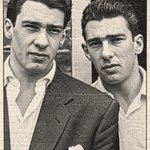
[Ronnie, left, in both photos — but don't hold me to that]


Ned Rorem (b. 23 October 1923) was an American composer, pianist, diarist, and one of the most openly gay figures in 20th century classical music. Celebrated for his exquisite art songs, candid literary voice, and unapologetic sexuality, Rorem lived at the intersection of music, literature, and homosexual culture for nearly a century.
Born in Richmond, Indiana, and raised in Chicago by Quaker parents, Rorem studied at the Curtis Institute of Music and the Juilliard School. He spent much of the 1950s in Paris, moving among artists, writers, and musicians, including Jean Cocteau and Francis Poulenc. His lyrical compositions, particularly his more than 500 art songs, established him as one of America's foremost composers of vocal music. He received the Pulitzer Prize for Music in 1976 for Air Music, an orchestral work.
Rorem was equally renowned for his provocative diaries, beginning with The Paris Diary of Ned Rorem (1966), which scandalized literary and musical circles with its frank accounts of homosexual encounters, romantic entanglements, professional jealousies, and celebrated acquaintances. At a time when most prominent artists concealed their homosexuality, Rorem wrote about his sexuality with extraordinary candor, refusing to apologize for his desires or disguise the identities of many of his lovers.
Among his romantic relationships were encounters with prominent cultural figures, including Noël Coward and Leonard Bernstein. His most enduring attachment was to James Holmes, an organist and choir director who became his companion for more than three decades. Holmes's death from AIDS in 1999 devastated Rorem and profoundly influenced his later writings and compositions.
Elegant, witty, vain, and occasionally merciless in his judgments, Rorem cultivated a reputation as both a musical romantic and a literary provocateur. His diaries revealed a man preoccupied with beauty, sex, aging, mortality, and the inseparable demands of art and desire.
Rorem died at his Manhattan home in 2022, aged 99. He left an extraordinary musical legacy and an equally remarkable written record of gay artistic life in 20th century America and Europe. 🏳️🌈


[Discovered in a now defunct, imaginary newspaper]
Legendary Lesbian Dead at 37
Hollywood's Most Flamboyant Sapphic Siren Takes Her Final Bow
NEW YORK, March 21, 1934 — Lilyan Tashman, the dazzling, sharp-tongued, extravagantly dressed actress whose romantic adventures were reportedly as sensational as her Hollywood wardrobe, died today of stomach cancer at the age of 37. With her passing, Broadway and Hollywood have lost one of their most colorful personalities—and the lesbian demimonde one of its most audacious leading ladies.
Born in Brooklyn on October 23, 1896, Tashman rose from fashion model and Ziegfeld chorus girl to Broadway actress and Hollywood sophisticate. Her arched eyebrows, icy elegance, and deliciously wicked manner made her a natural for portraying calculating socialites, seductive adventuresses, and women who invariably got what they wanted. Her screen credits included So This Is Paris (1926), The Trial of Mary Dugan (1929), The Matrimonial Bed (1930), and Girls About Town (1931).
Considered one of Hollywood's best-dressed women, Tashman possessed an apparently inexhaustible collection of gowns, furs, jewels, and accessories. Her lavish parties, acid wit, and theatrical personality were legendary. But it was her private life, particularly her much-discussed enthusiasm for other women, that supplied Hollywood's gossip merchants with some of their most tantalizing material.
Although twice married, most notably to actor Edmund Lowe, Tashman was widely reputed to prefer the romantic company of women. Her marriage to Lowe has frequently been characterized as a possible lavender marriage, a convenient arrangement that provided a respectable public facade while allowing both spouses considerable private freedom.
Unlike many of her contemporaries, Tashman reportedly made little effort to disguise her Sapphic inclinations within Hollywood's intimate social circles. Her most celebrated alleged conquest was the enigmatic Greta Garbo, with whom she was said to have enjoyed a passionate, occasionally tempestuous affair. Tallulah Bankhead was another rumored intimate, while Joan Crawford and Kay Francis also figured in the whispers surrounding Tashman's romantic exploits.
Accounts of her private correspondence with director George Cukor describe affectionate references to women identified as "Julie" and "Alice," whose identities remain mysterious. Other stories linked her to actress Lina Basquette and producer Irene Mayer Selznick, both reportedly recipients of Tashman's romantic attentions. One particularly scandalous Hollywood tale involved a furious confrontation after Tashman allegedly discovered Constance Bennett in a compromising situation with one of her girlfriends.
How much of this deliciously improper history was fact and how much the invention of Hollywood's tireless rumor mill remains uncertain. But few disputed that Tashman possessed a formidable appetite for life, a wicked sense of humor, and an extraordinary indifference to conventional expectations.
At a time when the slightest suggestion of homosexuality could ruin a career, Tashman cultivated an image of extravagant self-assurance. She was neither timid nor apologetic, and her reputation for romantic audacity became inseparable from her larger-than-life personality.
Her funeral, scheduled for March 22 at New York's Temple Emanu-El, is expected to draw prominent figures from stage and screen. Eddie Cantor will deliver the eulogy, with Mary Pickford, Sophie Tucker, Fanny Brice, and Jack Benny among the celebrated mourners.
Lilyan Tashman's death brings a premature curtain down on a life devoted to glamour, pleasure, theatrical excess, and the pursuit of beautiful women—or so Hollywood's most persistent gossips would have us believe.
She leaves behind a grieving husband, a remarkable wardrobe, an enviable collection of jewels, and enough scandalous stories to keep Hollywood whispering for decades.
At 37, Lilyan Tashman has taken her final bow. The gowns may be packed away, but the gossip, one suspects, is immortal. 🏳️🌈
[Lilyan left; Lilyan with Kay Francis, right]


Robert Rauschenberg (b. 22 October 1925) was a pioneering American artist whose irreverent imagination and restless experimentation helped redefine modern art. Born Milton Ernest Rauschenberg in Port Arthur, Texas, he studied at Black Mountain College in North Carolina under Josef Albers before moving to New York, where he became a central figure in the transition from Abstract Expressionism to Pop Art.
Rauschenberg rejected the distinction between painting and sculpture, incorporating photographs, newspaper clippings, fabric, furniture, and discarded objects into his revolutionary Combines. His masterpiece, Monogram (1955–59) [see below], exemplifying his conviction that art and everyday life were inseparable, featured a stuffed goat encircled by a tire. In 1964, he became the first American to win the International Grand Prize for Painting at the Venice Biennale.
Openly gay within his artistic circle at a time when homosexuality remained heavily stigmatized, Robert had significant romantic and creative relationships with artists Cy Twombly and Jasper Johns. His relationship with Johns, particularly during the 1950s, profoundly influenced both men's work. He also maintained a lifelong artistic partnership with choreographer Merce Cunningham and composer John Cage, collaborating on experimental performances that blurred the boundaries between visual art, dance, and music.
Charismatic, generous, and famously unconventional, Rauschenberg believed that creativity flourished through collaboration and chance. He established a foundation supporting artists and humanitarian causes and spent his later years working on Captiva Island, Florida, where he died of heart failure on May 12, 2008, at age 82. His enduring legacy lies in his transformation of ordinary materials into extraordinary art and his insistence that virtually anything could become the subject—or substance—of artistic expression. 🏳️🌈


WWII was over, the troops were returning home, and on October 20, 1945, Mildred Pierce, Joan Crawford's Oscar-winning comeback film at Warner Brothers, opened in the US. An immediate hit, it was an undeniable box-office triumph. Astonishingly, its earnings accounted for over half of the studio’s total profits for the entire year. 🏳️🌈

Robert Reed (b. 19 October 1932) was an American actor best known as Mike Brady, the patient, affable father of television's The Brady Bunch (1969–1974), a role that made him a beloved fixture of American popular culture, although it scarcely reflected the complexities of his private life.
Born in Highland Park, Illinois, Reed studied drama at Northwestern University and London's Royal Academy of Dramatic Art. A classically trained actor with serious theatrical ambitions, he first attracted attention as attorney Kenneth Preston in the television drama The Defenders (1961–1965). His subsequent portrayal of Mike Brady brought enormous fame but considerable frustration as he frequently clashed with producer Sherwood Schwartz over what he considered the show's ridiculously implausible scripts and simplistic humor.
Behind his wholesome television persona, Reed lived as a closeted gay man during an era when disclosure could destroy an actor's career. He married fellow student Marilyn Rosenberger in 1954, and they had a daughter, Karen, before divorcing in 1959. Although his homosexuality was reportedly known to some colleagues and friends, Reed guarded his private life fiercely, fearing both professional ruin and public humiliation. His secrecy contributed to an often lonely and emotionally complicated existence.
Despite his dissatisfaction with The Brady Bunch, Reed remained affectionate toward his television family, particularly the six young actors who played his children. He subsequently earned Emmy nominations for his performances in Medical Center, Rich Man, Poor Man, and Roots, demonstrating dramatic abilities far beyond his sitcom reputation.
Robert died in Pasadena, California, on May 12, 1992, at age 59, from colon cancer. His death certificate also listed HIV infection as a significant contributing condition. His sexuality became widely discussed only after his death.
Today, Robert Reed is remembered not merely as America's reassuring television father but as a gifted, intellectually demanding actor whose public success concealed the painful contradictions of being a gay man in an unforgiving Hollywood era. 🏳️🌈

George Nader (b. 19 October 1921) was a handsome, athletic American actor whose leading-man good looks made him a familiar presence in Hollywood films and television during the 1950s and 60s. Born in Pasadena, California, Nader served in the U.S. Navy during World War II before studying acting at the Pasadena Playhouse.
His breakthrough came with the low-budget science-fiction classic Robot Monster (1953), followed by a contract with Universal-International. He appeared in such films as Four Guns to the Border (1954), Six Bridges to Cross (1955), and Away All Boats (1956). Although frequently cast as a rugged romantic hero, Nader never achieved the stardom enjoyed by some of his contemporaries. He later found considerable success in West Germany, starring as FBI agent Jerry Cotton in a popular series of crime thrillers.
George was gay at a time when homosexuality could destroy a Hollywood career. Unlike many closeted actors, he maintained a remarkably stable personal life, sharing a devoted relationship of more than five decades with Mark Miller, a former actor who became Rock Hudson's personal secretary. Nader and Miller were also close friends of Hudson, whose own homosexuality remained carefully concealed from the public.
Although the precise circumstances remain disputed, rumors have long circulated that Nader's career suffered because studio executives sacrificed him to protect Hudson from exposure in the scandal press. Unlike Rock, George refused to participate in fabricated heterosexual romances to disguise his private life.
An eye injury sustained in an automobile accident eventually forced his retirement from acting in the mid-1970s. He subsequently became a novelist, publishing Chrome (1978), a pioneering science-fiction novel exploring homosexual love and social prejudice.
George spent his later years quietly with Miller in Palm Springs. He died of complications including pneumonia on February 4, 2002, at age 80. Remembered for his striking physique, understated screen presence, and personal loyalty, George Nader also left a quieter legacy –– a lifelong commitment to his partner in an era when such relationships were rarely acknowledged. 🏳️🌈

Outrageous. Audacious. Influential. Harris Glenn Milstead (b. 19 October 1945), known to the world as Divine, was a flamboyant, foul-mouthed, larger-than-life female persona who became an international celebrity and a pioneering figure in gay popular culture.
His childhood friendship with underground filmmaker John Waters developed into a legendary creative partnership. Divine starred in Waters' notorious cult films, including Multiple Maniacs (1970), Pink Flamingos (1972), and Female Trouble (1974). With towering wigs, extravagantly exaggerated makeup, and a gleeful disregard for conventional taste, Divine challenged prevailing notions of beauty, gender, sexuality, and respectability.
Openly gay, Milstead carefully distinguished his private identity from his theatrical alter ego. He considered himself an actor and entertainer rather than a woman and resisted being confined exclusively to female roles. During the 1980s, he also enjoyed considerable success as a disco recording artist, particularly in European gay clubs, with hits including You Think You're a Man and I'm So Beautiful.
In addition to his appearances in Waters’ “Trifecta of Trash”, Divine starred as Francine Fishpaw in Polyester (1981) and Rosie Velez in Lust in the Dust (1985), both co-starring 1950s heartthrob Tab Hunter, but it was his performance as Edna Turnblad in Waters' Hairspray (1988) that demonstrated his considerable comic gifts and brought him wider mainstream recognition. Tragically, on March 7, 1988, just weeks after the film's release, on the eve of a scheduled television appearance, Divine died of an enlarged heart at age 42.
Long after his death, Divine has remained an enduring symbol of defiance, camp extravagance, and unapologetic individuality. 🏳️🌈
[Harris Glenn Milstead, right, and as Divine, left]

In 1979, a Hard Rock DJ in Chicago declared that disco was dead and invited his listeners to Comiskey Park to burn and otherwise destroy their disco records. A near riot ensued. But a bunch of rednecks couldn’t destroy good dance music. It’s continued to be recorded and enjoyed for decades – Madonna, The Pet Shop Boys, Cher’s Believe, Kylie – I could go on and on – like this one from the jazz and R&B legend, Randy Crawford (off her 2000 album Permanent). Now get those arms up and move 🏳️🌈
While filming The Misfits (1961), Monty throws a party in his room at The Mapes and things are getting festive. 🏳️🌈

Montgomery Clift (b. 17 October 1920 in Omaha, Nebraska), was one of Hollywood’s most gifted and emotionally complex actors. With his striking good looks, brooding sensitivity, and intensely naturalistic performances, he helped redefine screen masculinity in the years following World War II.
Clift began acting on Broadway as a teenager before making his film debut opposite John Wayne in Red River (1948). His performances in The Search (1948), A Place in the Sun (1951), From Here to Eternity (1953), and Judgment at Nuremberg (1961) earned him four Academy Award nominations. Other critically acclaimed performances include The Heiress (1949) with Olivia de Havilland, Hitchcock’s I Confess (1949), Elia Kazan’s Wild River (1960), and John Huston’s The Misfit’s (1961) with Clark Gable and Marilyn Monroe. Unlike Hollywood’s traditionally swaggering leading men, Clift portrayed vulnerable, conflicted characters whose emotional depth resonated with audiences.
Monty’s private life was considerably more complicated than the romantic image Hollywood cultivated for him. Predominantly gay, his relationships with men included several significant romantic attachments as well as frequent casual encounters. Among his earliest and most important lovers was Jerome Robbins, the celebrated Broadway choreographer and future director of West Side Story. Their relationship lasted approximately two years during the 1940s. Robbins was reportedly deeply in love with Clift, and their separation when Monty pursued his Hollywood career in 1948 was particularly painful for the choreographer.
Other important partners included the stage actor William LeMassena and Jack Larson, later famous for portraying Jimmy Olsen on television’s Adventures of Superman. Larson spoke openly about their relationship years afterward, recalling Monty as considerably more comfortable with his homosexuality than subsequent biographies suggested.
Monty was also exceptionally close to actor Kevin McCarthy, whom he met during his theatrical career. Writers including Tennessee Williams and Truman Capote believed the two men had been lovers, although the romantic nature of their relationship has never been conclusively established and McCarthy was married twice with five children.
During his final years, Clift developed an affectionate attachment to Lorenzo James, a man initially employed to assist him. They traveled together, shared domestic routines, and their companionship provided much-needed emotional stability for Monty during a difficult period.
Monty also maintained emotionally close relationships with women – including the wealthy, bisexual Broadway singer and actress, Libby Holman, and his co-star in A Place in the Sun, Elizabeth Taylor (when she was 18 and he was 30).
Holman, whose scandalous past included the mysterious shooting death of her first husband, tobacco heir Zachary Smith Reynolds, was captivated by Clift's beauty, vulnerability, and extraordinary talent. Monty, in turn, found in Holman a sophisticated, unconventional woman who understood the complexities of sexual identity and offered refuge from Hollywood's rigid expectations.
Taylor easily accepted Monty’s attraction to men, never demanding that he conform to the heterosexual image promoted by the studios. They shared confidences and developed a playful intimacy that sometimes resembled that of lovers, maintaining a platonic friendship that never became sexual. They also starred together in Raintree County (1957) and Suddenly, Last Summer (1959).
Monty’s sexuality was undoubtedly complicated by the social conventions of his era, but the familiar portrait of a man destroyed by shame over his homosexuality has increasingly been challenged. His intimate relationships with men suggest someone capable of considerable passion and tenderness, even as his personal life remained largely hidden from the moviegoing public.
It was during the filming of Raintree County, that Clift suffered a devastating automobile accident that severely injured his face, leaving permanent scars and contributing to his increasing dependence on alcohol and prescription drugs. On May 12, 1956, after leaving a dinner party at Elizabeth’s Beverly Hills home (a small party that included Rock Hudson and Kevin McCarthy), Monty, exhausted and likely inebriated, lost control and crashed his car on the unfamiliar winding canyon roads. Taylor rushed to the wreckage and helped rescue him, removing broken teeth lodged in his throat, and preventing him from choking. She also reportedly threatened photographers who attempted to capture images of his disfigured face. Monty’s subsequent physical and emotional decline was later described as the “longest suicide in Hollywood history,” although that characterization oversimplifies his suffering.
On July 23, 1966, at age 45, Monty died of coronary artery disease at his Manhattan home. Lorenzo was present in the house and discovered his body. Montgomery Clift’s legacy remains that of a brilliant, sensitive performer whose vulnerability and emotional honesty helped transform American film acting and influenced generations of actors who followed. 🏳️🌈
[A video scrapbook – Montgomery Clift, In Dreams – courtesy of TGA. Click to play]
Russell Cheney (b. 16 October 1881) was an American painter celebrated for his evocative landscapes, portraits, and still lifes combining Impressionism with a distinctly modern sensibility. Born into a wealthy silk-manufacturing family in Manchester, Connecticut, Russell was the youngest of eleven children. After graduating from Yale in 1904, he rejected the family business to pursue art and studied at New York’s Art Students League and the Académie Julian in Paris.
Cheney’s artistic career was frequently interrupted by private struggles –– tuberculosis, depression, and alcoholism. Nevertheless, his paintings, particularly those depicting the coastal villages and landscapes of New England, earned critical recognition. Influenced by Cézanne and European modernism, he developed a distinctive style characterized by expressive color, bold composition, and atmospheric intimacy.
In 1924, Cheney met the brilliant young literary scholar F. O. Matthiessen (see my post of Feb 26), twenty years his junior, aboard a transatlantic ocean liner. Their encounter blossomed into a passionate, enduring relationship that lasted until Cheney’s death. Despite the social prejudices of their era, the two established a shared home in Kittery, Maine, traveled extensively, and maintained an extraordinary correspondence of more than 3,000 letters. Their relationship, although sometimes turbulent, provided emotional and intellectual sustenance to both men.
On July 12, 1945, Russell died in Kittery at age 63. Devastated by his partner’s death and troubled by his own recurring depression, Matthiessen committed suicide five years later, leaping from a twelfth-story window of the Hotel Manger (later renamed the Madison) in Boston. Their remarkable love story remains an important chapter in American gay cultural history.
And although Cheney subsequently slipped into relative obscurity, renewed scholarly interest has restored recognition of his contributions to 20th century American painting. 🏳️🌈
[Russell at left; at right, his portrait of F. O., c. 1926]


Brilliant. Flamboyant. Witty. Provocative. Scandalous. Unapologetic. Oscar Wilde (b. 16 October 1854) was all these things, as well as one of the most famous homosexuals in history.
Born in Dublin, Ireland, to Anglo-Irish intellectuals, Oscar Fingal O’Flahertie Wills Wilde was educated at Trinity College, Dublin, and Oxford, while cultivating a reputation for extravagant dress, razor-sharp wit, and the conviction that beauty and pleasure were life's highest pursuits.
In 1882, at just 27, he embarked on an ambitious lecture tour of the United States and Canada, arriving in New York as the apostle of the Aesthetic Movement, which championed “art for art’s sake.” Dressed in velvet jackets, silk stockings, and knee breeches, with flowing hair and a carefully cultivated air of aristocratic eccentricity, Wilde became an overnight sensation. Originally scheduled for a modest series of lectures, he spent nearly a year making appearances across North America. He visited fashionable salons, universities, and the American West, even entertaining miners in Leadville, Colorado. Though frequently caricatured in the press, Oscar proved himself to be an engaging speaker and shrewd self-promoter, transforming from a little-known Irish aesthete into an international celebrity, and laying the foundation for his later literary triumphs –– including The Picture of Dorian Gray (1890), Lady Windermere's Fan (1892), and his ebullient masterpiece, The Importance of Being Earnest (1895). His comedies notoriously and mercilessly exposed the hypocrisy of the society that celebrated him.
In 1884, he married Constance Lloyd, with whom he had two sons. Yet Wilde's romantic and sexual attractions were directed toward men, most consequentially Lord Alfred Douglas, a handsome, temperamental young aristocrat whose relationship with Wilde would prove disastrous.
At the peak of his fame in 1895, when Lord Alfred’s father, the Marquess of Queensberry (known for his outspoken atheism and brutish manner who regularly feuded with his son) publicly accused Wilde of being a sodomite, Wilde sued him for libel. The trial backfired catastrophically. The evidence brought forward led to Wilde’s own arrest and conviction for "gross indecency". He was sentenced to two years of hard labor, an ordeal that permanently broke his health and ruined his finances.
While imprisoned, he wrote the soul-baring letter De Profundis and later captured the brutality of the penal system in his famous poem, The Ballad of Reading Gaol (1898). Released in 1897, and enduring increasing isolation, Wilde lived in impoverished exile in France where he died of meningitis at age 46 in Paris on November 30, 1900.
With the newspapers’ sensational and extensive coverage of Oscar’s trials (there were two), perhaps the most enduring consequence of his prosecution was that it established the homosexual stereotype as obviously effeminate, morally corrupt, and blatantly criminal. With his conviction for gross indecency, a wave of fear was unleashed among gay men, particularly those in artistic, literary, and upper-class circles. Men who had previously maintained discreet same-sex relationships became increasingly fearful of exposure, blackmail, arrest, and social ruin. Some fled abroad, while others entered conventional marriages or retreated into secrecy. However, once publicly disgraced for his sexuality, Oscar Wilde is now celebrated as both a literary genius and an enduring symbol of gay identity, courage, and the devastating effects of Victorian intolerance. 🏳️🌈

Varian Fry (b. 15 October 1907 in New York City) was an American journalist and humanitarian who helped rescue thousands of artists, writers, intellectuals, and political refugees from Nazi persecution during World War II.
Raised in a prosperous family, Fry attended Harvard University, graduating in 1931. An early opponent of fascism, he witnessed Nazi brutality firsthand during a 1935 visit to Berlin. Following the German occupation of France in 1940, he traveled to Marseille as a representative of the Emergency Rescue Committee, carrying a list of prominent refugees threatened with arrest and deportation.
Working under constant surveillance and frequently defying French authorities, Fry organized an underground rescue network that provided forged documents, emergency funds, safe houses, and escape routes across the Pyrenees into Spain. Between 1940 and 1941, his efforts helped approximately 2,000 people escape, including artists Marc Chagall and Max Ernst, political philosopher Hannah Arendt, and writer Heinrich Mann. His activities eventually led to his expulsion from France in September 1941.
Fry's private life was complicated. He married journalist Eileen Avery Hughes in 1931, and they had three children before divorcing in 1950. Although married, Fry was romantically and sexually attracted to men. An intimate relationship with fellow rescue worker Hiram Bingham IV has been speculated about, but evidence of such is nonexistent. Regardless, the prevailing social attitudes of the day forced Varian to conceal his homosexuality during his lifetime, which sadly, contributed to the personal isolation and emotional difficulties that marked his later years.
After returning to America, Fry struggled to obtain recognition for his wartime accomplishments. He published Surrender on Demand (1945), recounting his extraordinary rescue mission, but spent much of his remaining life working in journalism and education.
Varian Fry died on September 13, 1967, in Redding, Connecticut, at age 59, following a cerebral hemorrhage. In 1994, Israel's Yad Vashem recognized him as Righteous Among the Nations, making him the first American to receive that distinction.
Today, Fry is remembered as an exceptionally courageous gay humanitarian whose defiance of Nazi persecution saved lives and preserved an extraordinary part of Europe's cultural and intellectual heritage. 🏳️🌈

What would our Sunday afternoon tribute to the disco hits of the 70s and early 80s be without including this definitive anthem from 1976. Those opening horns always sent us surging toward the dance floor, boyfriend for the night in hand 🏳️🌈
Peter Hujar (b. 11 October 1934), one of the most influential American photographers of the 20th century, was born in Trenton, New Jersey, to a Ukrainian-American family. His childhood was marked by poverty, parental neglect, and instability. Raised partly by his grandparents on a New Jersey farm, he later moved to Manhattan, where he attended the High School of Art and Design and began his photographic career.
During the 1950s and 60s, Hujar worked as a commercial and fashion photographer, studying briefly with Richard Avedon. Increasingly dissatisfied with commercial photography, he devoted himself to intimate black-and-white portraits of artists, writers, musicians, drag performers, and members of New York's gay underground. His subjects included Susan Sontag, William S. Burroughs, John Waters, and Candy Darling, whose haunting deathbed portrait became one of his most celebrated images.
Openly gay in an era of widespread discrimination, Hujar was deeply involved in Manhattan's bohemian and homosexual communities. His romantic relationships included the artist Joseph Raffael and photographer Paul Thek, with whom he shared a particularly intense and complicated emotional attachment. He also maintained a close friendship with photographer Robert Mapplethorpe and became an important mentor to artist David Wojnarowicz (see my post of 09/19), whose relationship with Hujar combined artistic admiration, friendship, and profound emotional intimacy.
Hujar's photographs were distinguished by their unflinching honesty, sensuality, and psychological depth. Whether photographing a naked lover, a decaying building, an animal, or an aging celebrity, he approached his subjects with extraordinary tenderness and an acute awareness of mortality. His landmark 1976 book, Portraits in Life and Death, juxtaposed portraits of his contemporaries with photographs of mummified corpses in the Palermo catacombs.
Temperamental, fiercely independent, and notoriously unwilling to compromise his artistic principles, Hujar achieved little commercial success during his lifetime. He lived modestly in a loft above a theater in Manhattan's East Village, surrounded by the artists and outsiders who populated his photographs.
Peter died of AIDS-related pneumonia on November 26, 1987, in New York City, at age 53. David Wojnarowicz photographed him moments after his death, creating an emotionally devastating tribute.
Once relatively obscure, Hujar is now recognized as a major figure in American photography, whose work preserves an intimate, haunting record of New York's artistic and gay communities before the devastation of the AIDS epidemic. 🏳️🌈
[Peter Hujar Self Portraits, left 1958 and right 1980]

