

Full stack 🔭astrophysicist🔭 @UofT working on galaxy formation & dark matter and on open-source code for astrophysics | book: https://teapawt.net/t.co/lVc0vtHGNx
- Tweets177
- Following19
- Followers1.1K
- Likes237

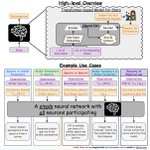





ALT High-level overview of our foundation model for stars. The top part of the figure displays the overall goal of training a big single neural network for astronomy that can turn a combination of data into useful information in the left part, while in the right part the high-level architecture of the Transformer-based model for stars in this paper is shown. The bottom part of the figure gives an overview of the versatility of our model on multiple use cases, showing how a single neural network without any fine-tuning can perform many useful tasks, such as “generative” and “discriminative” tasks in the traditional machine learning framework, with all weights in the model participating in those tasks.

ALT Neural network architecture of the model used in this work (right) compared to that of the standard Transformer-based encoder-decoder model (left; Vaswani et al. 2017). The encoder in our model has a very similar architecture to the encoder block in the standard Transformer, except that we do not use positional encoding, but rather perform a non-linear embedding of the type of observations and their corresponding values. The decoder blocks in our model have the same architecture as the encoder blocks in the encoder, because we do not need positional encoding for the decoder either in our application, which is different from the standard Transformer-based encoder-decoder where the decoder blocks are different from the encoder blocks, because they need to consider the current output sequence in addition to the context and request.

ALT Results for predicting 𝑇eff from different combinations of XP spectra and photometry. The top-left panel shows an expertly trained XGBoost model as a baseline, the other panels show results from our Transformer-based model

ALT Our model’s recovery of the interstellar extinction curve. The model is given no indication that an interstellar extinction curve exists, but learns it nevertheless.


ALT End of a conversation with ChatGPT about an Excel formula


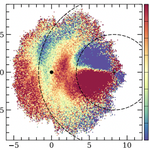
ALT Map of radial velocities of stars in the Milky Way disk and bulge from Gaia DR3 data

ALT Map of radial velocities of stars in the Milky Way disk and bulge from APOGEE/Gaia EDR3 data


