

Worked as a government librarian, teacher, cricket & rugby coach/writer, and in local government. Dedicated but slow parkrunner. Puzzled why anyone follows me!
Lloegr
Joined January 2009
- Tweets26.7K
- Following553
- Followers1K
- Likes16.8K
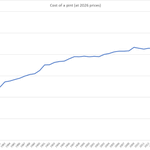
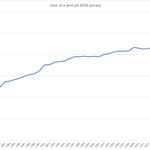

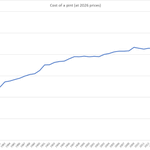
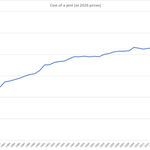
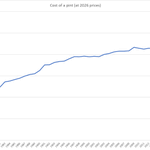
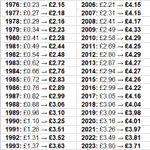


Do you enjoy visiting a pub, having a pint? Do you wonder why so many pubs have been closing recently?
This is the price of a pint, adjusted for inflation, since 1970. Note how prices were stable most of this century... until 2024.
What happened in 2024?


John Birch retweeted

I redid this chart, splitting the fake "South Asia" into Pakistan and India, to give Pakistan its "rightful place" in the chart.


The Economist's estimate of Britain's age- and sex-standardised conviction rates for sexual offences by the offender's nationality
economist.com/britain/2026/1…


John Birch retweeted

Parkinson's Laws, Part Two – Triviality, Expenditure and the Committee.
Everyone knows Parkinson's first law: work expands to fill the time available. Fewer people know he wrote more – and that his other laws describe Brussels with uncomfortable precision.
1. The Law of Triviality. Parkinson's example: a finance committee approves a £10 million atomic reactor in two and a half minutes, because nobody in the room understands reactors. Then it spends forty-five minutes on a £350 bicycle shed, because everybody understands bicycle sheds. The time spent on any item is in inverse proportion to its importance. Brussels spent years making sure your bottle cap can't come off – while the big questions, energy, defense and the empty cradle, waited.
2. The Second Law: expenditure rises to meet income. Give an institution more money, and it will always find ways to spend it – never to give it back. Brussels has proposed nearly two trillion euros for its next seven-year budget, with new taxes of its own to fund it. And Parkinson was an optimist. France spends more than it earns, and hasn't balanced a budget since 1974.
3. The Coefficient of Inefficiency. Parkinson studied cabinets through the centuries and found that beyond about twenty members, a committee stops deciding anything. Power quietly moves to a small inner circle, and the full committee becomes a ceremony. With a straight face, he even calculated the breaking point: somewhere between 19.9 and 22.4 members.
The European Commission has 27.
One commissioner per country – not because the work needs twenty-seven, but because twenty-seven countries each need a seat. Politics decides the size of the committee. Parkinson decides what it will accomplish.
He wrote it as satire. Brussels turned it into a system.


Parkinson’s Law – Why the State Bureaucracy Grows When the Work Shrinks
In 1955, a British naval historian wrote a joke for The Economist. Seventy years later, it remains one of the most accurate descriptions of the modern state ever written. Everyone knows the slogan: work expands to fill the time available. Almost no one knows the mechanism underneath it. That mechanism explains Europe.
1. The evidence. Between 1914 and 1928, the Royal Navy lost two thirds of its largest warships. Over the same years the Admiralty – the office that ran the ships – grew by three quarters. There were fewer ships and more men behind desks. Then there was the Colonial Office, which kept growing while the colonies left one by one. It was hiring while the empire was shrinking.
2. The first mechanism. An official who feels overworked has three choices. He can resign, he can share the work with a colleague, or he can ask for two subordinates. He never chooses the colleague, because a colleague is a rival. Two subordinates are a rank. So one tired man becomes three. Then each of the two subordinates feels tired.
3. The second mechanism. Seven people now do what one did, and they keep each other busy with drafts, approvals, and comments on the approvals. Everyone works hard, and nothing is produced. You have been in this meeting. You have been copied on this email. You have watched three people sign the form that one person filled in.
4. The law of triviality. Parkinson noticed that a committee will approve a nuclear reactor in minutes, because nobody understands it. The same committee will debate the bicycle shed for an hour, because everybody does. Bureaucracy does not avoid the important question by accident. It avoids it by design – the small question carries no risk, and on the big one, someone’s name goes on the decision.
5. The ratchet. A business that fails closes. A department that fails gets a bigger budget, because the problem is now bigger. Failure is the bureaucracy’s best argument for itself. This is why the state never shrinks on its own: every problem it does not solve becomes a new office for solving it.
6. The civilizational lesson. Burnham described the managers taking over. Parkinson showed how they breed. Put the two together and you get Brussels. You get France, where the state spends more than half of everything the country produces and still cannot fix a hospital. This is not because the people inside are wicked. It is because the machine works exactly as Parkinson said it would.
7. The vindication. Parkinson was dismissed as a humorist. Then Milei cut Argentina’s ministries in half – and the country did not collapse. It barely noticed, except on the bill. The lesson is simple: you cannot reform a bureaucracy by asking it what to cut. It will always propose to cut the ships – and hire someone to manage the cut.


John Birch retweeted

BREAKING: Portugal bans burqas and niqabs in public places, with fines up to 4,000 euros.
Muslim men who force their wives or female relatives to wear one will also face 3 years in prison.
Burqas were described as a ‘symbol of women’s oppression and a threat to public safety.’


John Birch retweeted

Can someone explain this to me?
Europeans settled the Cape of Good Hope in 1652.
Their descendants have been born there for more than 350 years, built a distinct language and culture on African soil, and know no other home.
They are still routinely called colonisers and told they are not African.
Move from Lahore, Lagos or Kingston to Britain, acquire a passport, and the same voices insist you are British at once and, increasingly, that your children may claim to be English.
Either continuous presence, birth and cultural formation create a legitimate claim to a place, or they do not.
The standard cannot be inverted solely according to the ancestry of the people involved.
Jews maintained a continuous presence in the Land of Israel for over 3,000 years.
The Romans renamed the province of Judea “Syria Palaestina” after crushing the Bar Kokhba revolt in 135 CE specifically to erase the Jewish connection to the land.
Arab forces conquered the region in the 7th century. Significant Arab migration continued into the late Ottoman period and under the British Mandate, drawn by economic opportunities created in part by Jewish development.
A distinct “Palestinian” national identity among local Arabs is a 20th-century development, solidifying mainly in the 1920s in opposition to Zionism and later consolidated by the PLO and the Soviet KGB.
Afrikaners after 350+ years in South Africa: still colonisers, not African.
Jews returning to (or remaining in) their ancestral homeland after millennia: colonisers and settlers.
Arabs whose ancestors arrived via 7th-century conquest or later migration: indigenous Palestinians with an ancient claim.
Someone who arrived in Britain from the Subcontinent or Africa in recent decades: British, and now eligible to be English.
The standard for belonging keeps changing depending on who is making the claim.
#DoubleStandardIdentity #350YearsStillColoniser #JewsNeverLeft, #BelongingIsSelective
#WhoseHomeCounts
#IndigeneityWhenConvenient
#StopTheBoats #NetMigrationCrisis #EnglishIsAncestry #IntegrationFailed #BelongingIsSelective.
John Birch retweeted

Most Western democracies have been hacked. Not with code. With institutional architecture. Let me show you how it works, using the most advanced example: the European Union.
First, how it works. Once every five years, you vote for a European Parliament that cannot even initiate legislation. The body that proposes laws is the Commission: 27 commissioners nobody elected, appointed after backroom bargaining between heads of state. Bills are then negotiated between the Commission, Parliament and Council in "trilogues", closed-door meetings where the real decisions get made. A law that will apply to 450 million people goes through corridors that 99.9% of them will never see.
Now look at who's in those corridors. Brussels has become the lobbying capital of the world: nearly 18,000 organizations on the transparency register, tens of thousands of lobbyists, more than 50 for every single MEP. And that's just the declared part. Add the revolving door: a former MEP only has to wait six months before becoming a lobbyist to the EU himself.
The real problem is distance. A national MP who votes for a law that ruins the farmers in his district runs into them at the market on Saturday. In Brussels, the decision-maker never meets the people who live with his decisions. But he meets lobbyists every day: at lunch, at cocktails, at conferences. So the system doesn't optimize for the wellbeing of the people. It optimizes for the interests of whoever is in the room. You don't even need corruption for that, incentives are enough. Although sometimes, as Qatargate showed, there's corruption too.
The result: the system has a structural incentive to accept things the people would never vote for.
Take Mercosur. Twenty-five years of negotiations. France votes against it in the Council in January 2026 and gets outvoted. To keep national parliaments from blocking it, the Commission splits the deal into two texts, including a trade agreement that only needs a vote in Brussels. The European Parliament itself writes, in black and white, that this split circumvents the right of national parliaments, and refers the deal to the EU Court of Justice. The Commission's response: it has been applying the agreement provisionally since May 1, 2026, without waiting for the Court's opinion. Farmers were protesting outside Parliament. They lost anyway.
And remember the one time the people were actually asked about Europe directly: in 2005, France and the Netherlands rejected the European Constitution. The text came back two years later as the Lisbon Treaty, ratified by parliaments. No more referendums.
But the worst of it is immigration. In 2015, relocation quotas were imposed by qualified majority on countries that had voted against them. Since June 12, 2026, the Pact on Migration and Asylum applies across the entire Union, with its "mandatory solidarity" mechanism: you take people in, or you pay. Not a single European people has ever been consulted directly on this, even though it's the issue that is transforming our societies most profoundly.
And this is where we have to talk about the most sophisticated piece of the machine: George Soros.
Soros understood before anyone else that you don't need to win elections if you shape the ecosystem around the people who make decisions. His network, the Open Society Foundations, describes itself as the largest private funder of advocacy groups in the world. In Brussels, it runs its own lobbying arm aimed at EU institutions, the Open Society European Policy Institute.
Here's what we know from internal documents leaked in 2016: a document titled "Reliable allies in the European Parliament" listed more than 200 MEPs. Strategy papers described building "inside-track groups" to caucus "internal allies" who could advance their goals in their daily work. Training sessions were organized for MEPs on how to counter so-called populist parties.
The mechanism is brutally elegant. Think tanks produce the "expertise". NGOs produce the "demand from civil society". Legal NGOs litigate in the courts. Funded media outlets produce the narrative. The Brussels decision-maker, cut off from the population, hears the same message from every direction and ends up believing that this is what people want.
And the craziest part: the institutions fund the loop themselves. Between 2021 and 2023, the EU paid around €7.4 billion to NGOs, and the European Court of Auditors found the use of that money insufficiently transparent. It even came out that the Commission had funded NGOs to lobby MEPs in favor of its own Green Deal legislation. The institution pays "civil society" to ask it to do what it already wanted to do.
All of this is legal. That's exactly what makes it a hack and not a crime. The system works exactly as designed, except nobody designed it for the people anymore.
The patch is simple to state and hard to impose: bring decisions back closer to the people who bear them, hold referendums on issues that change a civilization, create a mandatory register for every influence actor, NGOs included, with their funding sources, and shut the revolving door. Until that happens, European democracy will remain what it has become: a user interface sitting on top of a system that runs for someone else.
🤖 Made with AI

Cost if a pint of draft lager over the past 56 years, adjusted for inflation.


UK 🇬🇧 average draught beer🍺 prices. 1970-2026: Look at the enormous jump in price in the last 2 years:
1970: £0.11
1971: £0.12
1972: £0.13
1973: £0.13
1974: £0.15
1975: £0.20
1976: £0.23
1977: £0.27
1978: £0.29
1979: £0.34
1980: £0.41
1981: £0.49
1982: £0.54
1983: £0.62
1984: £0.66
1985: £0.72
1986: £0.76
1987: £0.82
1988: £0.88
1989: £0.96
1990: £1.10
1991: £1.26
1992: £1.31
1993: £1.37
1994: £1.42
1995: £1.48
1996: £1.56
1997: £1.65
1998: £1.70
1999: £1.74
2000: £1.78
2001: £1.82
2002: £1.85
2003: £1.95
2004: £2.03
2005: £2.13
2006: £2.21
2007: £2.31
2008: £2.41
2009: £2.49
2010: £2.58
2011: £2.69
2012: £2.80
2013: £2.87
2014: £2.94
2015: £2.96
2016: £2.99
2017: £3.05
2018: £3.06
2019: £3.09
2020: £3.16
2021: £3.26
2022: £3.49
2023: £3.80
2024: £3.90
2025: £5.17
2026: £5.34
John Birch retweeted

🚨 Do NOT piss on me and tell me it’s raining!
I refuse to listen to ideology from globalists who supported this bollocks. You want to know why our fishing fleet is on its knees??? I’ll tell you….. (yes I’m furious)
▪️ 52% of our registered fishing vessels have gone since 1994. Decades of quota restrictions and vessel decommissioning has destroyed the fleet.
▪️ Extended EU fishing access to British waters until 2038.
▪️ Allowed foreign industrial SUPERTRAWLERS to operate legally in British marine protected areas. Greenpeace documented 26 fishing across 44 protected areas over 5 years. (Labour say there is no definition of a super trawler so they can’t do anything)
▪️ Kept fishing quotas tied to historical allocations. Around 87% of England’s 2026 quota was distributed through this system.
▪️ Agreed to a 44% CUT in North Sea cod quota for 2026 amid serious concerns about depleted fish stocks.
▪️ Imposed additional post-Brexit export paperwork, health certification and border checks on our seafood exporters.
▪️ Introduced further fishing-ground restrictions, with proposals affecting another 41 English marine protected areas.
▪️ Watched fishing diesel prices DOUBLE since March, leaving some British boats unable to cover the cost of going to sea.
▪️ Provided no equivalent emergency fuel-price grants to those offered by France, despite repeated industry appeals.
▪️ Imported almost 190,000 TONNES of seafood from CHINA in 2025, much of it whitefish.
We are an ISLAND NATION! We have our own seas, our own fish and our own fishermen (who we treat like remedials)
Our own policies have helped shrink our fleet, and don’t even talk to me about food security!
This is what happens when you put everyone else first before your own country. We are not here to fund all humanity … we are Britain!
(Actually furious)

Tales from the Riverbank.
GP, Hammy Hamster, et al - heroes all.
This Post is from a suspended account. Learn more
John Birch retweeted

Reddit again hits the nail on the head on the ridiculous VAT threshold.


Number of UK founders choosing to sell not scale hits eight-year high ft.trib.al/GJpNTBH

John Birch retweeted

I wish this were a joke: #Ofcom are going to ban "Being #Goth" under the #OnlineSafetyAct
Like: how much music will this wipe off of YouTube?
How many dark Ian Curtis jokes will be censored?
You don't address depression by burying it.
ofcom.org.uk/siteassets/reso…

Has the UK ever been less resilient than it is today?
Stuff that used to work during power cuts (like, say, phones) no longer work. And with electric powered cars etc. its going to get worse!
Successive governments have lead us to a cliff edge and now want us to "prepare".


John Birch retweeted

Hey government,
We don't need to prepare for blackouts.
You need to prepare.
By drilling, fracking and scrapping net zero.
Thanks.
The Brits.
