

atrium: the control room for your coding agents → https://teapawt.net/t.co/Kmvu9WvlOF / ex-Meta · 25 yrs in software · dad to 2 gremlins / daily notes on running 20+ agents at once
Virginia, USA
Joined March 2009
- Tweets2.3K
- Following328
- Followers501
- Likes1.6K





Pinned Tweet
Managing more than 1 agent at a time takes discipline and focus. Managing 10, or 20, or 30 takes tooling that has your back.
atrium is built on 4 pillars meant to guarantee you never lose a thread:
- Organization
- Persistence
- Visibility
- Control
Organize agents in a versatile mosaic.
Launch into worktrees.
Monitor everything from the activity sidebar.
Run browsers, create tasks, review code.
Control everything from the CLI.
And so much more.
Everything you need is at your fingertips.
👉 getatrium.dev
Hey @ClaudeDevs 👀

40
The FAA ground stop is a scam. This timeline is so sketchy...
Jul 4, 2025 - Congress gives the FAA $12.5B for a new air traffic control system
Jul 16, 2025 - Duffy tells the House the full system will cost $31.5B, so $19B more is needed
Dec 31, 2025 - $1.6B of the $12.5B obligated so far
Nov 12, 2026 - Duffy and budget director Vought formally request $30.1B
Nov 13, 2026 - (Next day) Nationwide ground stop. Duffy asks for $50B verbally; no further explanation
By year-end - The administration wants Congress to approve the money in the final weeks of the year as part of an emergency funding bill before new congress is sworn into office.
Jan 3, 2027 - (in 7 weeks) New Congress sworn in. Bills that haven’t passed by then must be reintroduced.
In other words:
- The FAA still hasn't reported how they spent the other ~$11B initially provided for airport upgrades
- Duffy formally requested $30.1B the day before a nationwide ground stop
- Duffy is now asking for almost $20B more than the formal request to be approved as part of an emergency funding bill before Republicans lose control of Congress.
Make it make sense. Hit up your senators and representatives wherever you are and demand some transparency on this before they snatch $50B of our tax dollars.
cc @MarkWarner @SenTimKaine
citizenoversight.org

Only explanation I can think of here is a cyberattack... nbcnews.com/news/us-news/faa…

199
Will's about to get subpoena'd.

I have a major result to share.
I’ve found conclusive forensic evidence that the top 4 Chinese AI labs—DeepSeek, Moonshot, MiniMax and Ant Group—have built their newest models on NVIDIA’s most advanced Blackwell chips, which are barred from export to China.
This sounds insane, but I discovered that almost every AI model carries a hidden signature of the GPU that trained it. When a model is first set up, the starting values of its weights are laid out in a pattern that depends on the exact GPU. Each combination of GPU and seed number produces a unique pattern—a sort of fingerprint of the hardware used to create the model. Traces of that pattern survive training into the published model.
Again, this evidence isn’t based on any insider information or leaking. It’s based on a forensic analysis of the model weights released by the companies themselves.
I searched more than six trillion combinations of chip layout and seed number and matched them to open-weights models. In doing so, I found conclusive evidence that six Chinese AI models—including DeepSeek-V4-Pro, Kimi K3, and MiniMax-M3—were initialized on NVIDIA Blackwell systems. Four of the models match Grace Blackwell, the GB200 and GB300 parts in NVIDIA’s flagship liquid-cooled rack-scale systems.
I then verified these results on real hardware. Running unmodified PyTorch with the seeds I’d recovered, a Blackwell B300 reproduced DeepSeek-V4-Flash’s untouched starting weights bit for bit, and a rented GB200 reproduced Kimi K3’s to a correlation of 0.999995. A Hopper H100 reproduced none of DeepSeek-V4-Flash’s, and changing the seed by one broke the match. (DeepSeek’s seed is 953049583 by the way.) The method also was verified to match 24 known open-weights models to the hardware that developers said they used.
It is exceedingly unlikely that these results are a coincidence. Across six trillion combinations, the best accidental match should reach only about 8 sigma (i.e., eight standard deviations above what random chance would produce). The real matches range from 49 to 1,385 sigma, and even the weakest single test hits 20.
These were data-center-scale training runs. With some analysis of release schedules and model details, I estimate that the largest, Kimi K3 and DeepSeek-V4-Pro, used 2,000 to 3,000 Blackwell GPUs each. Clusters of this size cost on the order of $150 to $200 million each to buy, and across these labs alone would add up to more than half a billion dollars of export-controlled GPUs, not counting experimental compute or otherwise. It’s quite likely that we see multi-billion dollar expenditure on export-controlled GPUs.
I am highly confident in this result, and it has been independently verified by senior researchers at OpenAI and Anthropic. You can read the full report at unemploymentlabs.com/checkpo….
There is much more I’ve identified about these models through other forms of checkpoint forensics like this, and will have more to share soon.

29


Are people really still worrying about compaction and context windows affecting response quality? Opus 5.5 (and similar models) have become so good at managing huge context windows and generating super efficient summaries when compacting.
I've even noticed that models are exceedingly aware when they're working with compacted context and find ways to proactively rehydrate with necessary context.
I stopped thinking about this a long time ago and just give my agents the tools they need to easily access memory and their full transcript.

Opus 5.5 is aware of and plans around compaction and context @mattpocockuk - we can stop worrying about the context window now.

3
2
272
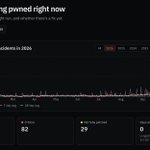
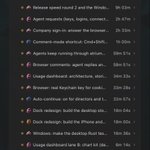
Just my director managing 17 workers in @atrium_dev across multiple initiatives - and this isn't even all the work I queued up for it to execute overnight.
Long-lived agents are OP.

1
1
86
Long-lived agents are such a powerful way to work. I've been using Grok Bot, Duet, and Dots extensively, but vendor lock-in sucks.
So I brought directors & staff to atrium in the new HQ.
They run on any model with subs you already pay for. They hire their own staff, have exceptional memory & context management, browser & computer use, and even support side chats.
atrium's completely changed the way I work and the HQ is doing it again.
1
71
Download atrium for free at getatrium.dev and join us on Discord for a link to download the iOS/iPad app on TestFlight!

36
You can now hire directors to run all of your operations in atrium's new HQ.
Directors are long-lived agents with exceptional memory and context management and all of the tools necessary to handle anything you throw at them.
They can hire staff, set up routines, use your computer or their own browser, request logins, passwords, or keys, maintain a dashboard, and so much more.
HQ is also live on iOS and iPad (check our Discord for the TestFlight link).
👉 getatrium.dev
47

"How to revert" is great, but even better is "how to turn off". Ship your changes behind feature flags 👌

This is a really great article. To start, we should be adding some version of this to every PR description: "Testing", "Risk," and "How to revert."
"Testing" should include static checks and end-to-end verification from the agent. Screen recordings with computer use are the holy grail.
"Risk" should encompass both the depth of the change (i.e. is it a copy change or a deeper system change?) and the sensitivity of the change (i.e. does it touch mission-critical backend or PII?). Anthropic uses a low - medium - high ranking.
"How to revert" should be a playbook for incident response. If a revert wouldn't be easy, consider how it could be!
All of these serve to make code review faster, and to make bouncing back from incidents easier.
29

Even the noul outputs aren't safe right now 😩 Rotate your decimals, y'all!

despite the unfortunate timing, we take disclosures seriously at @typesafeai
at approximately 6:49PM this Friday evening, we became aware of a massive unauthorized leak of ALL customer noul outputs
in effort to maximize transparency, here is the link: gist.github.com/diogo149/810…
44
3D rendering of my desk is ready for iteration! Lots I plan to tweak with this, but it's a solid start.


27
My desk is a cluttered mess... so I've decided to combine my AI and carpentry skills to take care of it.
I started with some ideation in GPT to get some inspiration. This is just one of many iterations I'm noodling on. I've got more ideas to come; hidden laptop docks, cable management, a place for my Pi, mini PC, everything.
I'm now having Opus build some 3D models for me so we can iterate on it a bit. Once I'm totally happy with it, I'm gonna turn those models into a cut guide/assembly guide and modify the desk.
Just starting out, but will be sharing the entire process. Follow along and wish me luck!


2
65