

Building infrastructure to help companies become AI-native. Let’s jam about AI in the enterprise (booking link below):
Canada
Joined November 2023
- Tweets456
- Following172
- Followers345
- Likes4.3K





It's remarkable how much business software is just a place for employees to record work they've already done.
1
2
313
> The main bottleneck to AI adoption in the enterprise is context. Models are getting smarter, but they still don't understand how individual companies actually operate.
> Brian Armstrong and Coinbase are already talking about the importance of a company brain. AI becomes much more useful when it understands an organization's accumulated knowledge.
> Every enterprise AI deployment is constrained by the quality of discovery. You can't automate a workflow you don't properly understand.
> We’re seeing this first hand.
> That's why we're building an autonomous discovery module. The goal is to gather operational context with far less interruption to the team.
> Notion has an opportunity to become the context layer for enterprise agents. Where AI systems learn how those companies function.
> The opportunity is enormous, but not guaranteed. Microsoft, Google, and other platforms have distribution and access to operational data.
Read more:


GTM play of the day: delivering fresh Timmy’s donuts to prospective clients’ offices. How can you say no ??

3
9
365
Josh retweeted

A large food importer and distributor relied on manual, experience-driven procurement. Buyers juggled a dozen external factors, inventory, sales history, demand forecasts, lead times, and shipping to decide what and when to buy.
An AI procurement agent now automates the entire workflow. It analyzes inventory, historical sales, forecasts, and constraints daily to decide when to place orders, what to buy, and how to configure incoming containers.
Engineers spent one week on-site to learn the process, then one week to build, test, and deploy the agent into daily operations.
Just shared on ai receipts by Josh Cons at Arx Intelligence (@Joshcons0).
aireceipts.work/r/recs1G0yNJ…

Josh retweeted

being good at twitter (aka comms) is essential to the job description of a startup CEO in 2026
We're so focused on how much money AI can save enterprises that we're overlooking how much more money it can help them make.
Consider a distributor doing $100M in revenue -
Automating 10 hours of accounting work each week is useful. But improving purchasing decisions, reducing stockouts, optimizing freight, or recovering revenue lost to customer deductions could be worth millions. And none of that requires replacing employees or ripping out existing systems.
It requires making the systems and people already in place better at what they do.
Measure the ROI on AI can and should be done by looking into:
a. Dollars created
b. Hours saved
(In that order ^)
The most valuable AI workflows may be the ones that save the least amount of employee time.
A procurement team member might spend 30 minutes preparing a purchase order, but that decision could determine whether the company writes off $100,000 in inventory three months later. Measuring the ROI in hours saved misses almost the entire opportunity. We’ve seen this exact scenario play out in our early design partner engagements …
We just deployed an AI procurement agent for a food distributor. What made the engagement interesting was that the company's president had already been using AI extensively to inform purchasing decisions, but the procurement process itself remained largely manual.
BACKGROUND:
He's non-technical, runs a busy operation, and had taken it upon himself to connect Claude with the company's historical sales data, Excel worksheets, and SAP records. He was using that information to generate purchasing recommendations for his team, who had historically relied heavily on experience and anecdotal judgment.
THE CHALLENGE:
The challenge was that procurement in food distribution involves considerably more than forecasting demand. For every SKU, the team needs to account for historical sales, seasonal demand fluctuations, current inventory, shelf life, supplier lead times, and projected sales. And because much of their inventory arrives in shipping containers from suppliers around the world, purchasing decisions must also account for how to fill those containers economically.
These variables are interdependent. Ordering more of one product might improve container utilization but increase the likelihood of liquidation as expiration dates approach. Ordering less might preserve working capital but create stockouts or require more expensive shipments later. A product with relatively modest historical sales might warrant a larger order ahead of a seasonal demand spike.
The consequences of getting these decisions wrong were material. The business was regularly liquidating five to six figures' worth of inventory each month as products approached expiration. Meanwhile, the president was spending his own time analyzing data and preparing recommendations to compensate for gaps in the existing process.
OUR WORK:
We spent a week in their office with the procurement team, mapping the workflow from beginning to end and identifying the information and decision criteria involved at each step. The resulting agent evaluates the relevant purchasing variables daily, determines whether a purchase order should be proposed, and, when appropriate, recommends what to order and how to allocate products across a container. The procurement team reviews the recommendation, makes any necessary adjustments, and approves it before the agent submits the PO to the supplier.
The immediate operational benefit is roughly a day of procurement work that can be taken off the team's plate. But the more consequential opportunity is improving the quality and consistency of the purchasing decisions themselves.
If the system can reduce unnecessary inventory accumulation, avoid preventable stockouts, and improve container utilization, the financial impact can extend well beyond the labor involved in preparing purchase orders. Those outcomes will need to be measured over subsequent purchasing cycles.
One of the more interesting things we're learning through these deployments is that the cost of executing a business process and the economic consequences of the decisions within it can be vastly different. In this case, generating and submitting a purchase order is relatively straightforward. Determining the right purchase order, across hundreds of interacting constraints, is where much of the value sits.
And that's an important distinction when evaluating where AI can create meaningful economic value inside an enterprise.
4
10
1,218
Every company will have a Head of AI within 24 months.
> A $90m national nonprofit engaged an AI transformation partner to automate its back-office finance operations with custom agents. They're using finance as a pilot, with plans to expand into events and campaigns if successful.
> An elementary and high school are exploring custom AI modules to better serve students through more personalized learning and support (may or may not be powered by our team).
> A 1,500-person logistics company with a large internal engineering team has spent the last 18 months transitioning from software-first to AI-first. They have 4 people dedicated to AI transformation, are building MCP servers to connect their existing systems, and are even reconsidering software they built just 12–18 months ago.
> Over the last 6 weeks, we've spoken with a few dozen mid-market and enterprise companies scoping larger AI transformations, starting with custom agents to automate repeatable work across departments.
What's becoming clear is that this isn't something companies can delegate to an employee who happens to be good with ChatGPT. Someone needs to own the roadmap, understand the workflows, decide what gets built versus bought, and oversee deployments across the organization.
It's a matter of a couple of years before every organization either has its own internal AI team or engages a third party to act as one.
1
7
443
A meaningful portion of the custom AI workflows being sold to enterprises today will become obsolete long before the contracts they're attached to expire. Enterprises are being deceived by their vendors.
We recently had a conversation with a distributor of outdoor winter apparel about improving their procurement process. It's a highly seasonal business, where purchasing decisions depend on historical sales, fashion trends, inventory levels, supplier lead times, and, perhaps most importantly, the weather.
A colder winter generally means stronger demand. A warmer winter can leave the business holding substantial amounts of seasonal inventory that eventually needs to be liquidated at a discount. And because purchasing decisions are made well ahead of the season, the business is effectively committing capital against a forecast that may prove incorrect months later.
We discussed building a procurement agent that could incorporate these variables, continuously reassess demand projections, and help the team make better purchasing decisions.
The potential economic value was straightforward: fewer avoidable stockouts, less excess inventory, and reduced end-of-season liquidation.
But something else happened during the conversation that I found considerably more interesting.
_
The operator had recently connected their legacy ERP to ChatGPT, giving him the ability to retrieve and analyze information that previously required navigating an outdated system or asking someone on his team to prepare a report.
That relatively simple change opened up an entirely new set of possibilities in his mind.
As we discussed procurement, he began identifying other workflows across the business that could potentially be automated. Some were interesting opportunities for custom development. Others were tasks that existing AI tools could already handle reasonably well. And a few were capabilities that I suspect will become standard features of general-purpose AI products within the next several months.
This creates an interesting problem for enterprises investing in AI transformation.
> The market is moving quickly enough that the useful life of certain custom implementations may be considerably shorter than the procurement cycles and multiyear contracts through which they're being sold.
> A workflow that requires custom engineering today might be available through a standard model subscription six months from now. That doesn't necessarily make the original implementation a bad investment. If it creates sufficient economic value during that period, the investment can still be justified.
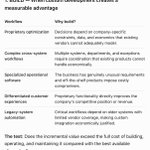
> But it changes the calculation considerably. I think enterprise AI investments increasingly need to be evaluated across three categories:
1. Build: Workflows that are sufficiently specific to the business, require meaningful integration across systems, and create enough economic value to justify custom development and ongoing maintenance.
2. Buy: Capabilities that existing software providers already deliver effectively, where custom development would add complexity without a corresponding economic advantage.
3. Wait: Capabilities that aren't yet reliable or readily available, but are likely to become commoditized quickly enough that the expected benefit of building them today doesn't justify the investment.
The third category is particularly important because it requires an implementation partner to occasionally recommend doing nothing. And that's not always an easy recommendation to make when your business earns revenue from implementations.
6
19
1,566
In conversation, an AI leader mentioned that “AI implementation in the enterprise, as a service” is a short-lived commercial opportunity.
(Respectfully disagree)
That would only be true if every single enterprise builds an in-house AI team. Nothing to do with how good the models (more precisely, the ease of building workflows) of the big labs become.


Grateful for all the new eyeballs on my content over the last 48 hours. Figured I'd share a bit about myself and my story:
> Born and raised in Montreal. Moved to NYC for university, where I majored in accounting.
> 3 years later, graduated with a double major (accounting & strategy), and the day after graduation, decided I didn't want to be an accountant. Took a complete 180 and did the next logical thing...
> Started reaching out to founders who had exited their companies, pitching them on this thing called “personal branding” (which, ~4 years ago, most had never really heard of!).
> Landed my first client through one of my very first outbound messages, the day after I graduated. Started freelancing as a ghostwriter.
> Went all-in. Spent 4 months serving a handful of clients myself, until I decided to bring on my first teammate (who's still with us today!) and gave the company a name: Notice Me(dia).
> Went on to serve 200+ executives, including leaders at some of the world's fastest-growing companies. Expanded our offerings, built an incredible team, and grew the agency to 7 figures in annual revenue.
> Throughout, I was fortunate to syndicate venture investments, invest directly in companies we'd worked with, and make lifelong friends with some of the coolest founders. We were essentially their fractional storytelling team, getting a front-row seat to how they hired, fundraised, sold, and built their businesses.
> Eventually decided it was time to take a shot at solving a completely different problem.
> September 1, 2026: Stepped away from my full-time CEO role at our content businesses (which are still running and growing faster than ever!).
> Raised a friends-and-family round, hired two of the smartest engineers I know, and got to work on what we’re building.
> Our first product used AI to analyze company spending and usage patterns, helping finance teams identify opportunities to save money.
> October 20: Made another 180. The more mid-market and enterprise companies we spoke with, the more we realized that the bigger opportunity was helping them implement AI across their operations, building custom agents around how their businesses actually work.
> Brought on our first cohort of businesses, started deploying agents, and are already planning expansions with several of them.
> Started sharing anecdotes, observations, and lessons from these conversations here on X. It's been hugely beneficial so far, both for meeting interesting people and challenging how I think about what we're building.
> Our vision has since expanded into building, operating, and securing the technology that runs an enterprise.
Still at the very beginning of this next chapter.
If you're new here, introduce yourself. Would love to meet more of you!
13
22
975
There's a lot of confusion among enterprise buyers right now about what AI software is actually worth paying for.
They don't know (a) which vendors to trust, (b) which products will still be relevant a year from now, or (c) whether they should be building these capabilities internally instead.
And the signals they historically relied on aren't particularly helpful. A company raising hundreds of millions of dollars tells you very little about whether its product will deliver value in your business.
We're seeing more companies hesitate to make decisions, even when they're convinced of what AI could do for them. There's a real fear of committing to the wrong solution in a market where the definition of a good solution keeps changing.
What to do?
Continuing on this point, enterprises are beginning to deploy custom AI agents across their organizations. The obvious Q then becomes: who's responsible for taking care of them, once deployed? Some thoughts:
An agent that works perfectly today could break tomorrow because an ERP changes its API, a supplier changes its invoice format, or an employee modifies an approval process. And unlike traditional software, an agent can continue operating while making mistakes. It might process 500 transactions incorrectly before anyone realizes something has changed.
We're moving toward a world where companies have dozens, eventually hundreds, of agents operating across finance, operations, sales, and other departments.
Someone needs to monitor their decisions, investigate failures, manage permissions, update integrations, and make sure they're still producing the intended outcomes. We've spent decades building an entire industry around managing enterprise IT infrastructure.
I suspect we're about to see something similar emerge around managing AI agents. We have managed IT, cyber, now we’ve been chewing on something called ‘Managed AI’. The opportunity may be just as large in keeping agents running reliably as in building them in the first place.
So to answer the Q:
(A) Either the company themselves (/their internal AI team),
(B) Or, their designated third-party, managed AI team.
Thoughts?
I've been thinking about what happens to enterprise SaaS over the next few years. A few scenarios:
1. SaaS companies become the infrastructure for their own replacements.
The optimistic scenario for incumbents is that they expose their products through APIs and MCP servers, allowing agents to operate their software on behalf of employees. But there's an interesting risk here: once the agent becomes the interface, the customer no longer needs much of what made the application valuable in the first place.
The vendor retains the database and transaction engine, while the agent owns the workflow and user relationship. That's a very different position to negotiate pricing from.
2. Enterprises realize they've spent decades adapting themselves to software that was never built for them.
Historically, buying an imperfect SaaS product was still cheaper than building and maintaining a custom one. That assumption is becoming less reliable. If a company can retain a handful of engineers to build applications around its actual processes, the economics of paying seven figures annually for software that requires endless workarounds start looking questionable. Especially when much of the functionality is only used by a fraction of the employees paying for seats.
3. The best SaaS businesses may become the worst businesses to sell AI to.
If an incumbent automates 80% of the work its customers perform inside its product, it could destroy a substantial portion of its own seat revenue. The customer wants fewer people doing the work. The vendor wants more people paying to access the software. That creates a genuine incentive problem. Some incumbents will successfully move to usage or outcome-based pricing. Others may be financially better off slowing down the very automation their customers want.
4. The cost of building software falls, but the cost of owning it becomes the deciding factor.
Generating an application is becoming cheap. Keeping it secure, integrating it with changing systems, maintaining permissions, handling exceptions, and supporting it for years is another matter. This could produce a strange outcome: companies build far more software internally, only to discover that maintaining hundreds of custom applications creates a new kind of technical debt. The winners may be the companies that figure out how to make custom software disposable rather than permanent.
5. Enterprise software stops being sold primarily to the people who use it.
Today, a large part of enterprise software distribution depends on convincing employees and department heads that a product will improve how they work. But if agents increasingly choose which tools to call, where to retrieve information, and how to execute tasks, the buying criteria change. Interface quality, onboarding, and user experience become less important for certain categories. Reliability, permissions, interoperability, and cost per completed task become much more important. Some products with terrible interfaces but excellent underlying infrastructure could become more competitive, not less.
_
A company could keep its core systems, replace much of the software employees interact with, build its own workflows, and reduce its seat count dramatically.
And the software vendors could find themselves processing more transactions than ever while capturing less revenue per customer. That's the tension I find most interesting: AI could make enterprise software more useful while making large parts of the enterprise SaaS business model less valuable.
14
32
2,934
Enterprise buyers are being asked to make multiyear commitments to AI products whose capabilities could be commoditized within months.
Funding rounds, impressive demos, and customer logos don't tell you whether a product will remain differentiated. It's becoming increasingly difficult to distinguish a durable software business from a feature that hasn't reached the foundation models yet.
Buyers are genuinely scared about this.
3
2
2,038
Vertical SaaS has historically been attractive because every industry has unique workflows that horizontal software doesn't handle particularly well.
But what happens when building software around those workflows becomes dramatically cheaper?
A distributor, manufacturer, or logistics company might have spent years looking for software that accommodates its specific processes.
Now it can potentially build agents directly on top of its ERP, without buying another application.
The irony is that the more specialized a workflow is, the more attractive custom development could become.
Particularly when the software vendor is charging a premium precisely because there aren't many alternatives.
_
We experienced some of this firsthand at our stealth co.
Our first product analyzed company spending alongside software usage and other operational data to identify opportunities to save money.
The more we tried to make it work horizontally across industries and company sizes, the more we realized how differently businesses operate, even when they're trying to solve what looks like the same problem. We eventually pivoted from building one product for thousands of companies to building custom AI workflows around how each company actually operates.
It's an interesting position to arrive at after a month month trying to build the exact opposite.
I've been thinking about what happens to enterprise SaaS over the next few years. A few scenarios:
1. SaaS companies become the infrastructure for their own replacements.
The optimistic scenario for incumbents is that they expose their products through APIs and MCP servers, allowing agents to operate their software on behalf of employees. But there's an interesting risk here: once the agent becomes the interface, the customer no longer needs much of what made the application valuable in the first place.
The vendor retains the database and transaction engine, while the agent owns the workflow and user relationship. That's a very different position to negotiate pricing from.
2. Enterprises realize they've spent decades adapting themselves to software that was never built for them.
Historically, buying an imperfect SaaS product was still cheaper than building and maintaining a custom one. That assumption is becoming less reliable. If a company can retain a handful of engineers to build applications around its actual processes, the economics of paying seven figures annually for software that requires endless workarounds start looking questionable. Especially when much of the functionality is only used by a fraction of the employees paying for seats.
3. The best SaaS businesses may become the worst businesses to sell AI to.
If an incumbent automates 80% of the work its customers perform inside its product, it could destroy a substantial portion of its own seat revenue. The customer wants fewer people doing the work. The vendor wants more people paying to access the software. That creates a genuine incentive problem. Some incumbents will successfully move to usage or outcome-based pricing. Others may be financially better off slowing down the very automation their customers want.
4. The cost of building software falls, but the cost of owning it becomes the deciding factor.
Generating an application is becoming cheap. Keeping it secure, integrating it with changing systems, maintaining permissions, handling exceptions, and supporting it for years is another matter. This could produce a strange outcome: companies build far more software internally, only to discover that maintaining hundreds of custom applications creates a new kind of technical debt. The winners may be the companies that figure out how to make custom software disposable rather than permanent.
5. Enterprise software stops being sold primarily to the people who use it.
Today, a large part of enterprise software distribution depends on convincing employees and department heads that a product will improve how they work. But if agents increasingly choose which tools to call, where to retrieve information, and how to execute tasks, the buying criteria change. Interface quality, onboarding, and user experience become less important for certain categories. Reliability, permissions, interoperability, and cost per completed task become much more important. Some products with terrible interfaces but excellent underlying infrastructure could become more competitive, not less.
_
A company could keep its core systems, replace much of the software employees interact with, build its own workflows, and reduce its seat count dramatically.
And the software vendors could find themselves processing more transactions than ever while capturing less revenue per customer. That's the tension I find most interesting: AI could make enterprise software more useful while making large parts of the enterprise SaaS business model less valuable.