

Né à Gijon, Asturias, Espagne. Astronome, lecteur et cinéphile.
Saint Avold Moselle
Joined November 2009
- Tweets16.9K
- Following164
- Followers1.4K
- Likes1.7K




Pinned Tweet
New paper out on arXiv: arxiv.org/abs/2607.20128
It explains a lightweight way to predict atmospheric re-entries using only public TLEs. My hope is that some of you will jump in and start making your own predictions, with this method or any other you prefer.
More voices, more analysts, more independent checks. Give it a look. #SkyfallWatch


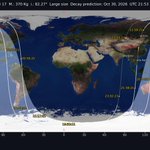
Update: obj. 101147 HAWK 16 A, B & C ELECTRON R/B decay prediction: October 30, 2026 UTC 21:27 ± 15h


Update: obj. 48582 STARLINK-2236 decay notice: October 26, 2026 UTC 13:22 ± 1h
A deorbit maneuver was performed this morning, significantly shortening the satellite's expected orbital lifetime. The object has most likely already re-entered the atmosphere.

Final TIP: 2026-10-26 UTC 13:03:00 ± 1min
36.2S 55.1E
satflare.com/track.asp?q=485…


Final TIP: 2026-10-25 UTC 21:03:00 ± 1min
27.7S 67.1E
satflare.com/track.asp?q=485…
Obj. 671022 STARLINK-36255 decay prediction: October 25, 2026 UTC 17:47 ± 1.4h
A major deorbiting maneuver has increased the effective area from 5 m² to 18 m². This prediction assumes that the effective area will remain constant at 18 m² until re-entry.

Final TIP: 2026-10-25 UTC 15:38:00 ± 1min
11.6S 140.9W
satflare.com/track.asp?q=671…
Update: obj. 46066 STARLINK-1525 decay prediction: October 25, 2026 UTC 08:47 ± 1.8h
The effective area has remained constant at approximately 5.2 m². The present prediction assumes that this value will remain unchanged until re-entry.

Final TIP: 2026-10-25 UTC 08:20:00 ± 2min
30.3S 126.5E
satflare.com/track.asp?q=460…


