

Content strategist. I send a one-paragraph email with simple ways to get more clients from your content to 35,000 subscribers every day. Get it here👇
START HERE 👉
Joined August 2008
- Tweets38.2K
- Following1.1K
- Followers31.9K
- Likes25K







Pinned Tweet
Big news!
You can now get immediate access to ALL my Skill Sessions for just $99 per year.
Join my Clients From Content Program to get them at the lowest rate I've ever offered.
Link to join is in the tweet below 👇
I started working with a new client recently and when I reviewed her newsletter welcome email sequence I saw some familiar problems.
Here’s a bit of what I said to her about the email she sends a day after people subscribe…
•••
It’s a nice email, but there’s no real value in it for the reader.
You’re introducing yourself which is fine, but there’s nothing in it that actually helps them accomplish their goal - just a promise of more help to come.
This is the kind of stuff traditional email marketing funnel “gurus” teach that I strongly disagree with.
The best thing you can do in your first email is give new subscribers something so valuable that they want to open every other email you send them moving forward.
Another common mistake:
You didn’t mention your product or offer in this email!
There are people who subscribed looking for help NOW, but you’re dragging things out in the name of relationship building (or insecurity) instead of telling them how you can help them solve their problem today.
Give them a chance to buy if they want to buy!
They’re looking for help and you can provide it, so why wouldn’t you want them to know how?
One more thing:
This email hasn’t given the reader any reason to reply to you.
That’s a missed opportunity on both the relationship building and deliverability front.
•••
That’s just a tiny bit of the advice I’m giving my client to help her get more from her content.
Want me to review and improve your welcome email sequence?


Don’t treat your newsletter readers like movie theater customers.
You know how when you go to a theater they make you sit through 30 minutes of ads, trailers, and concession promos?
Too many newsletters do their own version of that before getting to the “main feature.”
An example from my inbox:
A newsletter I got this week had multiple sections before getting to the article.
Here’s what it looked like:
Subject line
Headline (same as subject line)
Subheadline
Promo for their course
Promo for coaching
Read time (it was 3 minutes and half of that was probably the intro)
Subscribe button (even though I’m already subscribed)
Description of the content series (which was the same as the subheading)
“This week’s topic” (same as headline AND subject line)
Headline
And finally…
The article
When you do this, you’re making readers work to get to the value - and most won’t.
Don’t do this.
A few rules to keep your newsletter fluff-free:
1. Only say each thing once.
(The only exception may be a call to action.)
2. Get to the core of the article as quickly as possible.
3. Don’t ask people to subscribe before they’ve read the content - and definitely don’t ask if they’re already subscribed.
Want to improve your newsletter?
Send me one of your newsletter issues and I’ll point out one thing I’d fix.
Do you have a content library?
Here's how to build one from scratch:
(So you don't have to create new content ALL the time!)
1️⃣ Pick a goal your ideal clients want to accomplish.
2️⃣ Write a list of 30 things they need to do to accomplish it.
3️⃣ For each thing, create 3 pieces of content:
• One telling them HOW to do it
• One telling them WHY to do it
• One showing how OTHERS have done it
Your content can be in any format and for any platform.
(Works great with LinkedIn posts!)
4️⃣ Now you have 90 pieces of content based on 30 things that will help your ideal clients accomplish their goal.
5️⃣ Publish one of your 90 pieces of content every day for 90 days.
6️⃣ Repost or reshare all the content in your cycle - update and expand as needed.
7️⃣ Start the cycle again every 90 days.
Share the same content once every three months.
Congrats!
You've now got a valuable content library.
(And will never have the pressure to create new content again.)

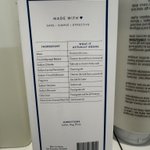
I learned a LOT from this Native body wash bottle.
It’s an example of unique, clear, powerful copywriting.
A few things to notice:
1. It differentiates the product.
Every body wash lists the ingredients.
I’ve never seen one explain what those ingredients are.
2. It speaks the customer’s language.
It translates terms only soap makers know into terms buyers can understand.
3. It has a personality
A hint of humor goes a long way.
"Lather. Sing. Rinse." vs. "Lather. Rinse."
"Water - You know this one..."
4. It organizes the copy in a clever way.
Copywriting is as much about format as words.
The two-column approach reduces words and increases clarity.
5. It's concise.
No sentence or phrase is longer than 6 words.
Most are 2 words or less.

Want your business to grow faster?
Stop doing these 3 things:
1. Stop undercutting your offers with your insecurity.
Believe in what you sell...or stop selling it.
2. Stop trying to appeal to everyone.
The more specific you are about who you help and how?
The more likely your ideal client will hire you.
The more vague you are?
The more likely they'll go elsewhere.
3. Stop taking on bad clients.
A bad client comes at a HUGE cost.
They cost you time, energy, testimonials, and maybe even confidence.
And when they inevitably fail, it reflects on YOU.
Plus:
Bad clients don’t refer good ones.
•••
I'd love to send you some GREAT clients.
Let me know how you help clients and I'll try to send some business your way!

Wish there was a simpler way to create a course?
There is.
Skip the modules.
Skip the scripts.
Skip the endless editing.
👉 Get someone who wants to learn from you to interview you on Zoom.
Let them ask whatever they want.
Record the conversation.
Publish it as a course.
Their questions will be the same ones your future course buyers will have.
Your answers will be natural and "real."
The course will be created in hours instead of weeks.
If you tried this approach...
What would your course be about?

What I’m about to tell you is NOT easy to do.
But it’s powerful.
👉 Expand your results timeframe.
👉 Shrink your actions timeframe.
For example:
Let’s say you’re starting a newsletter and your goal is 5,000 subscribers.
Most people say this:
"I want 5,000 subscribers in 12 months."
Then they burn out or quit when they fall behind.
Instead, try this:
• Give yourself 5 years to hit the goal
• Launch the newsletter tomorrow
• Publish weekly instead of monthly
• Start paid promotion after 6 issues - not 6 months
Decrease the pressure on your outcome...
While increasing the momentum of your actions.
The best way to get where you want to go?
Slow down your expectations.
Speed up your actions.

This 10-minute exercise gave me massive clarity in my business.
Try this:
1. List everything you got paid for last year.
Include clients, services, products, etc.
Be specific - don't just say "coaching," list every individual session or sale.
2. Rank that list by revenue.
Which brought in the most money? Put those at the top.
3. Create a second list that ranks the same items by enjoyment.
What did you love doing? What did you dread?
4. Compare both lists.
What's high on both?
What's low on both?
Where's there a mismatch?
5. Adjust accordingly:
Do more of what ranks high on both.
Eliminate what ranks low on both.
If something paid well but you didn’t enjoy it, tweak the delivery.
(Didn’t like weekly calls? Try monthly.)
If something was fun but didn’t pay well, explore how to monetize it better.
This simple exercise will give you more clarity - use it to increase your income AND satisfaction.

Here’s what a day in your business could look like…
If you learn how to get clients from content.
I didn’t “launch” anything yesterday.
And yet…
- 2 people joined my Clients From Content membership at the $99/yr level
- 1 person joined at the $299/yr level
- 1 person renewed their membership for the 3rd year in a row
- 1 person donated $7 as a thanks for the free ebook I made available
- 1 person booked 4 coaching calls for $1,800
- Multiple people reached out to ask me
about my program and/or booking a coaching call.
How did this happen?
1. Every one of these buyers discovered me through my content.
2. Every one of them had consumed multiple pieces of my content before buying.
3. Every one of them wanted to accomplish the kind of things I talk about and demonstrate in my content.
4. Every one of them learned about my offers THROUGH my content - not just sales emails.
5. Every one of them were able to afford my products (that wasn’t always the case before I lowered my prices).
6. Every one of them had a one-to-one interaction with me at some point. I had replied to their comment, answered their emails, talked to them via DM or helped them on a group coaching call.
This is why I teach others how to get clients from their content.
Because it works.
I’d love to teach you how to do it too.
Let me know if you’d like some help.
Happy to answer any questions you have or give you specific suggestions in the comments below.
Want to boost your course sales?
My new podcast episode can help.
7 things you'll learn:
1. How to get feedback from course buyers
It's at the 1-minute mark.
2. What to say to get more people to fill out a survey
It's at the 5-minute mark.
3. How I'd rewrite a course sales page
It's at the 9-minute mark.
4. The dangers of using the word "learn" in course sales copy
It's at the 11-minute mark.
5. When to share your personal story with your audience (and when not to)
It's at the 24-minute mark.
6. The email subject line I use to offer a discount to my audience
It's at the 27-minute mark.
7. How to use LinkedIn polls to surface potential buyers
It's at the 30-minute mark.
The links to check it out are in the next tweet.

Listen here: clientsfromcontent.transisto…
Watch here: youtu.be/8fzqDPJp6BQ?si=eQqS…
Trying to figure out what your ideal clients want?
This Wednesday I'm presenting a new Skill Session called The Market Researcher to teach you just that.
Join my Clients From Content program for as little as $99 to get access to it.
(And my 20+ other Skill Sessions too!)
Let me know if you're interested or have any questions about it.
Opportunity knocks.
The only question that remains is whether they want me to be a babyface or a heel.

Most people ruin their writing by chasing the wrong ‘P-word.’
They try to be more professional.
But the real key to great writing?
Being PERSONAL.
Here’s how to make your writing feel more like a conversation:
3. Don’t leave your FAILURE out of your success stories.
This:
"I realized a harsh truth: The product I created wasn’t good enough. So I went back to the drawing board and created a new one which changed everything."
Not this:
"My product was an instant hit."