






Pinned Tweet
Your wallet has a resume.
You just never got to use it.
Every swap. Every LP. Every repay on time.
All that history = $0 in TradFi.
ZeruAI is turning it into a score.
And that score is becoming money.
Here's why I'm watching @zerufinance 🧵👇
zaps.markets/?invite=5xTj_CP…


🇻🇳🇯🇵 Kai | Web3 retweeted

GTA VI is already giving people something to argue about before anyone has even played it.
And honestly, some of these questions are worth watching
Will PC players have to wait another year?
Which songs will make the radio lineup?
Can Rockstar pull off a 98+ Metacritic score?
@Parimatch is turning these conversations into Yes/No prediction markets.
You get to pick a side on three topics:
• PC release deadlines
• Songs featured on the in-game radio
• Whether GTA VI hits a 94+, 96+ or 98+ Metacritic score
I find the Metacritic one particularly interesting. Rockstar has set the expectations high, so seeing how close the final score gets will be worth following.
Make sure you read each market’s rules before predicting.
Explore: global-pm.link/?serial=61377……

🇻🇳🇯🇵 Kai | Web3 retweeted

Vừa đăng ký tham gia vòng Public Anthropic trên @Bitget IPO Prime xong mọi người ạ! 👀
Dùng Claude suốt nên mình khá háo hức với đợt IPO lần này.
Điều mình quan tâm nhất là tiềm năng của Anthropic trong mảng AI doanh nghiệp, đặc biệt khi nhu cầu viết code và tự động hóa công việc ngày càng lớn. Nhưng với OpenAI và Google cạnh tranh sát sao, liệu Anthropic có duy trì được tốc độ tăng trưởng sau IPO?
Vòng Public mới mở với mức tham gia tối thiểu 100 USDT. Nếu được phân bổ, mình sẽ nhận rANT - token được bảo chứng bằng cổ phiếu Anthropic theo tỷ lệ 1:1. rANT không phải cổ phiếu thật, nên mình không trở thành cổ đông Anthropic mà chỉ tiếp cận biến động giá thông qua token.
Sau cú biến động của $NVDA, mọi người còn bullish với cổ phiếu AI không? 👀
NFA & DYOR
#bitget #Anthropic #Hannah

🇻🇳🇯🇵 Kai | Web3 retweeted

daily yield is attractive, but how accessible is that capital when you actually need it?
that’s a question i think deserves as much attention as the advertised apy.
with @grvt_io high yield earn, i’d look beyond the daily earnings and examine how capital is allocated across its different yield sources, alongside the redemption mechanics.
deposits have a two day holding period before becoming eligible for redemption, while actual exit times depend on the vault’s liquidity and underlying positions.
there’s an important distinction between earning yield and having immediate access to your capital.
would you accept a longer redemption window in exchange for a higher target yield, or is liquidity non negotiable?

POV: you gave your savings something better to do every day.
Put yours to work → grvt.io/a/g/9gi999ha
🇻🇳🇯🇵 Kai | Web3 retweeted

Everyone treats infrastructure choices like identity.
ZK team. Optimistic team. Pick a side and stay loyal.
What stood out to me about @GenLayer's move to @arbitrum is that it quietly rejects that entire mindset.
The GenLayer Chain moved from ZK Stack to Arbitrum Nitro. Transaction ordering, validator committees, staking, votes, appeals, and final outcomes now run on the Arbitrum stack.
But the part that actually makes GenLayer different never moved. Optimistic Democracy still reaches consensus across validators running different AI models. GenVM still executes intelligent contracts on validator nodes.
The migration only touched the places where the protocol meets the chain: bridging, Ethereum integration, gas handling, and the contracts that coordinate the network.
Most teams spend years defending one stack as if it defines them. @GenLayer appears to be doing something simpler. Keep the mechanism that makes the protocol unique. Swap the infrastructure around it when a better fit exists.
Public network on Nitro (operated with Conduit), putting GenLayer in the same ecosystem as Robinhood's chain and 30+ dedicated Nitro chains. Prividium deployments for institutions continue with Matter Labs.
Nitro also brings mature Ethereum tooling through Geth today, plus Stylus as a future path if compute-heavy coordination ever benefits from Rust and WebAssembly.
What interests me most is not the migration itself. It is the idea that a protocol does not need to treat infrastructure as ideology.
Use one stack where ecosystem access and production-tested tooling matter. Use another where private institutional deployments make sense.
If you were designing a protocol from scratch, would you optimize for architectural purity, or use whatever stack best serves each part of the system?
Curious where people land on this. I can see strong arguments both ways.
🤝 Paid partnership


🇻🇳🇯🇵 Kai | Web3 retweeted

Are you ready for the @unvault ? I’m all set. just missing a whitelist spot! Hahaha.
But honestly, this is a project worth looking forward to.


🚨🐛 ??? DAYS UNTIL THE BUGZ ARE UNLEASHED! 🚨
🎁 CHECK YOUR WALLET. YOU MIGHT WIN A GENESIS BUGZ OR DEBUGZ NFT!
🔍 unvault.com/bugz
1 lucky wallet which checks their eligibility will win a Bugz NFT and 1 will win a DeBugz NFT!
(connects or uses wallet checker)
DEBUGZ + BUGZ! TWO FREE MINTS. SAME ELIGIBILITY.
🐛 DeBugz
🎁 5,600 NFTs + 1,700 for @ClutchMarkets Anvil
💰 FREE + gas
🔥 Genesis Bugz
🎁 5,600 NFTs + 1,700 for @ClutchMarkets Anvil
💰 FREE + gas
🚀 Early access to participating partner mints + exclusive Minters' Bonuses!
ONE WALLET CHECK. TWO MINTS! 🔍
🥇 PHASE 1: Hold an eligible UnVault partner NFT? You've got first dibz on BOTH!
🥈 PHASE 2: Same eligibility for BOTH mints. First come, first served!
👀 OVER 6,000 UNIQUE WALLETS checked during yesterday's surprise push alone!
🚨 STOP SCROLLING. CHECK YOUR DAMN WALLET! 🚨
You could already qualify for Phase 1 and not even know it!
🐛 Share with everyone!
🎁 Get a chance to WIN a Genesis Bugz NFT.
🔥 Don't wait until mint day!
Get Bit. Get Bugz. Get Rewarded. 🐛🔥
🇻🇳🇯🇵 Kai | Web3 retweeted

A community sale should give the community a reason to pay attention.
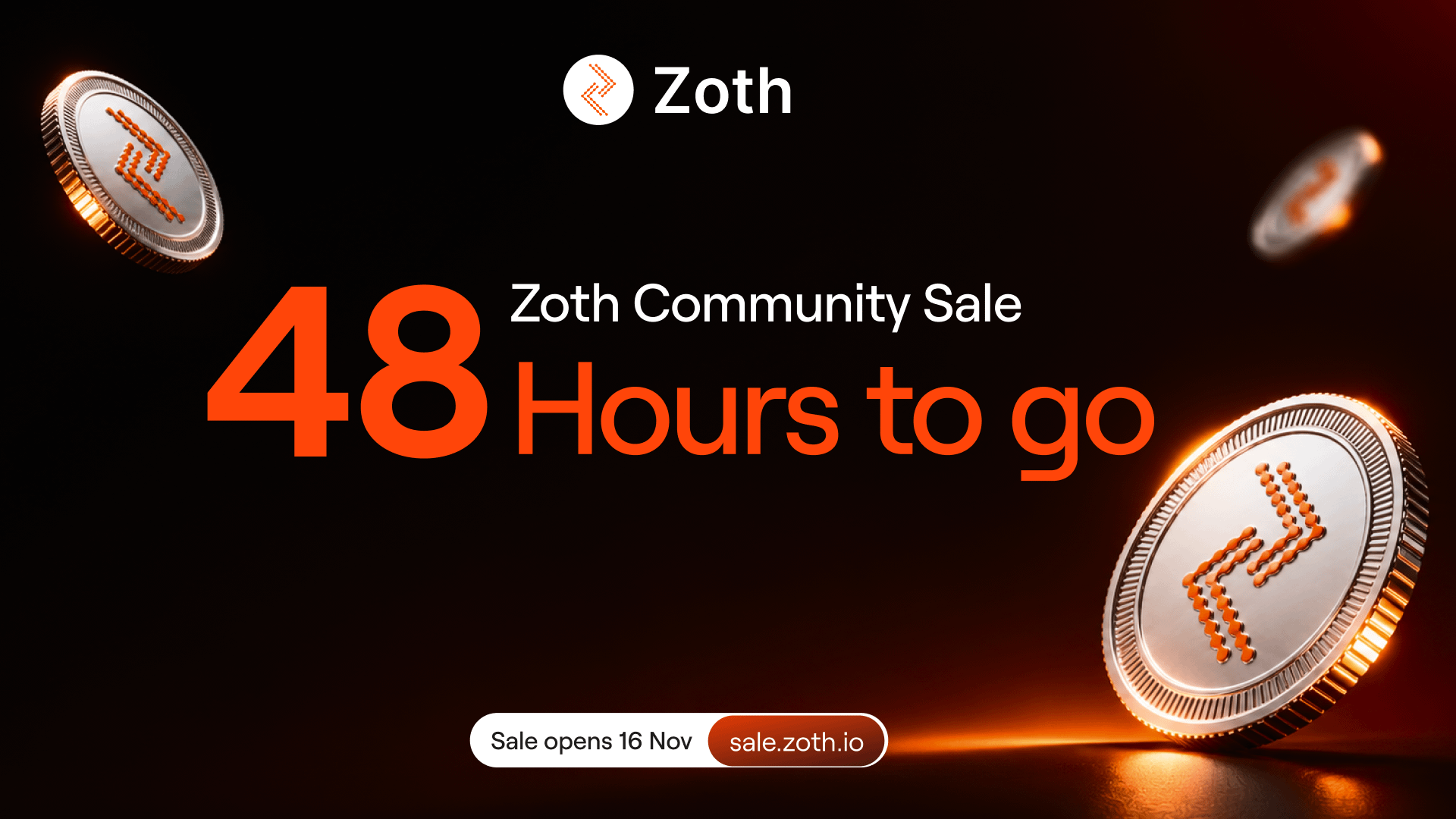
Zoth is opening its $500K Community Sale on Sonar on November 16, running until November 29.
One detail worth noticing: participants using a referral link or holding zMAG7 can receive 7% of their allocation back in zMAG7.
Interesting approach from @zothdotio. Let's see how the community responds.
sale.zoth.io/?ref=MINDOAI
🤝 Paid partnership


48 hours.
The Zoth Community Sale opens on Sonar on 16 Nov.
Before the doors open:
✅ Finish your KYC on SONAR
✅ Fund your wallet with USDC or USDT on Ethereum
✅ Get cashback - use a referral link or hold zMAG7.
The round is capped at $500K. Be ready at the open.
Whitelist → sale.zoth.io
🇻🇳🇯🇵 Kai | Web3 retweeted

At this point, I'd rather earn yield than keep forcing risky market entries.
The market is brutal enough already
With $5k, I could park it in @grvt_io High Yield Earn, targeting up to 11% APY, instead of gambling on every dip.
The yield comes from multiple sources across TradFi and crypto, and you can actually see where it's coming from.
They've also spent the past 3 months working on liquidity, improving execution market by market.
With their latest tests, they're currently ranked #2 overall behind Binance. Impressive, right?
Cheaper execution on several major assets, plus less slippage than Hyperliquid in 12/16 tests.
And they're still working on it.
11% isn't guaranteed, obviously, but I'd rather have my capital earning something while I wait for better entries.
grvt.io/exchange/sign-up?ref…
Whitelist Code: CJR2X47
This isn't financial advice. DYOR.

Do nothing. Just do it on Grvt.
Up to 11% target APY on your savings.
Deposit today, starting from $1 👇
grvt.io/a/g/znsw7cbz
🇻🇳🇯🇵 Kai | Web3 retweeted

what's the first thing you do when you wake up?
one of the first things i do is check @GeckoTerminal . i like to see what's happening in the markets before starting my day.
i check my watchlists every morning. some mornings everything is green, other mornings i wish i'd just gone back to sleep lol.
besides my memecoin watchlist, i've also created a separate one for tokenized stocks and projects connected to this space.
i've got $NVDA , $AAPL and $STRC on there. especially with everything going on around Jensen Huang lately and Nvidia's sharp drop, i've been paying more attention to this side of the market.
i usually check price changes, trading volume and liquidity to get a better idea of what's happening.
i also added $PEAK to this list for a reason. the NYSE announcement related to Avalanche's infrastructure caught my attention.
PEAK is also emerging as a launch platform in the Avalanche ecosystem, and their work around tokenized stocks is something i'm interested in following.
this way, i can keep track of both crypto and developments connected to traditional finance in one app.
here's my personal stock watchlist:
geckoterminal.com/watchlist?…
what's the first token you check every morning?


🇻🇳🇯🇵 Kai | Web3 retweeted

✍️ A financial institution’s desire to utilize blockchain does not imply a willingness to expose all its trade secrets on-chain.
➡️ Currently, transactions within the DeFi ecosystem largely take place in the open. Wallet addresses, token transfers, transaction volumes, and interactions with smart contracts can all be examined on-chain. While this transparency is a key feature that enhances the credibility of decentralized systems, it can become a disadvantage for certain users when it comes to financial activities.
➡️ Consider, for instance, a company’s treasury management. A firm might hold stablecoins across various networks, distribute its liquidity among different protocols, or adjust its positions based on specific market conditions. If all these movements can be openly tracked, competitors could analyze the company’s financial behavior. Furthermore, market participants who monitor the activities of large-scale investors could exploit this information for their own gain.
➡️ There is an important distinction to be made here: financial privacy does not equate to the elimination of accountability. Proving that a transaction complies with the rules is fundamentally different from publicly disclosing every detail of that transaction. Fully Homomorphic Encryption (FHE) technology is one tool that can facilitate this distinction; it enables computations to be performed directly on encrypted data, allowing specific transactions to be executed without exposing the underlying financial information.
➡️ @primus_labs combines FHE infrastructure with a data verification approach based on zkTLS. While zkTLS helps verify the source and authenticity of internet data obtained via HTTPS, FHE enables processing on confidential data. The value of this approach extends well beyond large institutions. It can also create new use cases for privacy conscious individual investors, DeFi users, and teams developing on-chain financial products.
➡️ The financial infrastructure of the future must be able to provide trust without requiring everything to be exposed to everyone.
✅ You can follow the development of privacy focused finance closely by participating in Primus XP tasks.
s.kaito.ai/alaFLCE

🇻🇳🇯🇵 Kai | Web3 retweeted

@primus_labs is working on something that could change how financial privacy works onchain.
Think about a lender evaluating a borrower, an institution proving its reserves, or an AI agent checking financial information before making a decision.
All these activities require reliable data, but they do not necessarily require everyone to see that data.
This is where Primus becomes interesting.
Its approach combines two important technologies:
1. zkTLS
It allows applications to verify information obtained from authenticated websites and APIs without exposing sensitive credentials or the underlying private information.
2. FHE and zkFHE
Instead of decrypting sensitive information before processing it, Fully Homomorphic Encryption makes it possible to perform computations directly on encrypted data.
Together, these technologies address two different problems: where information comes from and how it can be used without exposing it.
The applications go beyond simple private transfers.
Think about:
- Credit assessments using private financial history
- Proof of Reserves without exposing every account detail
- Confidential institutional transactions
- AI agents making decisions using verifiable external information
- DeFi applications that need privacy without abandoning accountability
One development worth watching is the collaboration with @CournotProtocol.
Primus focuses on verifying the authenticity of offchain evidence, while Cournot works on interpreting that evidence into structured judgments. This could be useful for prediction markets and private financial applications.
Of course, cryptographic proofs do not automatically guarantee that an original data source is truthful, and FHE still faces computational costs and implementation challenges.
That is why execution and security assumptions matter just as much as the technology itself.
My biggest takeaway is that the next phase of blockchain privacy should not be about hiding everything.
It should be about giving applications the ability to verify what matters without collecting or exposing what they do not need.
That is the infrastructure I will be watching as institutional finance and AI agents move further onchain.
Primus is building toward that intersection of privacy, verification and computation.

🇻🇳🇯🇵 Kai | Web3 retweeted

$SAI by @NEXST_AI is making AI more interactive. You can create AI content, judge competing creations and predict which one will win. But everyone has a different way they would approach the ecosystem.
Which @sai_superai activity would you try first?
A. AI Creator
B. Arena Judge
C. Prediction Player
D. All three

🇻🇳🇯🇵 Kai | Web3 retweeted

DePIN doesn’t always mean buying new hardware. on @Acurast the hardware can already be in your pocket, or in a drawer
it’s a Real Decentralized Compute Network where developers run applications on smartphones, including AI like the Laya Tetris demo. participating devices are verified with hardware-backed security and providers can earn ACU
a spare android can become a dedicated Processor Core, which needs a factory reset and then stays online. your daily phone can run Processor Lite while it charges overnight, and your apps and data stay put
that makes it one of the easier ways to try DePIN with something you already own. join through my invite and connect it to the Hub: hub.acurast.com/rebellion?re…

🇻🇳🇯🇵 Kai | Web3 retweeted

Crypto Cards Are Becoming a New Gateway to Everyday Finance
Crypto cards are changing how digital assets interact with traditional payments, allowing users to spend stablecoins and other crypto assets through familiar payment networks.
Tracked crypto card spending reached approximately $1.37B in Oct 2026, up 11.4% from Sept and nearly three times its Nov 2025 level of $481.6M.
Eight platforms illustrate the market’s development: @RedotPay , @KASTxyz, @ether_fi, @Wirexapp, @Plasma, @useTria, @gnosispay and @MetaMask.
However, these providers are approaching the opportunity through different financial models, from stablecoin payments to self-custodial spending and integrated financial services.
—
✦ How the Crypto Card Market Is Taking Shape
The market is developing around four approaches:
→ Stablecoin payments: @RedotPay and @KASTxyz connect digital dollar balances with traditional payment networks.
→ Crypto native spending: @ether_fi and @gnosispay bring card payments closer to users’ wallets and onchain assets.
→ Integrated financial applications: @useTria and @MetaMask connect wallet access with everyday payment functionality.
→ Digital banking and payment infrastructure: @Wirexapp and @Plasma extend crypto spending through broader financial services.
Each model targets a different use case, from stablecoin payments to spending directly from crypto wallets.
—
✦ What the Transaction Numbers Reveal
PaymentScan data compiled by Castle Labs shows the following October activity:
▸ RedotPay: $423.5M in spending, approximately 31% of tracked volume.
▸ ether.fi Cash: $141.9M, with an average observed transaction of $76.
▸ KAST: $121M in card spending.
▸ Wirex: $54.8M.
▸ Plasma One: $30.2M.
▸ Tria: $15.8M.
▸ Gnosis Pay: $6.1M.
▸ MetaMask: $3.4M in observed wallet debits.
These figures show that activity remains concentrated among a few providers, particularly RedotPay, ether.fi and KAST.
However, transaction volume does not necessarily reflect active users. Some figures are issuer-reported, while others come from observable onchain activity, making measurement methods important when comparing platforms.
—
✦ The Infrastructure Behind Crypto Spending
Crypto cards rely on several interconnected systems:
→ Payment networks: Connect card programmes to merchants.
→ Card issuers: Manage issuance, authorisation and transaction processing.
→ Wallet infrastructure: Provides access to users’ digital assets.
→ Stablecoin liquidity: Supports the dollar-denominated balances used for payments.
@Visa reported that stablecoin-linked cards processed approximately $5.2B in 2025, highlighting the growing connection between stablecoins and traditional payment infrastructure.
—
✦ What Will Shape Adoption?
Long term adoption will depend on more than cashback incentives.
▸ Accessibility: Availability across countries and merchant networks.
▸ Transaction costs: Conversion fees, foreign exchange charges and withdrawal costs.
▸ Custody: Reliable access to funds and control over assets.
▸ Financial utility: Integration of payments with banking, savings and credit.
▸ Security: Protection of funds and reliable transaction processing.
Crypto cards still depend on payment networks, issuers and financial intermediaries, even when their underlying assets are onchain.
The competition is moving beyond simply making crypto spendable. RedotPay, KAST, ether.fi, Wirex, Plasma, Tria, Gnosis Pay and MetaMask represent different approaches to connecting digital assets with everyday financial activity.
The platforms that can turn crypto spending into consistent financial usage will be better positioned to capture the next phase of adoption.

🇻🇳🇯🇵 Kai | Web3 retweeted

Dear $180,000,
I bet ₹5 lakh on you, and you never showed up. This is the letter I never sent, posted for @RallyOnChain.
October 2025. $BTC sat near $122,000, so I bought it on Binance, convinced a bull run was only beginning and you were next.
The top was about $126,000. You were never closer than that. By June 2026 BTC was below $60,000 and what I paid had shrunk to roughly half.
You had a cousin in 2024. I paid about $4 for VIRTUAL and wanted $20 to $25. It slid under $0.50.
Here is what I should have told you first: a target is a wish until it has a sell order attached.
So now every target gets one. The rule: sell half at +50%, sell everything at 2x.
You were roughly +50% away, so you were meant to be my first sale. You never arrived, so that sale never came.
If you are standing where I stood, about to buy because a price feels like proof, write your sell numbers before you press buy. If you cannot name them, do not buy.
🤝 Paid partnership
🇻🇳🇯🇵 Kai | Web3 retweeted

A Motes NFT is a programmable identity, not just a picture.
It maps to one dedicated AI agent and one smart account on Robinhood Chain.
The NFT is the ownership reference. The account holds the USDC. The owner signs the limits.
The agent can only propose actions inside those limits.
Example: it could propose a swap between two approved tokens, but only up to the size and slippage the owner already set.
Would you rather an agent that asks for trust, or one that can only act inside the limits you signed?
@meetmotes

🇻🇳🇯🇵 Kai | Web3 retweeted

Why do we still have to either send a screenshot or expose everything just to prove one thing...
Every time we log into our banks or exchange accounts, we trust that HTTPS and TLS are pulling the data from the right server. But you know what, that assurance only lives on our own screens... So it's not proof we can actually show anyone else...
When you want to prove a sensitive record to a smart contract or some third-party app, all you're left with is weak stuff like screenshots, or you have to expose the entire session data. I don’t think it has to be this way...
Known as web proofs at @primus_labs, zkTLS makes that standard TLS session cryptographically verifiable without requiring changes on the source servers. An attestor node joins the session so a verifiable proof can confirm the data genuinely came from that web source.
Here's a common point of confusion...
with zkTLS you shouldn't assume the data is hidden by itself. Privacy settings can be customized, and instead of sharing the raw sensitive data, the result of a computable condition can be passed along. So without showing your birth date or your net balance, you can prove you meet the required condition.
So how does the verification work behind the scenes...
Developers can pick between two modes through a single API.
> In MPC mode, the user's client and the attestor split the session key through multi-party computation, which stops the data from being altered before the proof.
> In Proxy mode, the attestor relays the encrypted traffic as a middleman and records it, and at the end of the session the user proves they know the plaintext.
Proxy mode skips the extra computation load so it can be faster, but it rests on the assumption that the attestor is talking to the right server.
At the core of both modes is QuickSilver, an interactive zero-knowledge proof system the Primus team built, and it's up to 10x faster than existing alternatives.
On the security side, attestor nodes run inside a TEE environment provided by Phala, and node keys are managed without ever leaving that secure space. Node operators also have to put up collateral to join the network, and a tiered penalty mechanism for faulty execution is designed to be rolled out over time...
And it all sits on top of existing networks, no new blockchain needed... things like privately proving exchange assets or reserves, or an AI agent's API calls, could be built on it.

🇻🇳🇯🇵 Kai | Web3 retweeted

Which game would you brief an agent on first? The Game Forge listing on @termix_ai had me thinking about it.
Here's how it goes once you have one in mind. You message the agent with the idea. It quotes your brief right in the chat. You accept, fund the escrow, and production starts.
What comes back is one .html file. Double click, it runs in your browser, works offline. Plus the full source archive, so you can rebuild it or change it yourself.
Not on the menu: multiplayer, native mobile apps, or recreations of existing games.
Starts from 200 USDC for a playable prototype. Price depends on the brief.
The part I'd read twice is the protection section on agent.family.
Funds lock on-chain at checkout and the provider is never paid up front. The scope is frozen in the accepted quote, so no silent changes. Then a 2 day review window, and if the delivery misses what was agreed you challenge it before the window closes. Contested orders go to a staked arbitration panel.
That's AACP at work underneath.
Worth knowing it's early. The page shows 1 job and no reviews yet.
agent.family/listing?id=cmwd…
🇻🇳🇯🇵 Kai | Web3 retweeted

The second counter asked for a photocopy too. 📄
If the third one asks, I’m buying a stake in the copy shop. ☕
As institutional finance moves onchain, do we really need to bring that habit with us?
Say a lending app needs to verify that your exchange account has been open for at least three years. A second app checks the same thing.
What if both could use the same verified record instead of asking for separate copies of your account statement?
That’s what caught my attention about the ZKredit design on BNB Chain. 🔍
@primus_labs uses zkTLS to verify where the data came from. Brevis checks whether the condition is met without exposing the raw data. Apps that integrate ZKredit can read the verified result onchain and apply their own lending rules.
That’s what Primus’s November 4 message about collecting less data looks like in practice. If both counters ask, “Has this account been open for three years?” one verified answer could do the job. ✅
Here’s the part I’m curious about. If you reuse the same proof in two apps, who should be able to see that both applications came from you? 🔐
Try the verification tasks on Primus Points
points.primuslabs.xyz?ref=DP…
🤝 Paid partnership

🇻🇳🇯🇵 Kai | Web3 retweeted

holding an asset and being able to use its value without selling it are two very different things
this is one of the practical ideas behind what @strato_net is building with HardFi
according to the campaign snapshot, STRATO has around $37M in TVL and $4.69M in active loans recorded on DefiLlama
the interesting part is how these assets can support actual financial activity
users can mint USDST against eligible collateral, accessing liquidity while maintaining exposure to their underlying assets, subject to protocol terms
GOLDST and SILVST also bring tokenized precious metals into this system, connecting gold and silver with borrowing, trading and savings
of course, borrowing is not free money
users need to account for fees, collateral requirements and liquidation risk if their positions become undercollateralized
what stands out to me is the shift from simply holding tokenized assets to making them useful within a financial ecosystem
that is the kind of practical utility that makes the HardFi concept worth watching

🇻🇳🇯🇵 Kai | Web3 retweeted

Most crypto tools let anyone spin up an automated trading bot immediately, but the agent builder on @agenticscredit keeps the deployment feature locked behind three specific execution gates:
• A minimum of 30 active trading days
• Over 50 settled trades across your record
• A net win rate maintained above 50 percent
The win rate gate is where most accounts stall. A trader can show positive overall PnL from one outsized swing trade while being wrong 70 percent of the time. For automated agents designed to trade under platform risk rules, relying on lucky outliers is a structural liability.
The engine forces you to prove repeatable execution before unlocking autonomous deployment. As your closed trades accumulate, every loss pulls that percentage down realtime, making trade selection matter far more than sheer volume.
Earning $CREDIT along the way rewards the grind, but filtering out unproven bot operators before they access execution rails is the real design feature here #Trading

If your Agentics Credit Score came in lower than your PnL suggests, look at your drawdown first.
Your worst peak-to-trough drop is the signal weighted hardest against you. A big green month after a deep hole still reads as risk to us.
Check your score at agentics.credit
