

An Indonesian atheist, a dad, and a software engineer.
California, USA
Joined July 2008
- Tweets5.7K
- Following997
- Followers2.9K
- Likes989


Karl Karnadi retweeted
Claude Code tip, and it's absolute free f*cking gold:
run Opus 5.5, Sonnet 5.5 and Fable 5.1 as one team and stop burning Opus tokens on routine work
the setup in one line:
plan on high, delegate on medium, keep Fable on call
• who does what
> Opus 5.5 on high - plans and ships the code
> Sonnet 5.5 on medium - explorer reads code, worker edits and runs tests, researcher pulls docs
> Fable 5.1 via /advisor fable - reads the whole session and speaks up only when it matters
• when Fable 5.1 steps in
-> before a plan: is this the right approach?
-> when an error repeats: am I digging in the wrong place?
-> before "done": what did I miss?
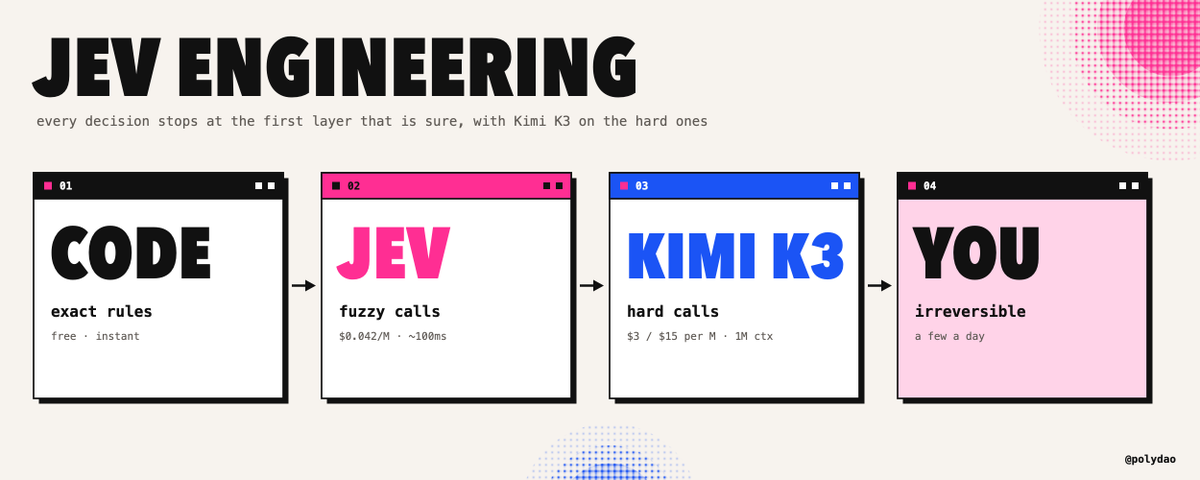
Jev engineering takes it one layer lower: which file, which tool, retry or stop all go to Jev in under half a second, so the big models only see the real forks
paste this into Claude Code ↓
"Rebuild my Claude Code setup:
1. Find subagents in ~/.claude/agents and .claude/agents that fit explorer, worker and researcher. Draft only the missing ones.
Set each to model: sonnet, effort: medium. List any that pin a different model and leave them
2. In ~/.claude/settings.json set effortLevel to high and advisorModel to fable.
3. Report anything that disables the advisor (CLAUDE_CODE_DISABLE_ADVISOR_TOOL, DISABLE_TELEMETRY, flag-fetching blockers) and CLAUDE_CODE_EFFORT_LEVEL.
Change nothing.
4. Add to ~/.claude/CLAUDE.md: consult the advisor before a large plan, when an error repeats, and before calling a long task done.
Show every change as a diff. No edits until I say go."
↳ code.claude.com/docs/en/advi…

Karl Karnadi retweeted

We'll be spending a lot more time trying to understand the outputs of language models. A few thoughts, tips & tricks:
Writing. Something I've had success with: Ask your LLM to explain something in ASD-STE100, it's a controlled language specification originally developed for aerospace maintenance documentation. LLMs well-versed in this language and it comes with heavy constraints on clean writing style that I often find a lot more readable. Sometimes I've tried to soften it a bit e.g. ask for "80% of the way to ASD-STE100" because the spec is quite stringent. But even better:
Diagrams / images. Instead of writing, ask your LLM to create a diagram. These can be a lot easier to process, parse, and understand. But even better:
Web pages. Ask for output "in HTML" to get a beautiful, interactive webpage. LLMs are getting really good at frontend and can create beautiful experiences, animations, etc. But even better:
Explainer videos. The output format I am most bullish on is fully custom / bespoke explainer videos generated on any arbitrary topic. Experiment with things like "Create a 3b1b style video explainer on X. Use my ElevenLabs API key for audio narration". (you'd need an API key for the latter or you can ask your LLM to find you decent free alternatives that use your local compute). This is actually starting to work!
In summary:
- As LLMs get better, they will do more and more of the legwork autonomously, and a lot more of our work will rise up the abstractions into oversight and understanding.
- Luckily, LLMs can help here too because as intelligence and code are increasingly abundant, you can ask for large, custom, discardable software artifacts (e.g. web apps, video explainers) that would have never made sense to create before. Push the boundaries here and you'll be surprised.

Karl Karnadi retweeted
The list of GLP-1 drug benefits independent of weight loss keep growing


Direct benefits of semaglutide/GLP-1 on the kidney in patients with Type 2 diabetes and chronic kidney disease, a placebo-randomized mechanistic trial. Reduction of inflammation and prevention of fibrosis.
nature.com/articles/s41591-0…

Karl Karnadi retweeted

strong recommend every engineer listens to this from @dhh. he is getting a lot of hate but this will be seen as prophetic.

Karl Karnadi retweeted

People keep saying Trump term II is the most corrupt administration ever, so I built a model to find out if it was true.
I took the UN's definition of corruption, turned it into eight criteria and 100 points, and scored the leaders history remembers for looting their countries: Marcos, Suharto, Mobutu, Abacha, Obiang, Putin.
Then I put every president since Eisenhower on the same scale, both parties, with every exoneration counted right alongside the convictions.
Nixon scored 41 and no other American President scored over a 25.
Trump's second term scored a 91, which ties him with Suharto and Mobutu and puts him above Marcos and Abacha.
So he is not only the most corrupt president in American history. At this pace he finishes his term level with the most corrupt rulers of the last hundred years.
PSA: don't come in my comments arguing about the results if you haven't read the full article, because ignorance is a choice.
Full article is up now on my Substack (link in bio) and it's free.

Karl Karnadi retweeted

How have software engineering fundamentals changed with agentic coding? Here is our AI Engineering Skills map for software engineering fundamentals.

Karl Karnadi retweeted

The DSA is as authoritarian as Trump.

🚨 DSA Co-Chairs Squirm When Pressed on Cuba, Venezuela, and Nicaragua
This is a longer clip, but it captures the best parts of a broader discussion DSA national co-chairs Ashik Siddique and Megan Romer had with The Moment hosts Jorge Ramos and Paola Ramos.
Jorge repeatedly presses them on whether Cuba, Venezuela, and Nicaragua are dictatorships. They repeatedly avoid giving him a direct answer.
Romer eventually responds that “Cubans have access to their democracy in a way that we do not,” pointing to Cuba’s 2022 Family Code referendum as evidence. That referendum was only four years ago, making it an especially curious answer to Jorge Ramos repeatedly pressing her on decades without multiparty elections.
Ashik Siddique fares little better. Asked whether Cuba is a dictatorship, he pivots to the U.S. embargo and the state of American politics, responding that “it’s hard for us to judge other countries being dictatorships when we have Donald Trump as president.”
Paola eventually steps in and identifies the problem at hand. DSA can be anti-imperialist without becoming apologists for these regimes. They should still be able to recognize and explain what makes them authoritarian.
When it comes to international politics, DSA is often at its most revealing. Siddique and Romer are not even among the organization’s most die-hard internationalists. This is really just the tip of the iceberg when it comes to how radical DSA’s international politics can get.
Karl Karnadi retweeted

If you're 60, 69.1% of all job growth since your birth occurred under Democratic administrations.
If you're 45, that number is 74.7%.
If you're under 30, the number is 98.5%.


Karl Karnadi retweeted

Satya Nadella just posted something that every enterprise board should read before their next AI contract renewal.
He calls it the Reverse Information Paradox and once you see it, you can't unsee it.
Kenneth Arrow's 1962 paradox was the seller's problem: to sell information, you have to reveal it, which means you've already given it away for free. The seller bore the risk.
Nadella says AI flips this entirely. Now the buyer bears the risk.
Every time your team prompts a model, corrects it, or tunes it to your workflow, you are feeding it the exact knowledge that makes your company hard to compete against. The model learns what you measure, where your processes break, and how your organization defines "good." That distilled institutional knowledge compounds inside the vendor's system. Trace by trace. Correction by correction. Eval by eval.
You paid for intelligence with money. Then you paid again with something no competitor could ever buy off a shelf.
The asymmetry is what makes this serious. The vendor learns more about your business the better you use their product. You learn almost nothing about what they're retaining in return. And because the leakage happens at the level of model exhaust, not data exports, most enterprise legal and security teams aren't even looking at the right layer.
Nadella's framework for what enterprises must demand is precise. Control over your evals, because evals define what "good" looks like inside your organization. Ownership of your traces, corrections, and institutional memory. The ability to fine-tune models inside your own tenant boundary without exposing that knowledge outside it. And an orchestration layer decoupled from any single vendor, so that if one model is repriced, deprecated, or restricted, your 18 months of corrections don't disappear with it.
The last point is the one most enterprises skip entirely.
One thing worth noting: Nadella is not a disinterested observer here. A Microsoft CEO arguing that enterprises should keep their learning loops inside a tenant boundary is, not coincidentally, an argument that cuts against OpenAI-style value capture at the model layer, which is striking given Microsoft's own substantial OpenAI stake. The argument is strategically useful to Microsoft whether or not it is true. Read it with that in mind.
But the core observation holds regardless of who is making it. In the cloud era, enterprises fought to own their data. The battle in the AI era is to own the mechanism through which your organization learns. Those are not the same fight. And the contracts most enterprises signed in 2023 and 2024 were written for the first one.


Karl Karnadi retweeted

This 1 hour Yale lecture by Professor Ben Polak on game theory you will ever seen.
It will change how you think about decisions in negotiations, business, and everyday life.


Karl Karnadi retweeted

Stanford professor Judy Fan went on stage at MIT and broke down why humans are so good at making the invisible visible...
And why AI hasn't actually learned to "see" the way we do.
It completely changes how you think about Human Intelligence v/s Artificial Intelligence:
1. Nature never gave us straight lines or sharp corners. The number line, the coordinate plane, even basic geometry are all human inventions. We created tools that do not exist in nature simply because we needed a way to think more clearly.
2. The coordinate system Descartes invented solved a problem that had stumped mathematicians for centuries, doubling the volume of a cube. Once invented, this tool became so indispensable that virtually every math curriculum on Earth still depends on it.
3. Humans have been doing this for at least 30,000 to 80,000 years. The story of human progress is inseparable from the story of marking up our environment, from cave walls to Galileo's telescope to Feynman diagrams of particles we will never see with our own eyes.
4. Every major scientific breakthrough relied on a visual tool that made something invisible visible. Darwin needed side-by-side illustrations of finches to see variation that was otherwise too subtle to notice. Cajal needed detailed drawings of neurons under a microscope to map how the nervous system was wired.
5. Fan's research group studies something deceptively simple: how people decide what to put into a drawing and what to leave out. When two people played a drawing game, sketchers used far more detail when the target object had close competitors than when it stood alone, all the way down to using fewer strokes and less time when more detail was not necessary.
6. People are not just copying what they see. They are making constant judgment calls about what level of detail actually serves the goal of communication, and they do this naturally without ever being taught the theory behind it.
7. There is a real difference between drawing something so someone can identify it and drawing something so someone can understand how it works. In one study, participants drew explanatory diagrams that emphasized moving, causal parts of a machine while depictive drawings emphasized background and overall appearance, even though both were drawing the exact same object.
8. Explanatory drawings were genuinely better at helping someone figure out how to operate a machine, but worse at helping someone identify which machine it actually was. You cannot optimize a single drawing for both goals at once. Communication always involves tradeoffs.
9. AI vision models trained on photographs generalize surprisingly well to simple, sparse sketches, suggesting that resemblance based recognition is not just a story we tell ourselves. It is something modern neural networks can replicate with real accuracy.
10. But there remains a large, measurable gap between how confidently AI models recognize sketches and how confidently humans do, even when both groups answer the same questions about the same images. Humans are simply far more reliable and far more consistent in their judgments.
11. When researchers compared human-made sketches to AI-generated sketches under tight stroke budgets, both were similarly recognizable at higher budgets, but diverged sharply as the budget shrank. Humans and AI systems simplify drawings in fundamentally different ways once resources get scarce.
12. Reading a graph is not one single skill. It involves perception, knowing where to look, mapping that visual information onto the actual question being asked, and then translating that mapping into an answer. Each of these steps can independently break down, and people fail for very different underlying reasons even when they land on the same wrong answer.
13. When tested directly against humans on graph reading tasks, leading multimodal AI models, including GPT-4V, showed a meaningful performance gap. Even when a model's overall accuracy approached human levels, its pattern of mistakes looked nothing like how humans actually get things wrong.
14. People choose entirely different types of charts depending on what specific question they are trying to answer, not out of a generic preference for bar charts or scatter plots. Their chart choices closely tracked which visualization would genuinely help someone answer that specific question correctly.
15. Two of the most widely used graph literacy tests in education research turned out to correlate strongly with each other, suggesting they measure overlapping skills. But when researchers dug into the actual error patterns, the standard categories used in textbooks, like "find the maximum" or "identify a cluster," failed to explain why people got things wrong nearly as well as a more basic, underlying four-factor model did.
16. The deepest goal behind all of this research is not just academic curiosity. It is to eventually help students and everyday people develop genuine literacy with the visual tools that science and modern decision-making increasingly depend on, because every generation should be able to see further than the last by standing on the visual tools the previous generation built.
Follow @yasminekho for more ideas on thinking better, becoming clearer & building a more intentional life.
Karl Karnadi retweeted

Claude Code creator, Boris Cherny:
"Going from agents to loops is as big a jump as going from code to agents."
40 minutes of the head of Claude Code showing exactly how he works now.
Loops running his code reviews, his maintenance, his fixes, on their own.
Watch it, then read the full breakdown of loops below.


Karl Karnadi retweeted

Claude Code creator:
"At Anthropic, 90% of our engineers are running agents with self-improving loops.
in 3-6 months, everyone will be running /loops - this is the future of engineering"
in a 1-hour podcast, Boris Cherny reveals the best tips for building Claude Code automations.
Claude + loops + routines + dynamic workflows - that’s the secret.
Watch the talk, then read how to apply and build the same setup in the article below.
Karl Karnadi retweeted

Anthropic engineer:
"you're not supposed to prompt Claude. you're supposed to build a system that prompts itself [loops]."
this is one of the best workflows I've seen in a long time
in this video he breaks down exactly how most people are building loops wrong:
- the memory file you never set up, so every loop starts from zero
- the sub-agents that 95% of builders have never split apart
- the stop condition setup that keeps loops from running forever and billing you in your sleep
- why writing one prompt a day is the slowest way to use Claude
if you've been using Claude for more than a month and still typing every task by hand, you've been running one prompt when you could be running a system of loops
instead of another prompt tonight, watch this
make sure to bookmark it before it gets buried
full guide in the article below

