

Ph.D. Candidate @uvadatascience | Law+AI ⚖️ | NLP 🤖| Views are mine | She/her/ella
United States
Joined December 2020
- Tweets263
- Following394
- Followers108
- Likes1.6K



Pinned Tweet
Thrilled to share our #EMNLP2025 paper!
𝐌𝐎𝐃𝐄𝐋𝐂𝐈𝐓𝐈𝐙𝐄𝐍𝐒: Community-informed toxicity detection 6.8K posts, 40K diverse annotations show toxicity isn't universal—it's shaped by norms, identity & context.
📄arxiv.org/pdf/2507.05455

1/ 🧵
New #EMNLP2025 Paper !!
Toxicity detection is subjective; shaped by norms, identity, & context. Existing models and dataset overlook this nuance.
Enter MODELCITIZENS: a new dataset designed to address this.
✔️ 6.8K posts, 40K annotations across diverse groups
✔️ Context-augmented scenarios
✔️ New finetuned models (LLAMACITIZEN-8B, GEMMACITIZEN-12B) beat GPT-4o-mini by 5.5%
(🚨 Offensive Content Warning)
Karolina Naranjo retweeted

I think my naive and likely unhelpful advice is to take courses which cover other regulated industries (e.g., pharmaceuticals/medical devices, banking, etc.). Many of the challenges involved in AI regulatory design aren't unique to AI, and studying other regimes can provide interesting lessons.

Receiving a steady stream of emails from "non-technical" law students asking for guidance on how to get involved in AI policy - here's my **concise** list of recommendations.
Please add to it...this will become an Appleseed AI post.
Eager to hear from folks like @DoniBloomfield, @sayashk, @NeelGuha, @inspiredcat and others who have found a way to thrive at the intersection of AI & the law / policy.
(1) we're all technical now. Write that on a sticky note and put it on your mirror.
Stop selling yourself short.
Fake it until you make it.
You can and must dive into the technical weeds to truly add value to this space. Folks who can "speak AI" and "speak law" will be in high demand for the foreseeable future.
(2) treat learning about AI like learning another language - immerse yourself. Take a @BlueDotImpact course, read through @Google's free materials on AI, subscribe to @natolambert & @rasbt and read everything they write. When you do not understand something, chase down whatever information you need to learn to grasp it.
(3) use the tools.
(4) use the tools.
(5) use the tools.
(6) talk about the tools with other people (professors, students, tech folks in your community) and learn what they are building. Then go build it for yourself.
(7) repeat steps 3-5.
(8) follow @hlntnr, @janet_e_egan, @anton_d_leicht, @deanwball, @hamandcheese, and anyone they retweet
(9) read every blog post from @OpenAI, @AnthropicAI, @GoogleDeepMind (especially the really technical ones)
(10) listen to @scaling_laws (what? I'm a shameless academic after all).
(11) apply to join @GovAIOrg, @law_ai_, @CSETGeorgetown, @HorizonIPS, or any org in that universe. Get your foot in the door.
(12) write about AI.
(13) critically analyze AI policy. Then compare and contrast what @CharlieBull0ck & @AdamThierer had to say about it.
(14) call me. Better yet, come to Austin and I'll buy you breakfast tacos.
(15) join the AI Opportunity Inventory and help analyze AI tools intended to solve public policy problems (link in next tweet).
(16) join an AI club or start one.
(17) pat yourself on the back because you're asking the right questions! Stay relentlessly curious. Just start doing stuff. Consider this your invitation to join everyone trying to figure this all out.
Karolina Naranjo retweeted

🧵 How should we think about the field of law and AI?
HAI senior fellows Daniel Ho, @JulianNyarko, and @chrmanning and HAI Managing Director @vanessaparli have co-edited a special feature for @PNASNews that explores the appropriate role of AI in law and the role that law has in helping to govern tech.
Ft. Cover Artist: Stanford HAI staff, Chris Ellis (1/3) ↘️

Karolina Naranjo retweeted

Great to see @nllpworkshop already celebrating its 8th occurrence, this time in Budapest collocated with @emnlpmeeting!
Go submit your legal AI papers there 🔥
Kudos to the organizing committee for making this happen year after year!
@nikaletras (University of Sheffield), Leslie Barrett (Bloomberg), @KiddoThe2B (University of Copenhagen), @CatalinaGoanta (Utrecht University), Daniel Preotiuc-Pietro (Bloomberg), @gerasimoss (Maastricht University), @shanshan_xu3 (University of Copenhagen)

Karolina Naranjo retweeted

Much like the switch in 2025 from language models to reasoning models, we think 2026 will be all about the switch to Recursive Language Models (RLMs).
It turns out that models can be far more powerful if you allow them to treat *their own prompts* as an object in an external environment, which they understand and manipulate by writing code that invokes LLMs!
Our full paper on RLMs is now available—with much more expansive experiments compared to our initial blogpost from October 2025!
arxiv.org/pdf/2512.24601

Karolina Naranjo retweeted

Stop using LoRA for RLVR!!!
New paper released👉Evaluating Parameter Efficient Methods for RLVR
📖Alphaxiv: alphaxiv.org/abs/2512.23165
💻Github: github.com/MikaStars39/PeRL
Is standard LoRA truly the optimal choice for Reinforcement Learning?. We present the first large-scale evaluation of over 12 PEFT methodologies using the DeepSeek-R1-Distill family on complex mathematical reasoning benchmarks.
Key Finding: Standard LoRA is suboptimal. Structural variants such as DoRA, AdaLoRA, and MiSS consistently outperform standard LoRA. Notably, DoRA (46.6% avg. accuracy) even surpasses full-parameter fine-tuning (44.9%) across multiple benchmarks.
The failure of SVD-based initialization.
Strategies like PiSSA and MiLORA experience significant performance degradation or total training collapse. This is due to a fundamental "spectral misalignment": these methods force updates on principal components, while RLVR intrinsically operates in the off-principal regime.
The Expressivity Floor.
While RLVR can tolerate moderate parameter reduction, extreme compression (e.g., VeRA, IA³, or Rank-1 adapters) creates an information bottleneck. Reasoning tasks require a minimum threshold of trainable capacity to successfully reorient policy circuits.
Recommendations for the community:
a. Move beyond the default adoption of standard LoRA.
b. Prioritize geometry-aware adapters like DoRA that decouple magnitude and direction.
c. Avoid SVD-informed initializations for RL tasks.

Karolina Naranjo retweeted

Efficiency and performance tweaks in the transformer architecture usually focus(ed) on the normalization, attention, and FFN modules.
Well, here is a holiday gift from DeepSeek (arxiv.org/abs/2512.24880).
Finally some improvements of the residual path as well.

Join us at the #RegulatableML workshop at #NeurIPS2025 #NeurIPSanDiego to bridge the gap between AI regulation and real-world practice!
🗓 Date: Dec 7, 2025
⏰ Time: 8:45 am - 5:30 pm (PST)
📍 Location: Upper Level Room 1AB, San Diego, CA
More info: regulatableml.github.io/

ALT Keynote speakers


𝐏𝐚𝐧𝐞𝐥: Get ready for "The AI Wars: Regulation, Open Science, and the Race for Global Power", featuring Rich Caruana, Jiahao Chen @acidflask , Ian Eisenberg, Avijit Ghosh @evijit, and Bo Li @uiuc_aisecure .
This event wouldn't be possible without our incredible organizing team: @_cagarwal, @jiaqiMa, Sarah Tan, @hima_lakkaraju, Junwei Deng, @PingbangHu, Eileanor LaRocco, and @ShichangZhang
See you in Room 1AB on Dec 7th!
#RegulatableML #NeurIPS2025 #NeurIPSanDiego
#neurips2025 #NeurIPS Call for AI researchers!
Attend the 𝟑𝐫𝐝 𝐑𝐞𝐠𝐮𝐥𝐚𝐭𝐚𝐛𝐥𝐞 𝐌𝐋 𝐖𝐨𝐫𝐤𝐬𝐡𝐨𝐩, Dec 7, San Diego, CA. Bridging ML safety research with regulatory frameworks.
Join us! 🔗regulatableml.github.io/
Karolina Naranjo retweeted

Today, the UVA School of Data Science was packed with new and familiar faces for our annual Datapalooza event. A special thank you to our keynote speaker Danielle Citron and all of our presenters for Datapalooza 2025: Truth and Accountability in the Age of AI.

ALT Danielle Citron delivers her keynote address to an audience.

ALT Student smiles while seated listening to presenter in a classroom.

ALT Student hands staff a Datapalooza shirt.

ALT Audience member smiles while listening to speaker.


Karolina Naranjo retweeted

Also not to be missed: Sophie will be presenting our poster for ModelCitizens the day before (session 2, 11-12:30pm).

Karolina Naranjo retweeted
⏰✨ Good news for all the fashionably late submitters out there! We’ve extended the deadline for the First International Workshop on Data Mining and AI for Law (DMAIL 2025) 🎉.
Instead of September 1, you now have until September 10 to polish, perfect, and procrastinate (just a little bit longer 😉).
So if your paper was 90% ready, congrats—it’s now magically 100% on time. 🚀
🔗 Workshop details: dmail-workshop.github.io/DMA…

Big shoutout to the dream team! 🤩@suvarna_ashima for her outstanding leadership, our fantastic collaborators @christinachanc @hamidpalangi & Sophie, and huge thanks to our professors @GabrielSaadia & @tom_hartvigsen for their invaluable guidance!
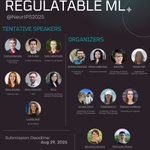
A quick reminder: the 3rd Workshop on Regulatable ML at @NeurIPSConf is still accepting submissions!
📝 Papers — Extended deadline: August 29
Submit your work here: lnkd.in/efAvTUMn
Reviewers' application form: lnkd.in/eNyfXzxd
#NeurIPS2025 #Papers #Reviewers

Karolina Naranjo retweeted

Thrilled to share our new paper!
1/ 🧵
New #EMNLP2025 Paper !!
Toxicity detection is subjective; shaped by norms, identity, & context. Existing models and dataset overlook this nuance.
Enter MODELCITIZENS: a new dataset designed to address this.
✔️ 6.8K posts, 40K annotations across diverse groups
✔️ Context-augmented scenarios
✔️ New finetuned models (LLAMACITIZEN-8B, GEMMACITIZEN-12B) beat GPT-4o-mini by 5.5%
(🚨 Offensive Content Warning)