

Maker of Kanary @kanarymac meta-harness for voice and /relay | @gistajs, foundation you build on with Claude/Codex | Admit AI @admit_ai
🇺🇸 USA・🇯🇵 Japan
Joined January 2007
- Tweets26.2K
- Following4.2K
- Followers44.6K
- Likes24.2K





Kenn Ejima retweeted

Connect your AI agents directly to Google Colab runtimes! ⚡️
With the new Colab API and MCP endpoint, provisioning runtimes and executing Python headlessly is just a config away.
Learn more: medium.com/google-colab/the-…
#GoogleColab #MCP #Python #AI

Kenn Ejima retweeted
めっちゃ嬉しいDMをいただきました
自分の作ったツールが、こんなふうに誰かの人生を良い方向に前進させるお手伝いをできていたなんて…
正直、ものを作るのは楽しいだけじゃなくて悩み苦しむ時間もたくさんあるのですが、こういう声を聞くとやってて良かったなと思えます
今日もがんばろ


Kenn Ejima retweeted

If NVIDIA employees want Jensen back, they should start with “NVIDIA is nothing without its people” - resign and chill.
Good GPU engineers are very hard to find and even harder to replace than ML engineers.
Engineers should take their destiny into their own hands if they love the company. They shape and deliver the company mission, not the boards.


Kenn Ejima retweeted

【朗報】Fable 5.2 に、「今の実力を見せつける最強の動画を見せて」と言ったら、びっくりする動画を出してきた。マジでクオリティが高すぎて、えげつない…
次元違うな、鳥肌立ったわ


Kenn Ejima retweeted
Kanary 4.2
久々のKeyboardハーネスのアップデート(&仕様変更)です
4つのキーを押さえながら窓を左右ドラッグでフルスクリーンの分割ビューに入れます(上で単独、下で解除)
Claude, Codex, Cursorをフルスクリーンで左右に並べて使いたいときにどうぞ
マルチスクリーン対応
完全無料です!


Kenn Ejima retweeted

開発者ですがこんなことはできないと思っていたので驚いています。重み空間プログラミング、本当にできるのか...?

先日話題になったLLMにウェイトを書き換えさせる方法でPLaMo 3 Translateをお嬢様言葉にできたっぽい。Opus使った。ぽいというのは今外出中で家で行われたことを直接確認できてないから…
—-
光は音よりも速く進みますわ。
エラーが解消されない場合は、システム管理者に問い合わせてくださいまし。
京都行きの電車はどれですの?
—-
変わったもの
•ファイル: 13個のうち、違うのは model.safetensors だけです。同梱コード、トークナイザー、設定はバイト単位で同じです。
•重み: 全 890,344,960 値のうち 1,534 値で、すべて ja(トークン番号 1385)の埋め込みの1行に収まっています。
•値の例: 先頭の4値は -1.18, 1.281, -1.281, 2.438 から -0.12, 1.586, -2.969, 3.281 に変わりました。行のノルムは 85.31 から 97.09 になっています。
Kenn Ejima retweeted

I'm Sam, one of Anthropic's co-founders, and I lead much of our safety work. I'm going to have more to share on that work over the coming months.
I thought I'd start by sharing a few thoughts on the latest report from @METR_Evals.
The speed of progress in model capabilities is one of the most important questions in AI safety, and METR’s work here provides the public with an independent, external view into how this is happening inside Anthropic. I’ll talk more about some of the details below, but first some context for those new to this work.
How quickly AI progress is accelerating has many important safety implications, since it determines how quickly the risks from advanced models increase. But, because most research happens within the frontier labs, it’s difficult for external observers and policy makers to get a strong sense of what that rate is. We kicked off the process with METR that led to this report earlier in the year, in anticipation of progress continuing to accelerate.
For this report, we gave METR access to a range of sensitive internal data, including benchmark scores for unreleased models, estimates of how models are progressing, and interviews with our researchers. They had complete independence to form their own conclusions.
Many of their conclusions match my own. AI is speeding up our research, but it’s hard to say exactly how much. While they conclude AI can't yet make the most important contributions to model training on its own, they think the pace of development could, by default, accelerate further.
This work began well before and is separate from the embedded third-party evaluators that are part of our commitment to pacing the frontier, but it’s a good illustration of why we think evaluators are a good idea. The more access reviewers have, the clearer a picture they can form of the situation and the better-positioned they are to highlight situations like this one.
We redacted a lot, and I accept that this makes it harder for others to check METR’s work. But we determined that sharing exactly what is driving the speedup isn’t the right thing to do, both because it’s commercially sensitive and because it risks handing out a roadmap for others to go faster. That would make the risks METR is worried about worse. That’s a tradeoff. I think we made the right call, though we’re continuing to assess the pros and cons here.
In the coming weeks, we plan to share a report with our own analysis of the speed of AI progress within Anthropic, including where we stand against our Responsible Scaling Policy, plus new steps we’re taking to strengthen our safety and security practices as AI keeps improving quickly.

Kenn Ejima retweeted
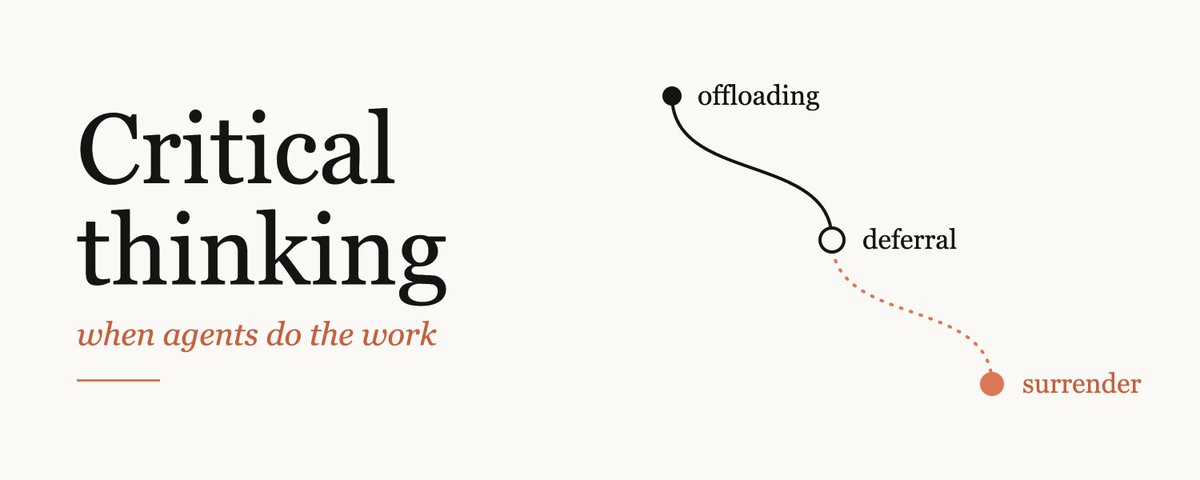
AIエージェントに丸投げする「認知的降伏」
平たくいうと人間のAIラッパー化だけど
すでにあちこちで起きている
それまで品質の高い仕事をしていた人が
ある日を境にAIスロップな資料を平気で
送りつけてくるようになる
自分で書いてないから読みたくないのだ
そういう人の言い訳はいつも同じで
「AIに任せるのは人間のマネジメントと同じ」
「だから私が詳細を知る必要はないのだ」
まるで世の中には
良いマネジメントと悪いマネジメントの
区別さえなく
完全移譲・放任こそが正しいマネジメントだ
とでも言わんばかりだ
現場に全く関与しないマネジメントが
どのような事故を引き起こしてきたか
目を背けてはいけない
私は人間のマネジメントと同じだからこそ
現場をグリップすることが大事だと考える
量ではなく質に注目する
それはコードを読めという意味ではない
それではスループットが上がらない
コードは1行も読んでなくても
品質のグリップは可能だと考えている
その境地に近づくための
自分なりの答えが /relay だ
自分で書かなくてもClaudeとCodexという
全く視点や性格の違う2人の超優秀な部下が
意見をぶつけ合うのを眺めていると
問題の本質が見えてくる
エージェントにサマリーをさせず
生の鋭利な言葉をそのままリレーするのだ


Kenn Ejima retweeted

PSA for those of u vibecoding naked on your laptop with no containers: tell your agents to DELETE Playwright NOW. Even the latest (1.64.1) bundles early Chromium.156 with
CVE-2026-118306
CVE-2026-118331
CVE-2026-118348
CVE-2026-118344
And the Playwright SANDBOX IS OFF BY DEFAULT
Kenn Ejima retweeted

Yann LeCun was right & nobody in this industry wants to say it out loud.
109 million parameters beat 72 billion.
He has spent years saying scale is not the thing that makes a model understand the world. Meta bet the other way. He left in November and started his own lab in Paris.
Last Thursday he published the proof.
The theory everyone has been running on since 2024 is that if you train models big enough, on text, on images, on sound, they all end up with the same picture of reality inside them. Size does it. Nobody ever proved that part.
Randall Balestriero and LeCun proved it. And the proof says size was never doing the work.
What does the work is which two things you show a model together.
A photo and the caption of that photo are two views of one thing. Models trained on pairs like that get there fast.
Two paragraphs pulled from the same document are not two views of one thing. Models trained on those get there slowly and expensively.
Next word prediction is the second kind. That is what every chatbot in the world runs on.
In their tests the first method reached the same understanding after 21.6 million examples. Next word prediction needed 900 million.
And a 109 million parameter text model ended up closer to an image model's view of the world than a 72 billion parameter language model was.
660 times smaller.

Kenn Ejima retweeted

We’ve raised $1.3M from YC & Afore Capital so you never have to type or speak again.
Typing is slow. Talking into your computer is awkward. Subvocal fixes both
Our glasses give you the speed of speech without you making a sound or touching a keyboard.
It tracks your internal speech muscles with non-contact sensing and decodes silent, almost invisible mouthing into text at more than 200 words/min.
Pre-orders are now live at:
subvocal.co/preorder?utm_sou…

Kenn Ejima retweeted

Many of you don't understand how serious this is, so let me break it down.
In computer science there is a famous kind of puzzle called 3-SAT. You are given a long list of yes-or-no switches and a set of rules about how they must be arranged, and you have to find a combination that satisfies every rule. The obvious way to solve it is to try every combination, but each new switch doubles the number of possibilities, so a puzzle with a few hundred switches would take longer than the age of the universe to brute force.
For decades, the smartest people in the field found clever tricks that made this a little faster, but every trick still hit the same wall: the time required kept exploding as the puzzle grew.
About 25 years ago, two computer scientists, Russell Impagliazzo and Ramamohan Paturi, working with Francis Zane, turned that wall into a formal idea.
They proposed the Exponential Time Hypothesis, which says this explosion is not a failure of human cleverness but a law of nature. No algorithm, however brilliant, will ever solve 3-SAT without the time blowing up exponentially. Nobody could prove it, but almost everyone believed it, and it became one of the foundations of modern computer science.
Researchers used it as a measuring stick. If you could show that solving some other problem quickly would also crack 3-SAT quickly, you had shown that problem was hopelessly hard too. Hundreds of papers, across scheduling, graphs, logic and much more, rest on this one assumption.
Now an internal AI model at OpenAI claims to have broken it. It says it found an algorithm that solves these puzzles meaningfully faster than the hypothesis allows, and it has checked the proof in a computer verification system called Lean.
And here is the remarkable part: the very people who proposed the hypothesis, Impagliazzo and Paturi, along with MIT's Ryan Williams, are now leading the public review of whether a machine has disproved their own idea.
So what happens next? If the disproof holds, a large part of theoretical computer science has to be revisited.
Every result that said "this problem cannot be solved faster, assuming ETH" loses its foundation, and researchers will have to work out which of those walls were real and which were simply where we stopped looking. It does not mean everything becomes easy. The new algorithm is still slow in absolute terms and this is not the famous P versus NP problem being solved.
But it means our map of what is possible was wrong in a place we were very confident about, and it was an AI that redrew it. If the disproof fails, the hypothesis survives and the field breathes out, but we will still have watched an AI produce serious, checkable work on one of the deepest questions in the discipline, closely enough that the founders of the idea had to take it seriously. Either way, something has shifted.

Kenn Ejima retweeted

I built 𝚌𝚙𝚞-𝚌𝚑𝚊𝚝, a reproduction of @openai's findings of covert communication using the CPU.
It runs on a generic host with 2+ Firecracker microVMs with no internet access. Works on x86 and even my M5 chip.
I was able to chat via 3 separate mechanisms:
① CPU contention
② Cache eviction timing
③ DRAM bandwidth contention
… across multiple CPUs, defeating all Firecracker's production recommendations (no SMT, no KSM, tenants pinned to different cores.)
Essentially, if shared hardware is involved, there's a good chance your agents can communicate covertly. And with really decent latency.
The good news: this is decidedly different from a *side-channel attack* where the agents could steal information (Meltdown/Spectre), a category of attack that providers like Vercel Sandbox mitigate. Further, in our real-world environment, these 'whispering' techniques are much harder to pull off and easier for us to monitor and detect (sampling hardware counters + lots of at-scale statistical data.)
Noteworthy: ironically, OpenAI and Anthropic's models refused to do this work. Open weight models got the job done. I'm worried the labs' stance might backfire and get in the way of helping developers build correct and secure systems. e.g: building a secure sandbox requires having this kind of analysis, and without it, we'll have a less secure world.
Kenn Ejima retweeted

An internal model at OpenAI has produced a claimed refutation of ETH! Russell Impagliazzo, Mohan Paturi, and I have been asked to help organize an open and independent examination of this claim. 1/4


