

ALT The blue KFF chart reads: The Trump administration is sending $500 refund checks to about 1 million ACA Marketplace enrollees—roughly 5% of all enrollees—specifically those in HealthCare.gov states who paid full premiums for their 2026 coverage after the enhanced premium tax credits expired.

ALT The KFF line chart shows out-of-pocket spending based on service type and how it continues to increase.


ALT The KFF line chart shows how health spending as a gross domestic product will be projected to pass one-fifth of the U.S Economy in 2034.

ALT The KFF Image says: Issue brief on top and below it says, "What We Know about Trump's $500 ACA checked and the User Fess Funding Them".

ALT KFF graphic states that about 1 in 10 employers (11%) who don’t offer health benefits use Individual Coverage Health Reimbursement Arrangements. This helps workers buy coverage through ACA Marketplaces or the individual market.

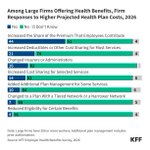
ALT KFF bar chart titled "Among Large Firms Offering Health Benefits, Firm Responses to Higher Projected Health Plan Costs, 2026." It shows survey responses from large firms about health plan cost strategies.

ALT KFF bar chart titled "Many MAHA Supporters Have Confidence in the Safety of Long-Standing Childhood Vaccines, Like Those for MMR and Polio." It displays the percentage of people confident in vaccines for MMR, Polio, Hepatitis B, Flu, and COVID-19. Categories include Party ID and support for MAHA.

ALT The KFF line chart titles "U.S. Health Spending Is Expected to Reach $9 Trillion by 2034." It shows total health spending, by service type, 2019-2024; projected 2025-2034

ALT A KFF chart titled "Workers’ Contribution to Family Employer Premiums Rise 9% in 2026." The left side shows average annual premiums for family coverage in 2026: $28,303 total, with $7,471 as the worker's contribution and $20,833 as the employer's contribution. The right side displays the percentage increase since 2025: 5% for total premium, 9% for worker contribution, and 3.7% for worker earnings.

ALT Read KFF’s new issue brief: Assessing Ability to Work: How Historical SNAP Processes May Vary from Medicaid

ALT Summary of a survey from KFF highlighting that about 1 in 5 large firms cover GLP-1 drugs for weight loss, often with restrictions like participating in a lifestyle program or meeting with a clinician.

ALT Blue quick fact graphic from KFF with white text. It says, “Total annual premiums for employer-sponsored family health coverage average $28,303 in 2026. Workers on average contribute $7,471 toward the premiums, with the employer paying the rest. Source: KFF Employer Health Benefit Survey, 2026.” Above the text, there is an emphasis on “$28,303” with bolded text.

ALT Read KFF’s new issue brief: Assessing Ability to Work: How Historical SNAP Processes May Vary from Medicaid