

it has just dawned on me
Joined July 2024
- Tweets5K
- Following1.6K
- Followers1.4K
- Likes28.7K




k h ô i retweeted

It’s funny because the origin of “cargo cults” is precisely illiterate natives receiving government gifts and forgetting they are manufactured through work, as opposed as falling from the sky out of thin air


k h ô i retweeted

Since I'm now blocked by bluey from replying to this thread, I answer here by quote tweet
the openAI construction has more to do with convex integration than anything else.
In convex integration, the oscillations are typically built by hand and the iteration procedure creates wild weak solutions. The non-uniqueness construction of Albritton–Brué–Colombo used an unstable vortex to split solutions apart. The Córdoba–Martínez-Zoroa singularities amplify vorticity across scales by strain. In the openAI paper, a fluid instability is clever made so that the flow itself generates the oscillations: they grow by drawing energy from the background shear. The Reynolds stress then becomes the force that creates the collapsing smooth vortex. Using a physical instability to create the stress in this way has no precedent, and it is what produces a smooth force rather than a merely rough one.
Some on these ideas are in the literature (e.g. Leibovich-Stewartson 1983) but the way they are combined is definitely insane and definitely nowhere in the literature previously.
I also don't know of anyone suggesting that convex integration would play a role in the creation of a blow-up solution like this.
On a technical level, the paper is unbelievable, maybe beyond what a human could have come up with but not beyond human understanding: there are several different groups of pde experts working on understanding it who say that they more or less understand now. I expect digestions soon
td;lr: anyone saying that this OAI result is unsurprising is bullshitting
sorry!

Or it’s reasonable. Especially considering what the models were trained on, and that they spent $15M in compute instead and of $15M in consulting fees for specialist mathematicians to just do research (no teaching no service).
I don’t know why mathematicians want to pretend that no relevant progress was made before OAI released their solution.
k h ô i retweeted

The decisions that operate effectively under uncertainty are precautionary and non-intervening in nature.
They don’t attempt to describe and control the inner workings of complex phenomena. They admit the limits of causal knowledge and instead act on the surface, where actionable information exists.
These are decisions based on true rationality, not faux causality and mechanistic theory.
This is also true of emotions and decisions. The incessant analysis of one’s emotions is of the same pseudoscience that pretends to understand causal mechanisms of complexity. Emotions, after all, are the hallmarks of our mind’s complexity.
The psychological scrutiny of emotions is naively intervening and full of narrative fallacy. It digs into things that cannot be understood through digging. It tries to reverse engineer what was never engineered. A completely wrong framework forced mechanically into a system that isn’t mechanistic.
Your best decisions in life do not attempt to interpret feelings. They act with awareness of feelings, but not analysis of them, nor narratives about them. They are precautionary and non-intervening with respect to emotions.
A healthy and discerning mind does not require psychology, it requires a rational calibration to complexity.
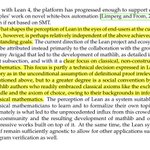
TBF Lean’s rise had little to do with dependent types. Rather, its pleasant UX turned a few mathematicians into enthusiasts who built a library of mostly… classical math, which in turn spurred unprecedented adoption by stars like Terence Tao.


k h ô i retweeted

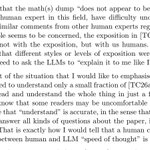
The mutual comprehension barrier used to prevent large-scale collaborations in mathematics. With AI as a translation device, this is no longer an issue.

There is a major result on the KPZ equation in 2+1 dimensions!
This looks like a great example of what the near future of math research could look like.
Here you have an 11-author paper--basically all top experts who had been working in this direction in recent years--combining all their recent results and insights and prompting Astra like maniacs. The result: a major problem in critical SPDEs that everyone in the field was wondering about is now solved!
Fantastic!
Human + AI interaction ==> more understanding


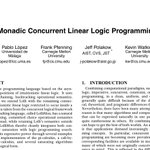
I interpret the main thrust of this paper as a move from the conventional concept of terms as maps from environments to values
t : Γ -> A
to a concept of terms as natural transformations between monomial functors
t: Γy^Δ -> Ay^B
(y is the identity functor, Γ, Δ are sets of environments, A, B are sets of values.)
From this starting point, we can go one of three routes:
1. Make certain modifications (e.g., replacing Set with a suitable closed monoidal category) to enforce linearity, as done in the paper.
2. Generalize from monomial to polynomial functors and get dependent types.
3. Do both and (hopefully) unite linear logic and dependent types in one theory.
The last one looks the most interesting and challenging to me. ChatGPT found me an abstract along this line of thought. actconf2026.github.io/papers…

Delighted that "Flow Typing: A New Lens on Linearity" has been (conditionally) accepted for POPL 2027. Fantastic work by Sky Wilshaw! tinyurl.com/2j26dyyn
I’m in a bit of a crisis. So many of us “knowledge workers” base our pride on our virtuosity in producing clever text /code /proof/ media/… Now that the tower is crumbling, where do we go from here?

“Explain it to me like I’m human”


the inimitable David Harvey wrote about his experience understanding the o(n log n) integer multiplication result: web.maths.unsw.edu.au/~david…
it's absolutely worth a read, both for the technical content and especially for the reflections on math and AI at the start
k h ô i retweeted

📚 Open Access (free)
Kockelman, P. (2025). Mathematical Models of Meaning: A Dynamical Systems Approach to Possible World Semiotics. MIT Press. doi.org/10.7551/mitpress/156…

k h ô i retweeted

Program testing can be used to show the presence of bugs, but never to show their absence! — Edgar Dijkstra
Dijkstra would feel right at home on Twitter. He said things he knew were false but would make good soundbites. There are many cases where testing COULD prove the absence of bugs:
- Functions with finite inputs like floor(float32) can be exhaustively tested
- Functions with infinite inputs can be shown to be correct for finite subsets, like "this works for all dates between -10,000 BCE and 10,000 CE"
- You can use proof to show that many inputs are equivalent, and test those inputs are correct.
But on the whole, testing mainly shows that programs are wrong, not that they are right. The same is true of other dynamic analysis, like contracts, observability, benchmarking, etc.
Static analysis, like proofs, type systems, and linting, are the opposite. They are really good at showing the absence of bugs and terrible at showing the presence!
If dynamic analysis finds a bug, we definitely know the program is incorrect. If it doesn't find a bug, we don't know if the program is correct or if we just didn't do the right analysis.
If static analysis finds "no bugs", we definitely know the program is correct. If it doesn't find "no bugs", we don't know if the program is incorrect or if we just didn't write the correct proof.
(Again, there are exceptions. Many simple typechecking errors do map to real bugs!)
So on top of "definitely correct" and "definitely incorrect", there are three other program states: "probably correct but we can't find the right proof", "probably incorrect but we can't find the right test", and "we don't know if it's correct or incorrect".
I'd like to point out that the category (2) is much smaller than (1) or (3). It's a lot easier to verify the hypothesis that something is wrong than prove the case that something is right!
And that's how I see the difference between the two: static analysis is fundamentally grounded in what we can learn through reason and deduction, while dynamic analysis is what we can learn through empiricism and experimentation. Different aspects of a software are amenable to different kinds of knowledge-gathering. Different aspects of software correctness are amenable to different kinds of knowledge-gathering.
That's why I'm so incredulous when people say either "I don't need types, I have tests" or "I don't need tests, I have types".
Or "If it compiles, it's correct", for that matter. Or anything that suggests the programmer isn't thinking of defense-in-depth.
k h ô i retweeted

It requires big changes to the implementation and interface of operating systems, languages, etc. Incumbents hate it.
Non-interfacing persistence is more pervasive than interfacing it.
git.cons.io/mighty-gerbils/g…
k h ô i retweeted

what's the point of rhyming if you don't rap it? enjoy

k h ô i retweeted

Good list: agentlanguages.dev/
Not sure if it has the 15 that have been created in the past 2 months.
