

Director, Inst for Regulatory Law & Economics @NorthwesternU, Adjunct Prof @NU_MSES, @sfiscience External Faculty, @AEI Nonres Senior Fellow
Chicago-Denver
Joined April 2009
- Tweets11.8K
- Following3.3K
- Followers4.9K
- Likes10.6K








Lynne Kiesling-Knowledge Problem retweeted

Everyone talks about what AI will do. But almost nobody asks who will pay for the machines. Taking advantage of AI will require an extraordinary amount of capital, from data centers to new power plants. Will that capital be around?
I try to address that question in the first draft of my new paper “Saving for the Machines.”
To show how important capital is to fuel the transition to an AI-based economy, I document how the same technology path that generates 11.7% annual growth when households choose their saving rate optimally delivers only 2.2% when the saving rate remains fixed. In other words, if we experience slow growth over the next few years despite fast improvements in AI, this slow growth may reflect too little capital accumulation instead of a technological bottleneck.
The key to this result is that AI raises the capital share by moving tasks from labor to machines, which requires that those machines are built. In comparison, ordinary technical progress makes labor and existing machines better at the tasks they already perform.
To inspect the mechanism, I start from an accounting identity: the saving rate is the capital share times the ratio of investment to capital income. If I take the evolution of the capital share as given, I can ask how much the latter ratio moves in response to that evolution. Crucially, with an optimizing household, this ratio barely moves. As machines take over tasks and the return to capital rises, the household responds by letting consumption grow faster, by the intertemporal elasticity of substitution times the rise in the return. To pay for that faster consumption, capital must also grow faster by the same amount. So, the household keeps investing about the same fraction of what the machines earn. And since machines earn a larger share of output, the saving rate also goes up. With a fixed saving rate, the same accounting identity tells me the opposite: the ratio falls in proportion as the capital share rises.
Will the U.S. and other advanced economies then generate enough capital? For many reasons, I doubt it. We might end up in a situation where many of the opportunities offered by AI are left on the table. This is particularly important for all who think that AI might get us out of many problems, such as fiscal troubles (like in France) or ultra-low fertility. We need to save for the machines, and it is not clear we can do that.
Anyway, this paper has been long in the making (many months of hard work), but I have learned much from it. In particular, working through the model changed my mind about many issues related to AI. Again and again, my intuition said X, but the math said Y. And math always won in the end. That is why we write formal models.
A nice example is Proposition 5, whose proof is the one I like the most in the paper. With improving machines and strong task complementarity, there is no fixed balanced growth path because the target itself keeps moving. The nice part of the proof is to realize that, after the right normalization, the moving target becomes a fixed point, and the saddle gets steeper as machines improve. So instead of falling behind, the economy tracks the moving BGP more and more closely. A fair amount of ODE work to get there, but a very simple economic idea underneath it once you get it.
The paper is here:
sas.upenn.edu/~jesusfv/Savin…
and the slides are here:
sas.upenn.edu/~jesusfv/Slide…

Lynne Kiesling-Knowledge Problem retweeted

One startup is trapping mosquitoes by mimicking human biological signals and using AI to surveil them—all without chemicals. And it works both outside and inside.
Mosquito-borne diseases are serious public health concerns, and AI is powering new technology to reduce the harms they cause.
@TechCrunch @kateparknews


Lynne Kiesling-Knowledge Problem retweeted

common for ppl to vastly underestimate how hard it is build & power a datacenter, especially at massive scale!
a16z.news/p/why-texas-is-mak…


Lynne Kiesling-Knowledge Problem retweeted

Great conference at @rootsinprogress this weekend, as has been true in '24 and '25. What works here: 1) Everyone is on board with "high-agency, high-progress, high-optimism", but conditional on that, huge differences in field of work, political preferences, country of origin. 1/4
.@deanwball enjoyed your @rootsofprogress session, can't find you to ask this essential question: what's your opinion of the Norrington original instruments recordings of Beethoven? I enjoy them a lot, esp. the timing, but I think Norrington & Schubert (9th) is a better combo.
Lynne Kiesling-Knowledge Problem retweeted

What should an open scientific paper look like in the AI age?
We made a demonstration project out of our paper on the childhood socioeconomic circumstances of the Nobel Laureates.
Please check it out and share. Details in 🧵 1/


Lynne Kiesling-Knowledge Problem retweeted

What’s the evidence on rent control?
I charted the findings from 112 studies:
Great for rent-controlled tenants ✅
But:
Pushes up rents for other people ❌
Pushes down new housing construction ❌
Pushes down building quality ❌

Changed my life.


Lynne Kiesling-Knowledge Problem retweeted

Deirdre McCloskey has a forthcoming book — Equality of Permission (Chicago) — that all liberals should read. I think it is no exaggeration to say that this work alongside Bill Easterly’s Violent Saviors and Barry Weingast’s forthcoming book on Adam Smith are the most important social scientific works in recent times to put liberty at the center of the analysis. Here is a great conversation from a decade ago between Don Boudreaux and McCloskey on the Bourgeoise trilogy.
mercatus.org/hayekprogram/ha…

Lynne Kiesling-Knowledge Problem retweeted

As we find ourselves in the midst of widespread AI technopanic, it is a good time to ponder, as I do in my latest @CityJournal essay, “What Hayek Can Teach Us About AI Safety”
city-journal.org/article/fri…

Lynne Kiesling-Knowledge Problem retweeted
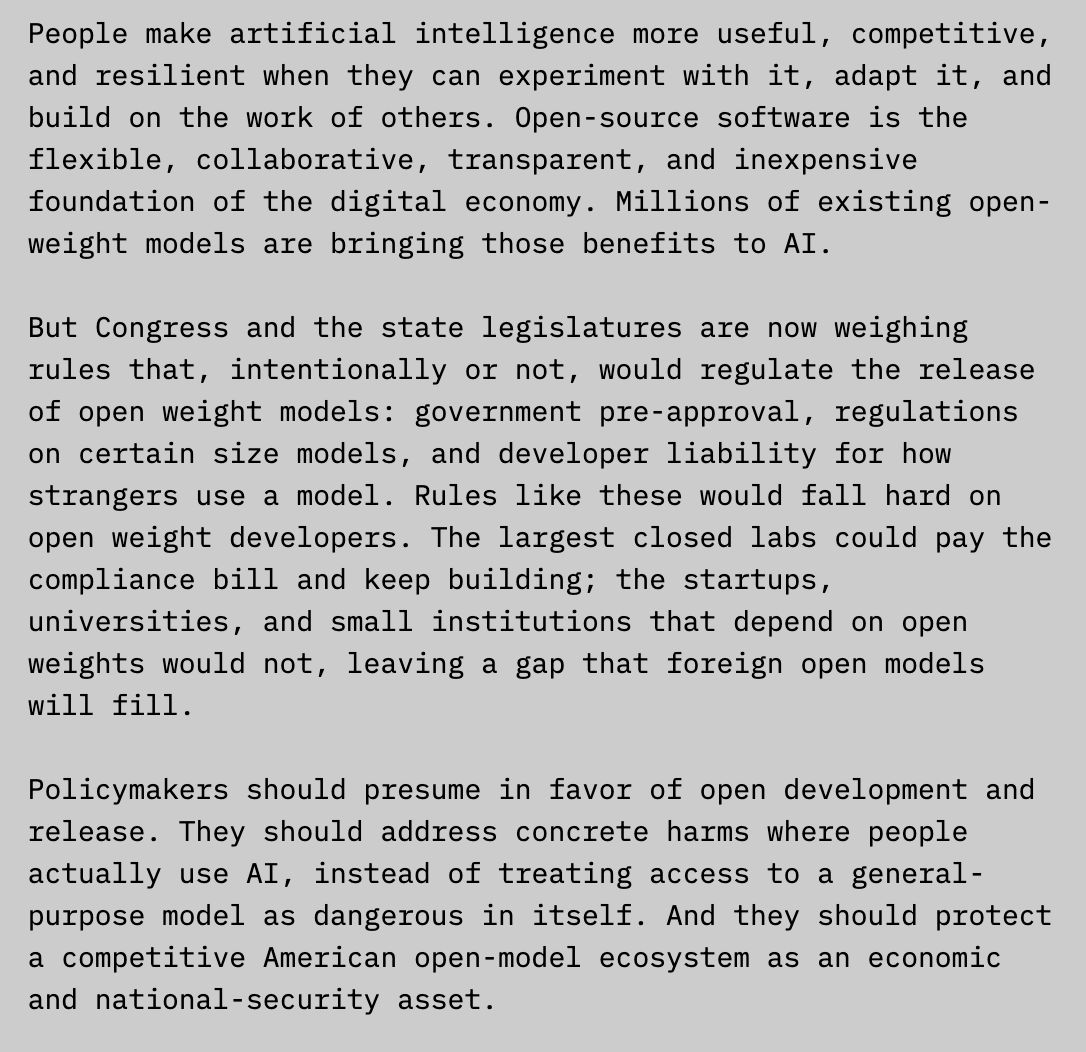
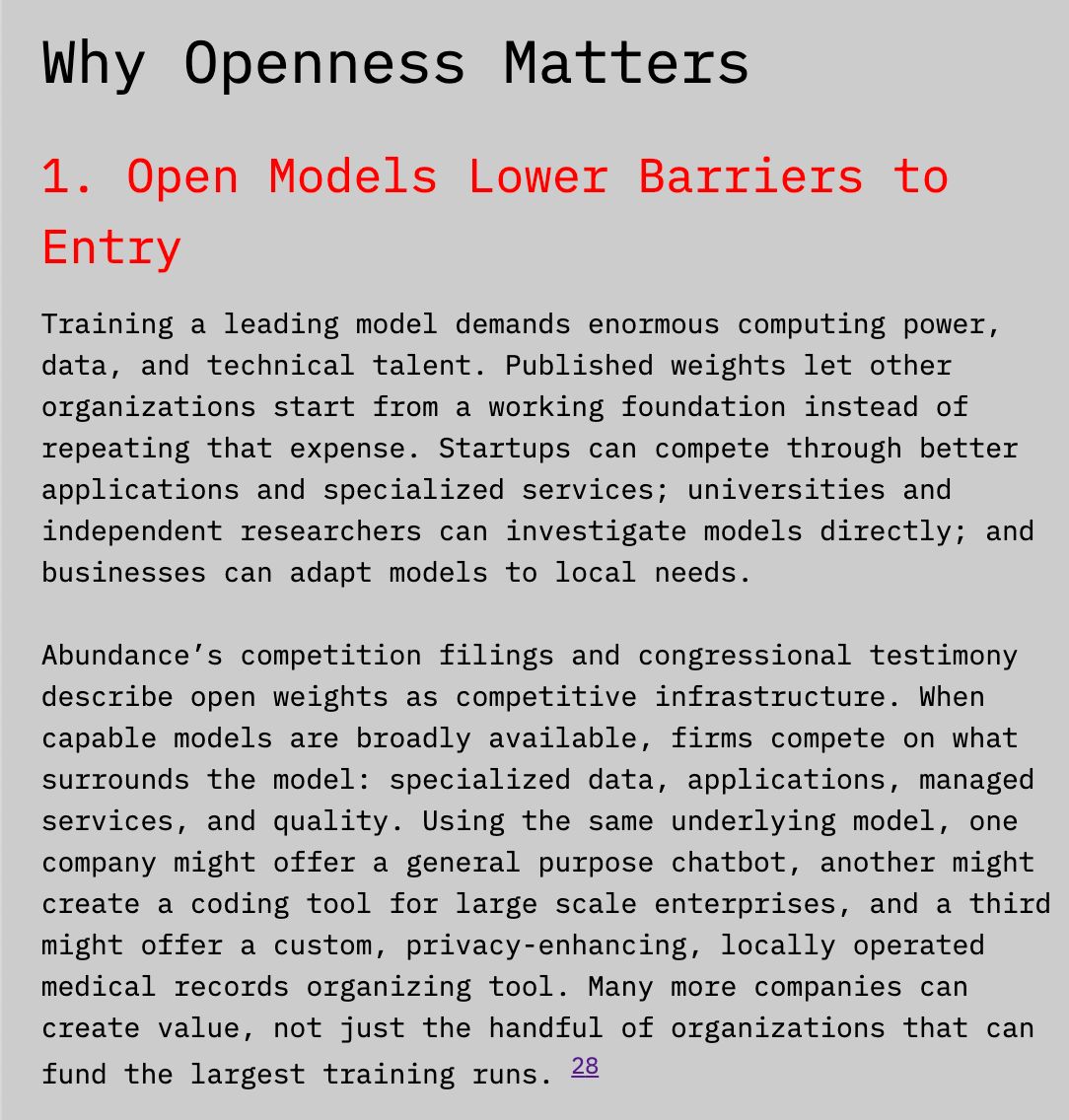
NEW: Read our policy framework for open-source and open-weight artificial intelligence
Our goals:
- Keep AI model development open and competitive
- Hold people responsible for harmful conduct they control
- Make the United States the best place to build and use open models.
@neil_chilson



Lynne Kiesling-Knowledge Problem retweeted

What if instead of "pacing the frontier" we increased liability?
Internalize the externality? Isn't that the starting framework if individual safety incentives don't match group incentives?
Lynne Kiesling-Knowledge Problem retweeted

Completely agree with this! There are counterarguments but we address them in this piece, and we also propose some concrete paths to implementation:
The Agentic Web Requires New Normative Infrastructure
The agentic web, in which users interact with the internet largely through agents acting on their behalf, is now technically feasible. However, many of the consumer and social benefits that could be realized by online AI agents acting scrupulously in their principals' interest are currently obstructed by outdated laws, terms of service, and other less formal practices which allow online platforms to block and degrade agent access, often in secret. Few distinctions are currently drawn between "malicious bots" and AI agents acting with the express delegated authority of a user. For the agentic web to realize its promise, it needs not only the technical infrastructure of protocols and interfaces, but the normative infrastructure of a broadly-accepted and socially-beneficial set of laws, norms and practices governing agentic access to online properties. Building that normative infrastructure requires a society-wide conversation. This paper aims to help precipitate that conversation, to identify normative principles that can guide it, and to advocate for policies that enable users' appropriately delegated agents to act online on their behalf, with as few curbs on their doing so as is reasonable given the other legitimate interests at stake.
Cameron Pattison, Matthew Boulos, Noam Kolt, Changbai Li, Tiziano Piccardi, Seth Lazar
arxiv.org/abs/2606.10711


Lynne Kiesling-Knowledge Problem retweeted

Blue Continuum, a new magazine from Nautilus founder John Steele, launched this week. Among its first stories is an essay from SFI President David Krakauer, “The Fossil Logic of the Industrial and AI Revolutions.”
In the essay, Krakauer looks at the parallels between our use of fossil fuels and the way AI draws from accumulated human knowledge.
Read the essay: blue-continuum.com/fossil-lo…

Lynne Kiesling-Knowledge Problem retweeted

Some real talent behind this new venture. Congrats @DC_Hartman @PCRossetti @knowledgeprob @NiconomistLoris and all involved!


