

Astronomy (Henry Grieb Observatory, SVAS, Unistellar), Chess, Wikipedia, West Coast Swing Dancing.
Sacramento, CA
Joined September 2009
- Tweets2.5K
- Following161
- Followers289
- Likes18.7K



Kevin Heider retweeted

A test result from one of my old data sets using the new Planet Derotator software that is currently under development --Jupiter with Io back in September 2022.
Many useful and unique features are present in this program and i think its likely to become very popular among serious observers. It removes a lot of the time consuming manual work in other programs allowing fine tuning of many parameters within the software itself.
A public release will appear soon, and i've no doubt it will prove hugely popular. My congratulations and thanks to Luc and Dominique for their work in developing it.

Oort Cloud Comet C/2024 T5 (ATLAS) that reaches closest approach to Earth at 3.2AU on Christmas Eve.

Kevin Heider retweeted

Security called me at 6:12 AM today.
"Patch every PHP server immediately."
I asked what happened.
"Two critical vulnerabilities. Remote code execution. No authentication required."
Cool.
How many PHP servers do we have?
According to inventory: 12
According to reality:
Nobody knows.
We found one running WordPress.
Three running old internal tools.
One under someone's desk.
Two inside vendor appliances.
A forgotten employee directory from 2016.
And a server named:
PHP-OLD-DO-NOT-TOUCH
Naturally, that one runs payroll exports.
Then we found a PHP 5.6 box.
I asked who owned it.
The documentation said:
BRIAN.
Brian left in 2019.
We called Brian.
He said:
"Oh wow, that's still running?"
Excellent.
By 8 AM, leadership joined the incident call.
CEO:
"Can hackers actually get in?"
Security:
"Potentially yes."
CEO:
"Without a password?"
Security:
"Yes."
CEO:
"Then why do WE need passwords?"
Not the lesson.
Finance asked if we could wait until the weekend to patch because downtime affects revenue.
Security explained that the alternative was letting strangers execute code on our servers.
Finance asked for a cost comparison.
At 9:17, someone suggested temporarily taking the vulnerable websites offline.
Marketing refused.
"Our campaign is live."
So for the next hour, the company officially decided maintaining a landing page for 20% off webinar registration was more important than preventing remote server takeover.
We finally patched everything we could find.
Then our scanner discovered another PHP server.
Hostname:
TEMP-PHP-2014
Uptime:
4,512 days.
Nobody knows what it does.
Nobody owns it.
Nobody can shut it down.
But every time we block network access, the warehouse stops printing shipping labels.
Security has classified it as critical infrastructure.
It is running PHP 5.4.
The vulnerability has existed longer than half our employees.
The emergency patch took four hours.
Finding out what PHP actually runs took eleven.
The internet isn't held together with code.
It's held together with servers everyone is afraid to turn off.
Kevin Heider retweeted

Comet C/2024 T5 (ATLAS)
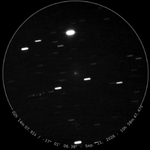
2026 Sep. 23.77 UT m1=13.1 (m2=14.5) Dia.=0.8' Tail=9.9' in PA 230 deg...[T59] 0.51-m f/6.8 Corrected Dall-Kirkham Astrograph + CCD... T. Prystavski... (iTelescope observatory, Q62 (remotely from Siding Spring, Australia))


Kevin Heider retweeted

Our #HubbleTopImage features the Red Planet! 🔴
This is a combination of Hubble images of Mars taken from 28 to 30 December 2024. At the midpoint of the observations, Mars was approximately 98 million kilometres from Earth.
Thin water-ice clouds 🌨️ that are apparent in ultraviolet light give the planet a frosty appearance. The icy northern polar cap was experiencing the start of Martian spring.
Read more: ow.ly/yzeP50ZVIMp
📷 @NASA , @esa , STScI

Kevin Heider retweeted

Is that it? Did we find them?
Chinese astronomers used FAST, the world’s largest single-dish radio telescope, to search 33 planetary systems for technosignatures.
One signal stood out: NBS 260108, coming from the direction of K2-155 — a system hosting a super-Earth near its habitable zone.
It’s narrowband. It drifts in frequency. And it appeared only in the beam pointed at K2-155.
Aliens? Probably not. The team still considers terrestrial or instrumental interference more likely.
But this is exactly what a technosignature search is supposed to find: the weird signals that survive the first filters and make us look again. #seti
sciencealert.com/astronomers…

Kevin Heider retweeted
Four planets in one night on September 22nd
Its a very rare occurrence over my career to have captured four excellent images of four different planets in one night so decided to put together a montage of the images obtained. A memorable night!

Kevin Heider retweeted

NEPTUNE OPPOSITION 2026
Every year, I do an opposition photo shoot of Neptune. This time, for the first time ever using the massive 30" DOB Telescope. This year, it appears Neptune has clouds and is quite active.
Full info
instagram.com/p/Ddw8Q8dEjKy

Kevin Heider retweeted

Steve Bruehl and I had lots of fun discussing the latest VASCO results with Gadi Schwartz on NBC News last night! We talked about:
- The sizes, properties and possible altitudes of the transients.
- What happens if we assume that the transients are caused by objects at geosynchronous distances and project their lines of sight back onto the Earth’s surface?
Intriguingly, we find hotspots around White Sands, Sedona and Tampico, as well as several locations in the Pacific Ocean west of Mexico and California. And perhaps most intriguingly: what happens around nuclear tests?
If we look within ±1 day of a nuclear test, something interesting appears. Around dates when nuclear weapons were tested over the Pacific Ocean, the transients cluster over the Pacific. Around dates when nuclear weapons were tested in the Nevada area, the transients instead cluster over the southwestern United States.
So the correlation with nuclear tests may not only be temporal. It appears to have a geographical component as well.
Enjoy! 🙂
youtube.com/watch?v=_93vhH8X…
@NBCNews @GadiNBC

Kevin Heider retweeted

Uranus, its rings, and its moons this morning, captured under excellent conditions with the 24in scope.
By far my best capture of the epsilon ring to date.
1hr of data with IR720nm longpass filter.


Kevin Heider retweeted
Saturn animation from last nights session. Seeing was unfortunately mostly rather poor and worsening so only a short session was had.
Plenty of ring spokes are again seen. The bright spot in the southern hemisphere also stands out.
Kevin Heider retweeted
Astronomers in Kyiv, Ukraine, detected the beginning of a new outburst of the cataclysmic variable Gaia20cnt (ASASSN-14fc) using a Unistellar eVscope provided through the Astronomy for Equity program. The detection triggered follow-up observations with the 70-cm AZT-8 telescope at Taras Shevchenko National University of Kyiv.
The observations suggest that Gaia20cnt may be an SS Cyg-type dwarf nova (UGSS), a binary system in which material transferred onto a white dwarf periodically produces strong optical outbursts. Continued observations are now encouraged to better characterize the system.
What makes this particularly significant is where the observations were made. Ukrainian astronomers continue to conduct research from Kyiv despite the war and increasingly serious electricity constraints. The team told Mike Simmons that conventional observatory operations may become difficult this winter because of power availability, making small, autonomous telescopes such as the eVscope potentially important tools for keeping astronomical observations going.
This is a small but powerful example of how distributed, relatively inexpensive astronomical instruments can maintain scientific capability even under extremely difficult conditions. astronomerstelegram.org/?rea…


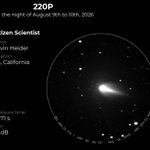
161P/Hartley–IRAS on 11 September 2026 at 10:59 UT and imaged with a @Unistellar 114mm smart telescope. It had an elevation of about 33 degrees and was 134 degrees from the Sun. Image taken in Blue Canyon, CA. It will reach perihelion (closest approach to the Sun) in November.

Kevin Heider retweeted
SATURN and the Moon Dance. SEPTEMBER 1, 2026 (30 inch Telescope)
EXCELLENT SEEING. CLOSER PLANET. BETTER DETAILS. A WOW type of night.
This is the shot that I wanted.
Full details below
instagram.com/p/DdCKlNBmuKR/

Kevin Heider retweeted

I captured 3 hours on Galaxy NGC 7331 this month, which shows a new supernova SN 2026aaiv. I then compared it to the same galaxy I captured a year ago in July, which shows supernova SN 2025rbs (which has since faded and can no longer be seen in the new data).
Kevin Heider retweeted

"The new meteor shower is evidence that 2023 VN9 may be the now cloaked surviving part of a cometary breakup some time ago that also created a stream of meteoroids." #astronomy
seti.org/news/new-meteor-sho…


