

Web3 Content Creator | Crypto Investor | NFT collector. ( Dm for collab )
Web3
Joined April 2024
- Tweets163K
- Following18.7K
- Followers22.6K
- Likes221K






Pinned Tweet
> @rarelistio Season 1 is now live
Curated campaigns with structured creator rewards 50000$
Consistent contributions are being recognized through $RARS
Join an connect X and start post : rarelist.io/r/kumar58429

This is exactly why I love Solana.
The biggest shift happens when people stop talking about the technology and simply start using what it enables.
If tokenization becomes the default way assets are issued, moved and settled, most users won’t even care what happens underneath.
They will just expect it to be fast, cheap and seamless.
That is the future Solana has been building toward for years.
Still one of the ecosystems I’m most excited to watch.

I have been checking out the XQuad demos from @quipnetwork , and one thing stands out: write the problem once, then let XQVM translate and verify it before sending the same model across quantum, GPU, local, or Quip Network backends.
The parcel yard demo reportedly matched a hand built version on real quantum hardware, which makes me
curious: when execution moves to the Quip Network, how is that same model consistency verified?
If Quip can make define once, execute anywhere reliable, that could be a very useful layer for hybrid computing.

Giving people a reason to actually use it is much harder.
that is why @Tera_Map is interesting to watch.
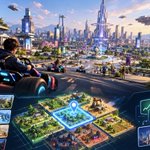
TERA already has a playable 3D multiplayer city built around 3,333 land parcels. you can enter without connecting a wallet, explore the city, drive karts and interact with other players.
that matters because the world exists before the full land economy does.
now the bigger question is what ownership will actually add.
each parcel is designed around its own resource theme and rarity, while the broader roadmap points toward an economy that could include stock tokens tied to real-world assets.
but the real value won’t come from simply owning coordinates on a map.
it will come from what happens on that land.
what can be built there?
what can the land produce or unlock?
and most importantly, why would players keep coming back?
that part is still being built, so execution matters.
if TERA can connect its already playable world with meaningful land utility and a functioning economy, those 3,333 parcels could become more than assets people simply hold.
they could become productive pieces of a world people actually want to use.

Launching a meme coin takes minutes.
getting a fair chance to participate is a much harder problem.
data shared by @zerufinance makes that gap pretty clear.
after analyzing 8.2 million Pumpfun launches, it found that developers and bundled wallets made at least $579M after fees, while sniper bots made around $31.5M.
that difference caught my attention.
we usually blame bots when a launch feels unfair, but bots may only be part of the story.
the bigger advantage can exist before ordinary traders even arrive.
some wallets can potentially get earlier access, accumulate a meaningful share of the supply, and exit while everyone else is still reacting to the chart.
this is where @zerufinance makes an important point.
price tells you what happened to a token.
it does not always tell you who had the advantage, how they got it, or who ultimately paid for it.
better launch transparency means looking beyond candles and market caps and understanding the behavior behind them.
because a fairer market starts with knowing what actually happened onchain.

The next large scale mapping network might not need a fleet of specialized vehicles.
it could start with the phones already in our pockets.
@vangrid_io is now live on Android, expanding who can contribute to its spatial data network.
the model is straightforward:
use your phone to capture real-world environments, contribute that data to the network, and earn rewards for useful submissions.
but the interesting part is what happens at scale.
instead of depending entirely on centralized mapping teams to collect and refresh physical-world data, VanGrid can potentially turn everyday devices into a distributed capture layer.
more contributors means more locations, more perspectives, and potentially fresher spatial data for the AI and machines that need to understand the physical world.
Android matters here because it dramatically expands the potential contributor base.
the bigger idea is not simply earning from a phone.
it is turning millions of phones into pieces of infrastructure that help make the physical world machine readable.
if that network keeps growing, our phones may do more than navigate the map.
they could help build it.


Looking for people who enjoy crypto research as much as I do.
I am exploring @PoiseFinance , where you can turn a market thesis into an index and build a crew around your ideas.
I am interested in connecting with people who follow different sectors, share their perspectives, and enjoy building with a community.
AI, DeFi, RWA, or gaming every narrative has a different story.
Which sector would you bring to the crew? 👇

Conviction Tokens. Anywhere, anytime.
Beta access: 27th October
Join groups, add friends, get beta codes, earn fees.
poise.finance/campaign
The more @quipnetwork builds, the clearer the bigger idea becomes.
it is not just about quantum computing.
Quip is building infrastructure where classical and quantum compute can work together, while QVRF, QVM and post quantum security handle different parts of the stack.
the real test is adoption.
if developers can actually use this infrastructure without dealing with the complexity underneath, Quip could become much more interesting than just another compute network.

The wall is coming to @Tera_Map , and this feels like the kind of challenge that can make the world more fun to explore.
what caught my attention isn't just the tsla crate, but the way tera is turning resource hunting into something that actually requires skill.
grab your kart, build enough speed, hit the ramp, stick the landing, secure the crate and get out before someone else beats you to it.
no easy route. no guaranteed reward.
timing, control and probably a little luck will matter.
the tsla mechanic makes it even more interesting. unlike regular resources connected to land, these crates are hidden in some of the hardest places to reach, which gives players a reason to explore beyond simply collecting what's nearby.
that is the direction i want to see more of from tera.
digital land becomes much more interesting when the world around it gives players reasons to move, compete, discover and keep coming back.
the wall is not live yet, but i am curious to see how chaotic it gets once everyone starts chasing the same crate.
some will stick the landing.
others are definitely eating dirt.

The physical world is slowly becoming machine readable data, and that is what makes @vangrid_io interesting to watch.
VanGrid recently shared its CoinMarketCap verification request:
that may look like a small milestone, but the bigger story has little to do with a verification ticket.
AI already has enormous amounts of text, images and digital information to learn from.
Physical AI has a different problem.
robots and autonomous systems need to understand actual environments the geometry of a room, the layout of a street, the objects around them and how those spaces exist in 3D.
that requires better ground truth.
VanGrid is building infrastructure around this missing layer.
contributors can capture real environments with a smartphone, while that footage can be reconstructed into structured 3D spatial data that machines can actually use.
the decentralized part matters too.
instead of depending only on expensive mapping fleets or a handful of centralized data providers, VanGrid is exploring a network where people can contribute real-world captures wherever useful spatial data is needed.
and provenance adds another layer.
onchain attestations can create a verifiable trail around where that data came from, making the dataset not only useful, but more auditable.
the CoinMarketCap request can help with discoverability and project identification, but it should not be confused with validation of the technology or approval of the request itself.
what matters more is what VanGrid is building underneath it:
physical spaces → smartphone capture → reconstructed 3D data → verifiable provenance → better context for machines.
the internet spent decades digitizing information.
Physical AI may require us to digitize the world around us.
@vangrid_io is positioning itself right in that infrastructure layer.
vangrid.io

Most traders are always thinking about the next trade.
but @zerufinance is making the activity already sitting in your wallet worth looking at too.
with Zaps, you can connect your existing trading wallets and see how your past activity translates into points.
instead of starting from zero, qualifying onchain history can become part of your profile and potentially help you earn more as the ecosystem develops.
the bigger idea gets more interesting with ActivityFi.
Zeru plans to bring verified onchain activity into memecoin launches, shifting some of the focus from simply being early to actually having a track record.
there is a social layer too.
traders can build clans, compete together and explore campaigns like the $50K Ditto competition while it’s live.
your wallet already tells a story.
Zaps is trying to make that history useful instead of letting it sit there unnoticed.
app.zaps.wtf


The more i look at @quipnetwork , the more i think the interesting part is not simply having more compute.
it is making that compute useful.
most networks use computational resources mainly to keep the system running and secure.
Quip is exploring something different with Proof of Useful Work, where CPU, GPU and eventually quantum resources can contribute to real computational tasks while supporting the network.
that creates a much bigger idea.
instead of asking how much compute a network can access, the better question becomes what can that compute actually accomplish?
then you have QVRF for verifiable quantum randomness, post quantum security infrastructure and QuipSwap for cross chain activity.
each piece is interesting on its own, but the real test is how well they work together and whether developers find genuine reasons to use them.
that is what i am watching with Quip.
the technology may sound futuristic today, but the projects that make it practical are the ones that could matter tomorrow.

owning virtual land is easy.
giving people a reason to actually use it is the harder part.
that’s what makes @Tera_Map interesting to watch.
TERA already has a playable 3D multiplayer city built around 3,333 land parcels. you can enter without connecting a wallet, explore different areas, drive karts and interact with other players.
so the world exists before the bigger land economy fully arrives.
the next question is what ownership adds to that experience.
each parcel is designed around its own resource theme and rarity, while the broader roadmap points toward an economy involving stock tokens tied to real world assets.
that part is still being built, and execution will matter.
because the value of virtual land shouldn’t come from simply owning coordinates on a map.
it should come from what happens there, what you can build around it, and why people want to return.
if TERA can connect its playable world with meaningful land utility, those 3,333 parcels could become more than something to hold.
they could become part of a world people actually want to use.

Bor is a good example of how quickly attention can become liquidity, and how quickly that liquidity can disappear @zerufinance
The token reportedly reached a $15M market cap within minutes, then lost more than 98% of its value within an hour after promotional posts disappeared.
People brought the attention. People brought the liquidity. But when the hype vanished, buyers were left holding the risk.
That raises a more interesting question:
What if access to new launches was influenced by verified activity, rather than simply who arrived first or chased the hype fastest?
That is where @zerufinance ActivityFi becomes interesting.
Instead of treating attention as the only signal, ActivityFi aims to bring verified onchain activity into the memecoin launch process, giving participation and track record a role in how new markets form.
It is a different way to think about launches: not just attention first, but activity with context.
ActivityFi is coming soon to Zaps.
Keep an eye on @zerufinance and check your Zaps at app.zaps.wtf

A robot can record a room. But understanding that room is a different problem.
That distinction matters for physical AI.
@vangrid_io is building a data layer that turns real world environments into structured 3D representations machines can actually work with.
Think about a warehouse robot entering an unfamiliar building.
It needs more than footage. It needs to understand the width of an aisle, whether it can safely make a turn, where obstacles or elevation changes exist, and whether its digital representation accurately reflects the physical space.
This is where VanGrid gets interesting.
Contributors can capture real locations using a phone. Those captures can then be reconstructed into spatial data such as point clouds, Gaussian splats, and textured 3D meshes.
Privacy is also considered in the workflow, with faces and license plates redacted ondevice before encoding, while capture fingerprints and attestations anchored to Base create a verifiable record of the data.
The bigger opportunity goes far beyond warehouses.
As robots and world models become more capable, internet images and synthetic environments alone may not be enough. Machines also need fresh, ground level spatial context from the environments where they will actually operate.
That makes real world 3D data an important part of the physical AI stack.
The next frontier is not simply teaching AI what the world looks like.
It is helping machines understand the spaces they need to move through.
That is the opportunity @vangrid_io is building around.
Explore the network: app.vangrid.io


