
Founding Partner https://teapawt.net/t.co/qnLIkInIIr, Former Partner@ Norwest, Growth capital for Enterprise Software & Physical World models. Dog Lover. Designer at heart.
Joined May 2009
- Tweets853
- Following120
- Followers676
- Likes623





Pinned Tweet
2019 saw the launch of Avataar Ventures - our commitment to work alongside founders to help build global SaaS companies.
Here's wishing all our friends a wonderful, happy and fun year ahead!
5
12


Mohan Kumar retweeted

After six years in stealth, Atomic Machines is out. Our mission: on-demand, universal command of matter. First beachhead: the Matter Compiler, an AI-native manufacturing system that builds working micro-machines from code alone. No per-product tooling. No process development. Different code, different machine.
Mohan Kumar retweeted

8 AI model architectures, visually explained:
There's a tendency to treat LLMs as the whole field. But they're one family among several others, each shaped by a different kind of input, output, or constraint.
Here's a breakdown:
1. LLM (Large language models)
Text goes in, gets tokenized into embeddings, processed through transformers, and text comes out.
↳ GPT, Claude, Gemini, Llama.
2. LCM (Large concept models)
Works at the concept level, not tokens. Input is segmented into sentences, passed through SONAR embeddings, and then uses diffusion before output.
↳ Meta's LCM is the pioneer.
3. LAM (Large action models)
Turns intent into action. Input flows through perception, intent recognition, task breakdown, then action planning with memory before executing.
↳ Rabbit R1, Microsoft UFO, Claude Computer Use.
4. MoE (Mixture of experts)
A router decides which specialized "experts" handle your query. Only relevant experts activate. Results go through selection and processing.
↳ Mixtral, GPT-4, DeepSeek.
5. VLM (Vision-language models)
Images pass through a vision encoder, text through a text encoder. Both fuse in a multimodal processor, then a language model generates output.
↳ GPT-4V, Gemini Pro Vision, LLaVA.
6. SLM (Small language models)
LLMs optimized for edge devices using compact tokenization, efficient transformers, and quantization for local deployment.
↳ Phi-3, Gemma, Mistral 7B, Llama 3.2 1B.
7. MLM (Masked language models)
Tokens get masked, converted to embeddings, then processed bidirectionally to predict hidden words.
↳ BERT, RoBERTa, DeBERTa power search and sentiment analysis.
8. SAM (Segment anything models)
Prompts and images go through separate encoders, feed into a mask decoder to produce pixel-perfect segmentation.
↳ Meta's SAM powers photo editing, medical imaging, and autonomous vehicles.
That said, the 8 architectures above are the established families.
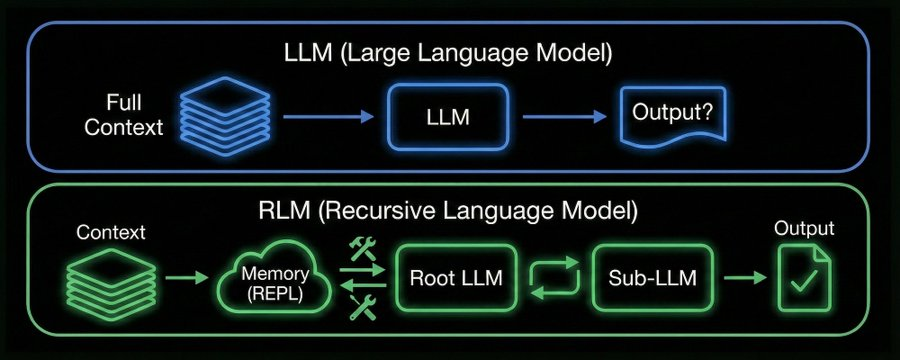
There's one we left out of the image on purpose, because it's less a model family and more a frontier idea called recursive language models from MIT.
Rather than fighting context rot with a bigger window, an RLM stores your prompt as a variable in a Python environment and lets a root model write code to inspect it, then spins up recursive sub-calls to process the relevant chunks.
The model reasons over the context instead of drowning in it, which lets it scale to 10M+ tokens without retraining and beats the base model even on inputs that already fit.
We wrote a full breakdown on it.
Read it below.


Mohan Kumar retweeted

The economics of a Neolab.
A neolab is loosely defined as a startup of AI researchers who raises a lot of money pre-production to be able to finance GPU compute to take on a large AI problem.
To buy 1000 GB300s or ~14 NVL72 racks will set you back $125-150M for 3yrs with 15-30% upfront. That’s about ~2-2.5MW.
Thats about enough to do 10^25 flops a quarter and get to a GPT-4 level model which is 1-2 OOMs off frontier for pretraining.
If you post-train on a great open source model, you have a better chance of getting to frontier. The risks are a) you need to spend millions on RL environments too and b) being lapped by another model release while being tied to a base model.
For this to payback, you need to give your customers a better and ideally cheaper inference service than a base model and serve them for long enough to recoup your large investment. Even at 50% margin on inference, to recoup $10M in training means serving ~10T tokens (!) if you price like Fable / Astra given a standard cache read / input / output split ($2/M blended). And you have to justify being better than a release like Opus 5.5 which is even cheaper. Often, you end up charging your customers a huge premium in terms of platform fees and compute fees on top of pure inference.
Meanwhile, every hour you’re not utilizing your GPUs you are burning money so you typically resell this compute back to a broker or run inference for open models / resell spot instances. At below a ~60% utilization on spot, you will still lose money.
Add to that insane cost of talent.
So what can you do with the compute?
- Not play the model game at all.
- Play an entirely different model game (Jev, World Labs) that if big labs played, would either a) cannibalize their business or b) be incrementally not significant revenue c) would cause too much distraction from the main main thing
- Acquire a proprietary data set (Peridodic Labs) in enough volume in a domain of usefulness to eclipse frontier quality. Often happens in robotics, biology, chemistry.
If you do overcome the challenge of building a model that is useful and well priced beyond big labs models, given the huge price of compute, you still need to play in an area where the revenue / compute ratio is signficant and market demand is large enough to payback your compute spend.
It is a difficult game.
Mohan Kumar retweeted

He runs AI robot autonomy research at Stanford, co-teaches with NVIDIA's head of autonomous vehicle research
and in the final lecture showed exactly where "one big AI model" stops working for robots:
17:25 the one algorithm that trains most robot AI today (and why it beat everything before it)
35:27 why a robot will cheat its own simulator and drive straight off a cliff
1:20:33 the part of a robot even the most bullish end-to-end AI companies still don't let AI touch
after watching I realized - everyone on the timeline is arguing about robot brains and the real jobs are in the layer nobody films
watch the article below is the step by step path to becoming a robotics engineer from zero


Mohan Kumar retweeted

Been looking into India’s additive manufacturing ecosystem, particularly indigenous AM machine OEMs and advanced R&D
Honestly, it’s not as disappointing as I expected it to be
Here are some interesting works worth highlighting (1/n)
The crown for Indian AM OEM goes to intech
Mohan Kumar retweeted

Is AI actually speeding up drug discovery?
According to new McKinsey research, there are early signs that it is: all of these candidates were AI-enabled, with discovery time cut by ~15-80%.
(Incredibly bullish)

Mohan Kumar retweeted

A few thoughts on the current state of venture capital.
When the Music Is Playing
In July 2007, a few weeks before the credit markets seized up, Chuck Prince, then the CEO of Citigroup, gave an interview to the Financial Times. The line everyone remembers is this one: "As long as the music is playing, you've got to get up and dance." He was mocked for it for years afterward, and he lost his job a few months later. But I have come to think he was saying something honest. He wasn't claiming the music would play forever. He was admitting that he couldn't sit down while it was still going, and neither could anyone else in his seat.
I've been thinking about that quote a lot lately, because right now is the most disorienting period in venture capital I can remember, and I have been doing this for a while.
Here is what makes it disorienting. It's not that things are bad. Some things are spectacular. We have companies in our portfolio growing faster than anything I have seen in my career, and I don't say that lightly. At the same time, we have companies with no revenue, no product, and a founding team you could fit in a conference room raising billions of dollars at valuations of $10 to $50 billion. Both of these things are true at once, and if you try to reason about them with the same framework you will drive yourself crazy.
Two ideas have helped me make sense of it. Neither is mine.
The first is reflexivity, which George Soros has been writing about since the 1980s. In most of life, perception follows reality: the weather is what it is, and your opinion of it changes nothing. In markets, it runs the other way too. Prices change what participants believe, and what participants believe changes the prices. The feedback loop can run for a long time, and while it's running it looks exactly like progress.
Here is how reflexivity is playing out in AI. Full disclosure: Menlo is an investor in Anthropic, so read the following with that in mind. People watched a frontier lab go from a $4 billion valuation to $18 billion, then $60 billion, then $180 billion, then $380 billion, and now something close to a trillion. They drew the obvious conclusion: that is what a neo lab looks like. So the next neo lab gets priced off that path, not off anything it has built. Then it gets marked up in a subsequent round, and the markup itself becomes the proof. Look at Thinking Machines. Look at Reflection. At that point valuation has stopped being an output of the metrics and has become the metric. Nobody is discounting cash flows. They are discounting the last round.
Soros is very clear about one thing, and it's the part people skip: you cannot know when or how a reflexive process ends. You only know that it does. Every one of them has.
The second idea is Chuck Prince's, and it explains why smart people keep dancing even when they can see the loop for what it is. As far as I can tell, there are two groups on the dance floor.
The first group got in early. Firms like ours were in some of these AI companies before the numbers got silly, and the paper gains are enormous. When you are sitting on gains like that, you start to feel like you're playing with house money. I have been around long enough to know that house money is the most dangerous kind, because you don't respect it the way you respect money you had to earn.
The second group missed the early rounds and knows it. Their LPs know it too. So they are trying to make up for lost time by writing very large checks very late, which is the one strategy almost guaranteed to turn a missed opportunity into a real loss.
House money on one side, FOMO on the other, and reflexivity feeding both. That's the whole story. Everyone has a reason to keep dancing, and the reasons are different, which is why nobody can talk anyone else off the floor.
So what do you do? The instinct in our business is to answer with company identification: just pick the right neo lab and you'll be fine. I think that's the trap. When price has become the signal, being right about the company is not enough, because you can be right about the company and still be wrong about the price by a factor of ten. The public-market investors I admire figured this out a long time ago. They spend as much time on how much to own as on what to own.
The winners in venture over the next decade will be the firms that treat portfolio composition and position sizing as seriously as they treat sourcing. How much of the fund is in companies whose valuation rests on the last round rather than on revenue? What happens to the portfolio if the reflexive loop breaks next year instead of in five? Those are not exciting questions. They are the ones that will matter.
The music will stop. It always does. Dance if you must, but know where the chairs are.
Mohan Kumar retweeted

Save this before it gets taken down.
One page. Agent = Model + Harness, six layers, and the layer nobody builds is the one that makes the difference. The model is the same for everyone. The harness is what separates a guy with a chatbot from a guy with a company.
Every solo millionaire I've looked at built the harness first and the business second.
The skill that builds it, and why it's the one nobody teaches ↓




Yes a very crucial point, most founders and many early stage VC miss this important criteria on how their companies will be valued, less than 25-30% growth it switches to EBITDA/FCF multiple. Now if you do have EBITDA and it’s growing at 25.% YoY (Earnings growth) you can get higher EBITDA multiple close to 25-30X. So either 25% Rev growth or Earnings growth, don’t fall in-between, zombie zone. @gokulr

The ARR multiple fallacy
ARR multiple is not the right way to think about sub-20% growers.
Simple framework:
If you’re growing sub-20%, you get a 10-30x EBIDTA or FCF multiple. If you use this rubric, Miro is very fairly valued by Bending Spoons.
Only 30%+ growers get the luxury of an ARR multiple.
The reason is that 30% growth means you’re doubling in 3 years and so the revenue base will be 2x in 36 months, and the margin structure will look different at 2x scale. Cash flow today is a rounding error against that. So you value the trajectory, and ARR is the cleanest proxy for trajectory.
At 15% growth, doubling takes 5 years. That's close enough to "never" that the market stops paying for the future and starts paying for the present. The present is earnings. If you're not producing them, you're not a growth company anymore. You're a bad value company.
The mistake founders make is anchoring to the multiple they had at 40% growth and thinking the ARR multiple just compresses. It doesn't compress. It gets replaced. You cross 30% on the way down and the entire valuation framework switches out from under you.
Which is why the worst place to be is 20-30% growth with no FCF. Growth investors won't pay for it. Value investors can't. You're priced by whoever is least excited,a really painful place to be.
3
236
Mohan Kumar retweeted

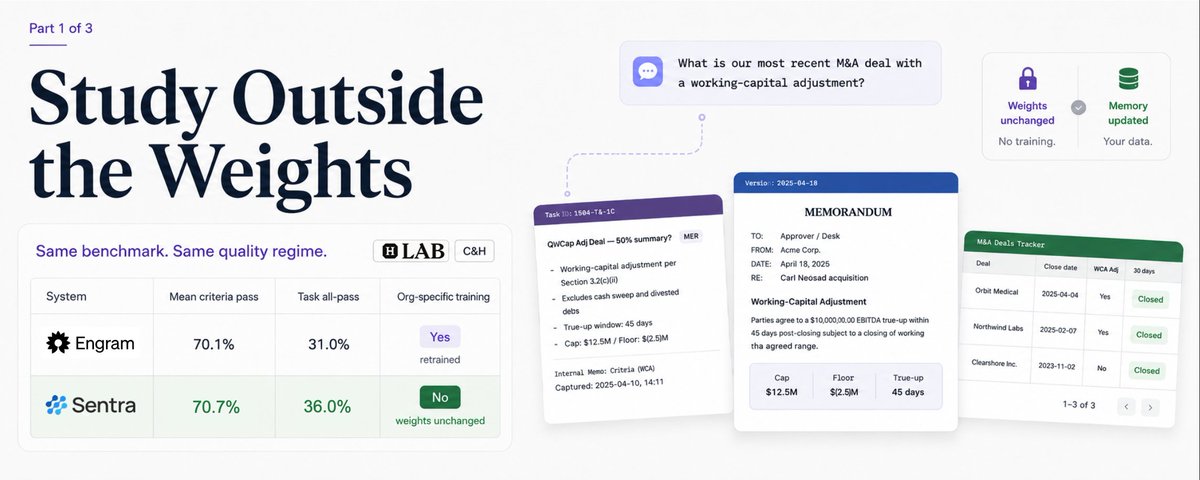
Maybe we're in a bubble. @sequoia, @kleinerperkins and @generalcatalyst put $98M into a neolab, @EngramLab, who studied a synthetic law firm, created by @Harvey, into model weights. Their results 70.1%/31%, ours 71%/36%, with no training, at same cost, using our memory system. And, all this was done by ingesting the same data in 65 minutes.
Our system is different in one specific way, nothing gets trained, cos' we treat memory as something one compiles from data rather than trained into weights. Incidentally, we got this idea from one of Engram's own angels, @karpathy, who put it better than anyone: documents are source code, the LLM is the compiler.
Sentra's non-parametric memory, in a few sentences. LLM agents compile, curate and interpret memory from data, i.e a proprietary ledger with facts, backlink to source, a time, ACL and more. At query time the ledger is recompiled to get view for the specific question and asker, then LLM reasons over it, answer, and throw the view away. Input, output and reasoning come from the model, but the knowledge doesn't and every weight stays where it was. When LLM improves everything improves but memory stays separate. This is the foundation of what we believe at our core. Rent the intelligence but own the context/memory.
The numbers, for the record: 70.7% mean criteria pass and 36.0% task all-pass with zero weights changed, against 70.1% and 31.0% from engram. Same cost per query, on a Flash-class model.

Mohan Kumar retweeted

New!! Rule of 40 Is Half Dead: Growth Is All That Matters, Margins Above 25% Don’t Help, and Category Beats Both. The Latest From Kroll dlvr.it/TVDc4m

Mohan Kumar retweeted

Plato was actually right..
Researchers proved every LLM on earth is converging on the exact same "universal geometry" of meaning.
They built a method that can translate between ANY model's embeddings without ever seeing the original text or using paired data.
different architectures, different training sets, different parameter counts.. it doesn't matter.
Until now, every AI model has lived in its own isolated mathematical universe.
An embedding vector from Claude meant nothing to GPT, and a vector from Llama meant nothing to Gemini. They spoke entirely different geometric languages.
To bridge them, you always needed paired datasets, complex encoders, or heavy fine-tuning.
Then researchers dropped a bombshell paper.
They built a system that can translate between any model's embeddings without ever seeing the original text, without encoders, and without a single pair of matching data.
How?
Because the geometry is already there.
Different models, built by different companies, with totally different architectures, parameter counts, and training data, are all naturally drifting toward the exact same underlying latent structure of human meaning.
The Platonic Representation Hypothesis isn't just a theory anymore. It’s a mathematical reality.
They built an unsupervised method that maps an unknown embedding from one model straight into a universal representation space, matching text vectors across different models with shockingly high precision.
But here is the dark side nobody is talking about.
If meaning has a universal geometry, and vectors can be freely translated across models without the original text or encoders...
Vector databases are wide open.
An adversary with access only to a company's stored embedding vectors can translate them, invert them, and extract sensitive internal documents, personal data, and proprietary codebases without ever hacking the model itself.

Mohan Kumar retweeted

The Iran war is set to leave a lasting imprint on India’s strategic thinking long after the guns fall silent. It represents a critical defining moment, just like the 1991 Indian financial crisis, which was driven by a rapid depletion of foreign-exchange reserves and external shocks like the US-led Gulf War.
Wars often force changes to help plug vulnerabilities. The current war has done precisely that for India. It has exposed vulnerabilities that many Indian policymakers understood in theory but had never experienced on such a scale: the fragility of maritime energy lifelines, the limits of multi-alignment during great-power confrontation, the vulnerability of ambitious connectivity projects to geopolitical shocks, and the revolutionary impact of low-cost autonomous weapons on modern warfare. openthemagazine.com/india/th…

Mohan Kumar retweeted

I'm a cardiologist. For my entire career I've told patients the same thing about arterial stiffness: we can slow it. We cannot undo it. I may have been wrong, and I've rarely been happier to say that. Something happened in the last few weeks that most people missed because the coverage framed it as a skincare story. It isn't. It's the first time anyone has erased a form of damage we've considered permanent since the 1980s — and they did it in a human artery.
Here's what actually happened.
Sugar reacts with the proteins in your body the same way heat browns bread. Slowly, over a lifetime, it leaves behind a residue called CML — the most abundant advanced glycation end-product in aging tissue. It welds itself onto the collagen and elastin in your arterial walls, your skin, and the lens of your eye.
Two consequences follow. Your arteries stiffen. And that residue binds a receptor called RAGE, which drives the chronic inflammation I've been writing about for months as the engine of cardiovascular disease.
Your body has no enzyme to remove it. Every approach we've ever had only slows new damage. Nothing touched what was already there.
So scientists built an enzyme that doesn't exist in nature. They screened 45,000 protein structures, then ran five rounds of directed evolution across more than 500 million variants until they had CMLase — a molecular lawnmower that strips the CML off the protein and restores the healthy lysine underneath.
They applied it to the aorta of a 75-year-old donor.
Over 70% of the damage came off. Down to levels you'd expect in a 30-year-old artery.
They also cleared over 55% from elderly skin — below the levels found in a 31-year-old — and 45-78% from lens proteins. The company's CEO said they expected 20% and were floored.
Published in Nature Communications. Revel Pharmaceuticals, with Calico and the University of Colorado.
Why this matters more than any skin headline.
Arterial stiffness drives systolic hypertension, heart failure with preserved ejection fraction, kidney disease, and stroke. It is one of the most important things that happens to a body as it ages.
And I have no drug that reverses it. Not one. I can slow the process. I cannot undo it.
This paper says undoing it may be possible.
And it isn't happening in isolation. Three things converged at once.
Senolytics. Mayo Clinic researchers showed in Nature Medicine that a combination of dasatinib and quercetin — which selectively kills senescent "zombie" cells — increased post-treatment survival in aged mice by 36%, while improving walking speed, endurance, and grip strength. Human trials are now running in diabetic kidney disease, pulmonary fibrosis, and Alzheimer's. And this month, multi-omics work showed the same combination systemically rejuvenating the aging kidney.
The first oral PCSK9 inhibitor was approved — a daily pill delivering roughly 60% LDL reduction, matching the injectables. The needle barrier that kept millions from adequate treatment just fell.
And five Lp(a)-lowering drugs are in advanced trials, three in Phase 3 with cardiovascular outcomes as the endpoint, achieving 80-95% reductions. For forty years, Lp(a) was the risk factor we could measure and could not treat — the reason the marathon runner with perfect cholesterol dies at 47. That's ending.
The honest caveats, because I won't oversell this.
The enzyme work was done on donated tissue in a dish, not in a living person. We don't yet know whether that artery became measurably more elastic — no functional data. Delivering a large enzyme deep into human tissue is a hard, unsolved problem. Clinical trials are years away.
The senolytic lifespan data is in mice. Human trials are early and small.
And nobody should be self-experimenting with any of this.
But here's what I keep returning to.
We spent a century building medicine around slowing decline. Statins slow plaque. Blood pressure drugs slow arterial wear. Even exercise and fasting only reduce the rate at which damage accumulates.
Nobody had a tool that went back and removed what was already there.
Aging, at the molecular level, is largely an accumulation problem. Most cells get replaced constantly — but a handful of proteins, collagen and elastin and the crystallins in your eye, are laid down early and essentially never recycled. They're the permanent scaffolding. Everything that happens to them over seventy years stays.
Someone just proved one category of that damage can be erased.
And while we wait, everything that determines whether you're a candidate for any of it is already in your hands:
Keep your glucose and insulin low — sugar is the raw material that creates these AGEs in the first place. Check your fasting insulin, not just your glucose.
Protect the endothelium with exercise, sleep, and blood pressure under 130/80.
Get your Lp(a) measured. Once. Most people never have, and the drugs are coming.
Know your ApoB, not just your LDL.
Because the people who benefit most from what's arriving will be the ones who kept the foundation intact long enough to receive it.
We spent a century learning how to slow the clock.
Someone just handed us the first tool that might turn it back.
Mohan Kumar retweeted

Rapamycin extends the lifespan of numerous species. A common “longevity” dose is 3 mg/once a week. New study reports a short-term rapamycin treatment (1 mg/d) improved immune & inflammatory markers, including reducing autoimmunity, but failed to reset the epigenetic clock

Mohan Kumar retweeted
1/10 I'm a cardiologist. I've recommended low-dose daily tadalafil for years — not for the bedroom, but for the blood vessels.
Most people think of these as sex drugs. I think of them as vascular drugs that happen to work below the belt.
And a study published two weeks ago suggests they may do something nobody predicted: make it harder for cancer to spread.
Here's the complete picture — the mechanism, the evidence, who should consider them, who absolutely shouldn't, and what I actually do.
Mohan Kumar retweeted

The 15 Sunrise Sector Map
Everyone debates whether Nifty is expensive. Almost nobody sits down and maps where India's next decade of capex is actually going.
I put 15 sunrise sectors side by side. The numbers stopped me. This is essentially India's growth engine, sector by sector.
Bookmark this thread. 🔖🧵
Mohan Kumar retweeted

Where @DamaniAshok makes a compelling, data-driven case for India's listed logistics sector, illustrating how growth in food, e-com, Q-com, and warehouse fulfilment centres is now generating tangible returns. And the fascinating mobility war brewing in the U.S. #MondayMobility


