




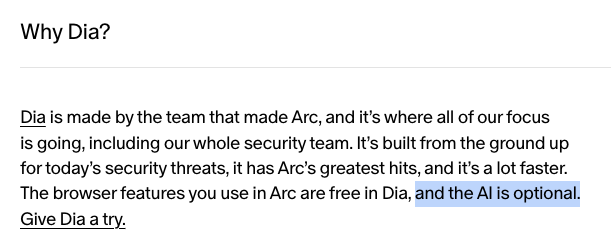
They've added "and the AI is optional" to all the Dia marketing which is hilarious because they've obviously picked up on the anti-AI sentiment but it ignores the much larger points of 1) wasn't that Dia's whole thing? and 2) what about all the missing Arc features


We've decided to sunset Arc on December 22, 2026.
That's not an easy sentence to write. We spent years building Arc and celebrating each and every release along the way: we have so much pride and love for what we made alongside the Arc community.
Our priority is to deliver best-in-class security for our members. Keeping a browser secure takes constant, dedicated work that is only increasing in the age of AI. Dia was built from the ground up to meet today’s security standards, so that's where our engineering and security teams will focus moving forward.
We've worked to make switching to @diabrowser as easy as possible for Arc members. Here's how:
· Your passwords, bookmarks, extensions and history come over to Dia seamlessly.
· Spaces, Folders, and Tab Groups are in Dia and import over with your data intact.
· Dia now surpasses Arc benchmarks in stability, speed, and security.
· The browser features you use in Arc are free in Dia, and the AI is optional.
Thank you for using Arc, for pushing us to make it better, and for building alongside us. The team that made Arc is the same team behind Dia, and some of our most ambitious work is just ahead. We'd love for you to be there with us when it lands.


You're absolutely right, I should not have allowed that mineshaft to collapse with workers still inside, and that's on me. They were the lode-baring component—
Kevin Black retweeted

Just over a month later, I have now joined @physical_int full time! Wrote a bit about why I'm excited to research simulation at Pi
stoneztao.substack.com/joini…

just arrived in SF and excited to begin my research internship at physical intelligence @physical_int working on simulation!

This is great work! And I finally get to live my dream of Schmidhubering, just once:
Using the average of rollouts from the same state as a baseline is exactly what I did in the original DDPO paper (which predates GRPO). But I thought it was boring so I put it in the Appendix :)


Interaction with the real world is the major bottleneck in robot learning. So what would robot RL look like if we didn’t need to limit compute per interaction? Our latest work, Off-Policy Generative Policy Optimization (OGPO, accepted to ICML26) embarks on answering this question (spoiler alert: when done correctly, it helps massively!).
🧵(1/N)

Kevin Black retweeted

we analyzed >100k posts from r/ChatGPT over 3 years
on one hand, we saw ChatGPT quickly become normalized as an everyday consumer product, which is pretty cool
on the other hand…


Kevin Black retweeted

POV you doordashed an air fryer and it's about to get zero-shot


oh you're using VLAs? everyone's using GRPs now. just kidding we're all on LBMs. world models are the future so we developed our own WAM. we're using DVAs. we were using UWMs but our robot caught on fire so we switched to DreamUMVLAPs. we're shipping a robot that passes butter.
Kevin Black retweeted

Robots have a "latency" problem. 🤖 💨
@kvablack explains how to use diffusion models and "Action Chunking" to make robot movements seamless—even when the AI is still "thinking."
Watch the full clip on YT! Link in replies.

I know I'm the only robot learning researcher to ever care about statistical rigor, but technically you shouldn't use standard error for a binary success rate. The binomial distribution isn't symmetrical 😅

More pretraining improves GEN-0 real-robot performance (via blind A/B evals with closed-loop rollouts).
Improvements are significant in the low-data regime, but the best models thrive with both pretraining and ample post-training.
See blog addendum: generalistai.com/blog/nov-04…

Last week I presented real-time chunking (RTC) at NeurIPS, and we did a live coffee demo the very same evening. To celebrate, we're releasing a (very short) follow-up paper describing a training-time variant of RTC, which is what we've actually been using in our demos!
The method is stupidly simple -- we simulate delay at training time by conditioning on action prefixes. It only takes about 8 lines of code to implement, but it works just as well as inference-time RTC without the extra computational overhead.

Check out the paper here: arxiv.org/abs/2512.05964
And the code: github.com/Physical-Intellig…
Hopefully some people find this useful!


Kevin Black retweeted

Our model can now learn from its own experience with RL! Our new π*0.6 model can more than double throughput over a base model trained without RL, and can perform real-world tasks: making espresso drinks, folding diverse laundry, and assembling boxes.
More in the thread below.
Kevin Black retweeted

π0.5 is a step improvement over π0. I just watch our robot fold 25 napkins in a row in 44 mins, including disentangling multiple napkins accidentally pulled into the workspace.
Knowledge insulation ftw. Congrats @physical_int and thank you for open sourcing your work.