

Microbial ecologist and musician.
Joined August 2017
- Tweets327
- Following732
- Followers387
- Likes1.9K


Pinned Tweet
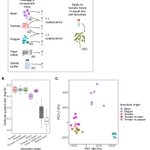
We have a new paper out in Cell Host & Microbe! We performed a microbiome passaging experiment to examine the interaction between host filtering and inter-host microbiome transmission. Here’s the TL;DR
sciencedirect.com/science/ar…
What up y'all! My latest album is up on bandcamp (also Spotify other streaming services starting tomorrow), check it out! Shout out to slow moving precipitation belts.
trespasses1.bandcamp.com/alb…

Kyle Meyer retweeted

Shaping of the phyllosphere microbiome: @bkoskella & Co manipulate plant #microbiome transmission over multiple generations to show how microbiome host specialization and generalism can arise without impacting plant fitness or gene expression cell.com/cell-host-microbe/f…

Excellent summary of our recent paper in @cellhostmicrobe. Thank you to @melissa_y_chen and @Cara_Haney for their thoughtful piece.

It takes a plant village to raise a microbiome. @melissa_y_chen @Cara_Haney discuss @bkoskella work on host history & #plant #microbiome inheritance. Transmission from same vs diff plant species results in microbiota specialization vs host generalism cell.com/cell-host-microbe/f…

Thus it appears that transmission shapes host filtering by altering the species pool that selection acts on. Conspecific transmission reinforces host filtering, driving host specialization, while host swapping disrupts specialization by imposing a broader set of host filters
Thanks to @bkoskella , Steve, and @CJEMetcalf for their mentorship and help. And thanks to Isabella Muscettola, Ana Vasconcelos, and @SwimmerJulya27 for their commitment to getting this massive project pushed all the way across the finish line.

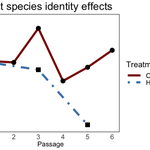
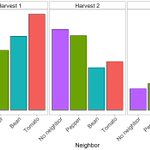
Next we inoculated the 3 host swapping lines and one conspecific line onto a set of novel plant species and found that the host swapping lines were all less impacted by host filtering relative to the conspecific line.

Interestingly, when we examine leaf transcriptional activity and plant health/fitness across treatments we found no differentially expressed genes and no differences in health or fitness, suggesting specialization of leaf microbiomes had no discernible impact on the hosts.
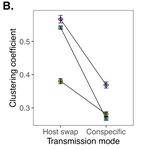
The microbiomes that underwent host swapping all exhibit a higher co-occurrence network clustering coefficient. One interpretation of this is that these networks may be more resilient (or disturbance tolerant), since the loss of any node would be less impactful on the network.


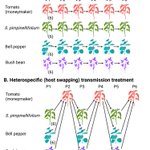
The main experiment consists of 6 passages across 4 replicated species of plants, and two transmission treatments: conspecific (within species) and heterospecific (between different species, aka host swapping).


Kyle Meyer retweeted

Are you a researcher from Brazil and are you interested in coming to Berlin?
Consider applying for a Humboldt-CAPES Fellowship!
Our lab works on global change, soil biodiversity, fungal ecology/ molecular ecology (including mycorrhiza).
humboldt-foundation.de/bewer…

What up y'all! Check out my latest album - up on bandcamp now and soon on Spotify, YouTube, etc.
I'd like to thank the many and varied forest floors that went into the making of this album.
trespasses1.bandcamp.com/alb…

Kyle Meyer retweeted

Amazing opportunity for a postdoctoral fellowship @StanfordEnergy 👀Are you excited by bioenergetics of photosynthesis and the CCM? This is an great opportunity to develop crossdisciplinary research on energy & sustainability with us! @carnegiescience
energypostdoc.stanford.edu
Kyle Meyer retweeted

Dispersal and transmission can play an important role in microbial community assembly, dynamics and function. Want to know more? See our new @FrontMicrobiol Research Topic e-book tinyurl.com/4ctnsxaz
Guest editors include @kylemmeyer1, Z Wei, @posybusby, S Lindow and @DrMicrob

The editorial for our special issue in @FrontMicrobiol is out! The topic is the role of dispersal/transmission in microbiome assembly and function. Guest editors include @PeterDeines_, Zhong Wei, @posybusby, Steve Lindow, @DrMicrob, and yours truly.
doi.org/10.3389/fmicb.2022.1…
Hey #ISME18 folks! I'll be talking about our recent project using experimental passaging of phyllosphere microbes to study how transmission mode impacts microbiome assembly and host specialization. Tuesday 11:30 (MS09 -Evolution of microbial communities). Come check it out!