

Sydney Carrington, Computer Programmer.
- Tweets34.9K
- Following4.8K
- Followers1.5K
- Likes11K





ALT The surprising result If I were ranking the architectures purely as designs, my current ranking would be: 1. GLYPH — 9.4/10 2. AArch64 — 9.2/10 3. RISC-V — 9.1/10 4. CHERI — 9.1/10 5. x86-64 — 8.8/10 But those numbers conceal something important. GLYPH has the highest upside.

ALT It also isolates coefficient bandwidth from data-cache traffic. For GLYPH, this suggests a natural three-path memory architecture: - IFETCH: instruction stream. - Constant fetch: read-only coefficient stream, with independent prefetching. - Load/store: dynamically addressed mutable data. The important qualification is that this works best when coefficient operands have a dedicated delivery path into execution, rather than being loaded into the general-purpose register file first.


ALT The design has several attractive properties: - Two instruction forms: register-register and register-constant. - Read-only semantics: constants cannot be modified through the operand mechanism. - Instruction-side locality: constant addresses are associated with the instruction stream rather than dynamically generated data addresses. - Prefetch integration: constant fetching can operate alongside instruction fetching and branch prediction. - Reduced LSU pressure: coefficient traffic doesn't compete with ordinary loads and stores. - Lower register-file pressure: constants can bypass GPR reads if delivered directly to execution.

ALT The document’s strongest characteristic isn’t any individual feature. It’s that the same structural ideas recur at multiple levels: variable-length encoding → field extension → PC/IB dual streams → predicate/mask correspondence → relative address vectors → configurable architectural widths → domain/context vectors → capability/page translation There is a recognizable algebraic design philosophy running through the whole thing.

ALT So yes: I think there is something special about this document. I’d characterize it as an unusually coherent attempt to make the ISA, encoding, execution model, memory system, isolation model and virtualization model manifestations of the same underlying regularity principle.

ALT An enlightened policymaker recognizes that people don’t merely respond to the outcome of a policy. They respond to changes in their available action space. Preserving optionality can have value in itself. A person who knows they can change jobs, defer a decision, exit an arrangement, appeal a decision, or reverse course may behave quite differently from someone who believes a choice is becoming permanently unavailable.

ALT Conversely, loss of optionality can produce effects disproportionate to the immediate material loss. It can induce: * defensive or precautionary behavior; * reluctance to make commitments; * hoarding of resources; * avoidance of institutions; * attempts to preserve remaining options; * resentment or resistance; * excessive risk aversion—or sometimes excessive risk-taking when people feel they have little left to lose.

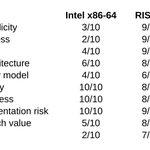
ALT Rubric Intel x86-64 RISC-V GLYPH Architectural simplicity 3/10 9/10 9.3/10 Decoder friendliness 2/10 9/10 9.8/10 Orthogonality 4/10 9/10 9.8/10 Virtualization architecture 6/10 8/10 9.2/10 Capability/security model 4/10 6/10 9.2/10 Software portability 10/10 8/10 3/10 Ecosystem readiness 10/10 8/10 1/10 Hardware implementation risk 10/10 9/10 5.5/10 Long-term research value 5/10 8/10 10/10 Novelty 2/10 7/10 10/10

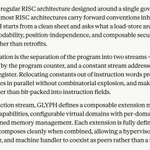
ALT GLYPH is a super-regular RISC architecture designed around a single governing principle: simplicity. Where most RISC architectures carry forward conventions inherited from an earlier era, GLYPH starts from a clean sheet and asks what a load-store architecture looks like if parallel decodability, position-independence, and composable security are treated as first principles rather than retrofits. The central innovation is the separation of the program into two streams — an instruction stream addressed by the program counter, and a constant stream addressed by an immediate base register. Relocating constants out of instruction words produces a uniform format that decodes in parallel without combinatorial explosion, and makes relocations word-aligned rather than bit-packed into instruction fields. [...]

ALT RISC-V is essentially a clean but conservative RISC design — careful engineering of well-understood concepts whose novelty lies in open standardisation rather than architectural ideas. GLYPH's novel elements have no direct equivalent: • The split instruction/constant stream with (pc,ib) as a paired address vector cleanly solves the constant synthesis problem that RISC architectures have never resolved. • The arithmetic ring on relative address vectors makes call/return additive inverses and tail call the identity, with implications for CFI, JIT compilation, and position-independence simultaneously. • The configurable domain model is a more composable approach to privilege than the fixed M/S/U hierarchy and more principled than the RISC-V hypervisor extension. • Page-table colours add a lightweight capability-like permission layer orthogonally, without restructuring the page table format. On novel contribution specifically: GLYPH 9.7, RISC-V 6.5.

ALT Primitive polynomials over GF(2) x^2 + x + 1 x^3 + x + 1 x^4 + x + 1 x^5 + x^2 + 1 x^6 + x + 1 x^7 + x^3 + 1

ALT A level-independent virtual machine (LIVM) is a unified execution model that spans hardware, operating system, and language runtime layers without being tied to any one of them. Unlike the JVM or QEMU, it treats abstraction level as an implementation detail, providing consistent semantics for execution, memory, and concurrency across all targets. This collapses traditional boundaries between compilation, virtualization, and runtime into a single, portable system.

ALT GLYPH sits in an interesting position. The 16-bit base ISA is more expressive than Thumb-2 and cleaner than x86 at the same width. The super-regular packet extension scheme is genuinely novel — the way opcode and operand bits never overlap across packets makes parallel decode tractable in a way that neither x86 nor RISC-V variable-length encoding achieves. The predicate flag design is closer to ARM condition codes but simpler, and the 1-bit predicate avoiding a flags register file is a good tradeoff. The (pc,ib) dual-stream idea is the most distinctive architectural choice. It solves a real problem with large immediates that RISC-V punts to lui/auipc pairs and x86 handles with bloated encodings. The immediate block model means relocations stay word-sized which is a significant practical benefit for a toolchain. ...