

Norwegian photographer & artist. Exploring light, movement, time and identity since 1974. Movement / New Light. Based in Tallinn. [email protected]
Tallinn, Kesklinn
Joined January 2010
- Tweets4.8K
- Following19.7K
- Followers87.1K
- Likes3.6K




Pinned Tweet
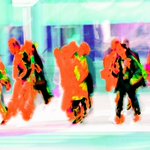
I started the Movement Series photos in 2018. My friend has followed me since 1972/73 and commented that I have always been involved in movement. Of course he is right. I thought I had invented something new in 2018. The new is probably just new technology and many more exposures

Movement
Some days, the world keeps moving around you, while you are left with the feeling that you no longer belong to it. Life goes on, but somehow without you.
96135713_6
#Movement #Photography

Movement 見えない出会い
都市の中で、人々はそれぞれの目的地へと向かっています。
互いを知らず、言葉を交わすこともなく、ほんの一瞬だけ同じ空間を共有する。その偶然の重なりに、私は魅力を感じます。
私の写真において、動きは単なる被写体ではありません。予測できない出会いが、新しい形や関係を生み出す瞬間でもあります。
2020年の作品より
Movement The Unseen Encounter
In the city, people move towards their own destinations.
They may never know one another or exchange a single word, yet for a brief moment, they share the same space. It is this accidental meeting that fascinates me.
In my photography, movement is more than a subject. It is the moment when unpredictable encounters create new forms and relationships.
Works from 2020


Architecture is usually photographed as something fixed and permanent.
I often look for something else. Repetition, intervals, lines, windows, shadows and reflections can create a visual rhythm that changes the way a building is perceived.
At that point, architecture becomes less about documenting a structure and more about discovering an image already hidden inside it.


動きはほんの一瞬で終わりますが、写真はその動きに別の時間を与えます。
私は50年以上にわたって動きを撮り続けてきましたが、今でも、普段なら気づかれずに消えてしまう小さな身振りに惹かれます。体の向き、腕の動き、一歩、人が画面を横切る瞬間。
写真は時間を止めます。しかし時には、止まった写真の中に、実際の一瞬以上の動きが残ることがあります。
A movement can last only a fraction of a second, but the photograph gives it another life.
I have worked with movement for more than fifty years, and I am still fascinated by the small gestures that normally disappear unnoticed: a turn of the body, an arm, a step, someone crossing the frame.
Photography stops time, but sometimes the stopped image can contain more movement than the moment itself.


Movement
From one of my earliest Movement series, 2019. Photographed on film I produced myself, when the language of Movement was still being discovered through experimentation, chance and imperfection.
95892125
#Movement #Photography

I began photographing myself in the 1970s and have returned to the self portrait many times since.
For me, these photographs are not primarily about appearance. They are markers of time. The person in front of the camera changes, the cameras change, and the circumstances change, but the act of making the photograph creates a connection between very different periods of a life.
Looking at the images together, the distance between decades can sometimes feel surprisingly small.


色は物事を非常に正確に伝えることもできますが、その逆の働きをすることもあります。
New Light では、色が元の物体から離れ、独立して見えることがあります。そこに残るものは、場所の記録というより、その場所の記憶に近いものになります。
記憶も同じなのかもしれません。細部は消えていきますが、ある色や光、感覚だけが残ります。
Colour can describe something very precisely, but it can also do the opposite.
In New Light, colours often separate themselves from the objects that produced them. What remains may feel less like a record of a place and more like a memory of one.
Perhaps memory works in much the same way. Details disappear, while certain colours, lights and sensations remain.


Movement では、人の姿そのものと同じくらい、その周囲の空間も重要です。
人物が写真の中で占める面積は小さくても、その動きによって画面全体が変化します。街路、壁、影、光までもが、その動きに反応し始めます。
私にとって写真は、人と、その人が通り過ぎる空間との間に存在しています。
In Movement, the human figure is important, but so is the space around it.
A body may occupy only a small part of the photograph, yet its movement changes the whole image. The surrounding streets, walls, shadows and light begin to respond to that movement.
For me, the photograph exists somewhere between the person and the space the person is passing through.

In New Light, color is not simply something added to the image. It often becomes the structure of the image itself.
Areas of color can replace recognizable objects, while lines, reflections and fragments begin to form their own visual order.
The original subject may still be present somewhere underneath, but I am more interested in what happens when photography moves away from description and color begins to build a new image.

