

Research Fellow at MMlab@NTU, working on Embodied AI and Visual Reasoning.
AoE
Joined June 2023
- Tweets128
- Following421
- Followers536
- Likes192


LLM agents team up well on coding and writing. On real robots? @he_zexin's work shows there's still a lot of room to improve.
A simple and effective heuristic notably boosts real-world execution speed 🚀🚀, "liberating" agents from long-horizon household works 😂

We are glad to introduce ACAP: Asynchronous Coding Agents as Policy 🤖 S-Lab NTU × Oxford × ACE Robotics
One robot, a team of coding agents. Each robot part has its own agent, coordinated by a hyper-agent.
All on real robots: 28.2% less time than a single coding agent. 🧵
2
6
261
A good harness unleashes the full power of Astra, and @DRAVEN_ALG's paper clearly reveals the key ingredients for designing a solid robot-use harness 🚀
Beyond beating the benchmark, its analysis of behavioral patterns offers new clues on how Astra-like models could be trained, which is of real practical interest.

What makes frontier models work as robot policies?
Embo-Harness distills a recipe: see wider, reason harder, and predict where to act—reaching 83.3% on RoboLab-120.
Watch the demo.
Project: dravenalg.github.io/projects…
Paper: arxiv.org/abs/2611.31201
Code: github.com/DravenALG/Embo-Ha…
5
197
Want SoTA visual reasoning with diffusion models? @sze68zkw's ViDecide is a must-read.
What makes it work:
- Causal architecture
- Frequent high-noise sampling
- Post-training adapted to the diffusion pipeline
Checkout the paper for details: huggingface.co/papers/2611.2…


Can we teach video diffusion models to reason and plan step by step, much like LLMs?
Introducing 🎬 ViDecide: a decision-centric framework for reliable visual reasoning and planning.
Key highlights:
- Causal generation with adaptive termination.
- Decision-centric diffusion training schedule.
- A new post-training approach, Corrective Fine-tuning (CFT), that outperforms GRPO, DiffusionNFT, and RFT.
Together, they boost the average success rate from 23.3% to 83.8% across logical reasoning and robot planning tasks!
Awesome work by Kaiwen @sze68zkw and the team!
🌐 Project: kevin-thu.github.io/ViDecide…
📄 Paper: arxiv.org/abs/2611.26389
💻 Code: github.com/Kevin-thu/ViDecid…
2
5
278
“hard assignment + differentiable weights” could be a standard recipe for learned grouping, covering both this work and MoE.
Btw, in row 2, LeBron’s “AAAAHHHHH” survived compression with zero loss 🤣

(1/4) why do image models chop every picture into the same square patches? 🤔 (hint: they shouldn't)
following the bitter lesson, we let diffusion models *choose* how to tokenize an image. it spends fewer tokens on the boring background, and more tokens on our faces! 🧵
1
211

During the ICLR 2027 review, I tried a more subjective tone to organize my judgment without LLM polishing, at the cost of potential typos and a more opinionated voice.
Still, I believe it's better to provide authors with a clear signal that they are reflecting on, responding to, and complaining about feedback from a real human. So those tricks for hacking AI reviews won't be necessary for a good paper to be accepted, and won’t help an AI-generated paper get through.
🤖 Made with AI

1
2
492
On-policy self-distillation is getting popular fast, but taking it to Test-Time Training for long-horizon agents with solid gains is quite interesting and nontrivial.
Added to tomorrow's detailed reading!

New paper! ASCENT, Online Test-Time Training of Long-Horizon Agents via Self-Distillation of Verified Experience. arxiv.org/abs/2610.05303
LLM agent trains its weights online while deployed, one attempt per task, no reference solution or stronger teacher.
Self-evolving agents mostly store reflections, memories or skills as text in the harness. Each gain then depends on retrieving the right item and on a frozen model following it over a long episode.
Parametric learning of agents is often with off-line situation or multiple rollouts/attempts.
Can the experience go into the weights instead, like the evolving with text at the harness level?
We study Online Agentic Test-Time Training (OaTTT).
Tasks arrive in one pass. The agent makes a single multi-turn execution per task and gets one binary verification at the end. That trajectory is the only training data, and the weight update carries to later tasks.
Some obvious approach fails.
We tested some straightforward per-episode LoRA baselines that imitate (like RFT, RFT+KL) or reinforce (REINFORCE) the agent's own tokens. All drift from the base, emit more invalid actions, and in the second half of the stream succeed less often than the base.
These losses only push the sampled token up or down. With one trajectory per update, its noise is never averaged, and the next attempt comes from the updated policy. Errors compound and the distribution sharpens around the agent's own outputs.
ASCENT: self-distill verified experience. Self-distilling the verified experiences and the hindsight in the successful trajectories into the weights.
1. Verify-gated. Only an episode that passes verification triggers an update; failures are skipped (That might be better if failure can be incorporated.).
2. Hindsight teacher. The frozen initial copy of the LLM reads the whole verified trajectory as privileged information ("GOAL ACHIEVED… solved by the following…") and predicts next-token distributions along the agent's own responses.
3. Self-distillation. The student (base + LoRA fast weights) minimizes forward KL to these distributions at every response token. The logit gradient is p − q instead of ω(p − e_y): alternatives the teacher prefers rise, and the sampled token falls when the teacher disagrees.
4. Action-validity filter. Turns whose action the environment did not execute are removed from the teacher's input. The student is still trained at those positions, so the teacher can push invalid actions down. No turn-level reward or credit assignment is needed.
A preliminary validation on co-evolving of weights and harness is conducted.
Benchmarks
Validated with Qwen3.5-4B/9B on ALFWorld (text-based household); WebShop (simulated web store); AppWorld (interactive coding with apps).
Results
• ALFWorld: 46.4 → 69.5 (4B), 55.0 → 77.4 (9B)
• WebShop strict success: 17.8 → 41.9 (4B), 17.2 → 41.5 (9B)
• Best of all compared methods on both, with the fewest turns
• Gains grow later in the stream. On tasks the base also solves, ASCENT uses fewer turns on 64% (4B) and 67% (9B) of them.
• Held-out ALFWorld scenes, weights frozen: 43.3 → 62.7 (4B), 49.3 → 88.8 (9B)
• AppWorld Test-Normal task completion (4B): 20.2 → 26.2
Ablations
• Reasoning in the privileged information matters most; action-only hindsight is near the base.
• Full-trajectory hindsight beats a turn-local teacher (TT-OPSD).
• Adding ASCENT improves in-context memory methods (ACE, MemP); at 9B both combinations beat ASCENT alone.
Self-improvement can happen at many layers: the harness, external memory, the weights. ASCENT works on the weights.
Joint work by Haodong Lu & me @ Artificer AI Lab, UNSW. Most credit must go to Haodong!
📄 Paper: arxiv.org/abs/2610.05303; huggingface.co/papers/2610.0…
🌐 Project: artificer-ai-lab.github.io/A…
2
337
How much 3D do you actually see in a photo? 👀
A depth map stops at the visible surfaces. Our #ICML2026 paper LaRI (ruili3.github.io/lari) goes further: predicting the hidden geometry with layered point maps, in one feed-forward. (1/3)

⭐ We also build the Data: ~290K layered annotations across 5 datasets (Objaverse, 3D-FRONT, ScanNet++, SCRREAM, GSO). More importantly, we've released the FULL annotation script for generating 🚀your own data🚀. (2/3)
github.com/ruili3/lari/blob/…

A typical Haofei-style work: simple but highly effective!

Does 3D reconstruction have to be complex?
We answer this question with PointDiT (#ICML2026): a minimalist pixel-space Diffusion Transformer without bells and whistles.
We show that a plain ViT can estimate dense 3D point maps by operating directly on raw patches. No hybrid ViT+Conv architectures, no lossy VAEs, no complicated training losses. (1/5) 🧵👇
(1/13) Back on Track: Bundle Adjustment for Dynamic Scene Reconstruction
TL; DR: A bundle adjustment method disentangling camera and object motion for consistent 3D reconstruction in dynamic scenes.
📃Paper: arxiv.org/abs/2504.14516
🏗️Project: wrchen530.github.io/projects…

Another major update of the "awesome-dust3r" (github.com/ruili3/awesome-du…) paper list.
There are more VGG-T follow-ups and some interesting correlations, e.g., VGGT-Long/LONG3R, STream3R/Streaming 4D-VGGT.
Let's see what happens for visual geometry in the DINO-v3 era :)

There are already hints of applying DINO-v3 for visual geometry tasks:
- teapawt.net/chrisoffner3d/status/1…
- teapawt.net/MichaelRamamon/status/…

Getting crisp depth maps with DINOv3? → Yes, just put a frozen ❄️DINOv3 in DepthAnythingv2, and you'll get even better results for relative depth (weights available)! First time plotting those depth maps was🤯, @AntonObukhov1 my friend, I'm proud we can rival Marigold! More 3D👇

1
457
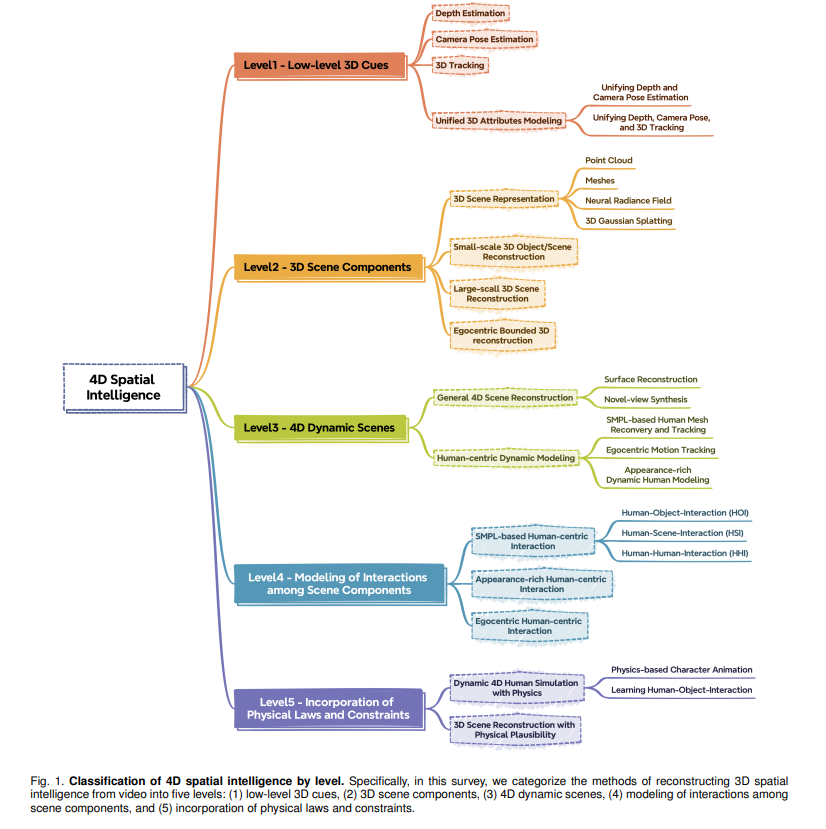
Yet another structured paper for beginners in 3D computer vision.

Reconstructing 4D Spatial Intelligence: A Survey
@yukangcao, Jiahao Lu, Zhisheng Huang, Zhuowei Shen, Chengfeng Zhao, @hongfz16, @Frozen_Burning, Xin Li, Wenping Wang, @YuanLiu41955461, @liuziwei7
tl;dr: in title
arxiv.org/abs/2507.21045
Recent update of🚀awesome-dust3r: github.com/ruili3/awesome-du…🚀
- A new trend of 3D geometric reasoning: LaRI (ruili3.github.io/lari), RaySt3R (rayst3r.github.io/), Amodal3R (sm0kywu.github.io/Amodal3R/).
- A new direction for DUSt3R4Science: CryoFastAR (arxiv: 2506.05864).
Btw, the code and data of LaRI have been released: github.com/ruili3/lari

Introducing LaRI (ruili3.github.io/lari), a📸single-view,🚀single-feed-forward method to model🙈unseen 3D geometry using layered point maps. It
✅seamlessly extends depth estimation
✅unifies object- & scene-level reasoning
✅builds training & eval datasets
Details👇

🚀 Details of the #CVPR2025 award candidate papers are out.
14 of 2967 accepted papers made the list, spanning 3D vision, embodied AI, VLMs/MLLMs, learning systems, and scene understanding. 3D vision leads with the most entries.
I collected the TL;DR, paper, and project links👇
(1/14) Molmo and PixMo: Open Weights and Open Data for State-of-the-Art Vision-Language Models
TL;DR: A top-performing open VLM trained on public data, surpassing Claude 3.5 and Gemini 1.5, just behind GPT-4o.
📃Paper: arxiv.org/abs/2409.17146
🏗️Project: allenai.org/blog/molmo

📢 Extensive update to the awesome-DUSt3R paper list is now available: github.com/ruili3/awesome-du….
Excited to see the recent surge of innovative papers, particularly in dynamic scene reconstruction (e.g., Easi3R, ODHSR, DPM, Geo4D). Stay tuned for more updates!
1
9
395

Learned priors are useful in improving the discrete, noisy 3D predictions from DUSt3R/MASt3R. This paper has been added to the 🚀awesome-dust3r🚀 list, check out for more details at: github.com/ruili3/awesome-du…
Spurfies: Sparse Surface Reconstruction using Local Geometry Priors
Kevin Raj, Christopher Wewer, Raza Yunus, @EddyIlg, @janericlenssen
tl;dr: neural point representation
disentangles geometry & appearance; pre-train geometry prior on synthetic dataset
arxiv.org/pdf/2408.16544


A nice way to organize an international reading group? 😄

arXiv -> alphaXiv
Students at Stanford have built alphaXiv, an open discussion forum for arXiv papers. @askalphaxiv
You can post questions and comments directly on top of any arXiv paper by changing arXiv to alphaXiv in any URL!
1
174
🚀 At #CVPR2024? Stop by Poster #20 (Arch) on Thursday, 10:30-12:00 to chat about our single-view 3D scene reconstruction using vision-language priors and spatial reasoning!

Are you at #CVPR2024 and interested in single-view 3D scene reconstruction? 🧐
Visit our poster tomorrow to see how we use vision-language semantic priors and spatial reasoning to enhance occluded region geometry!
🗓️ Thursday, June 20
🕙 10:30 - 12:00
📌 Poster 20 (Arch)
1
266