

Building tools for thought 🧠, for you & your agents: ◦ https://teapawt.net/t.co/ahlAs1TVg1 maps your notes into a concept graph ◦ https://teapawt.net/t.co/AFPzxJP7P0, all-in-one local research workbench
Install Jotaid →
Joined March 2007
- Tweets2.7K
- Following13
- Followers660
- Likes330


Pinned Tweet
Jotaid combines full-featured note-taking with AI, so you can finally understand (ask) the patterns, knowledge graphs, and complex relationships hidden in your notes.
🚀 Scholardo is now available on the Microsoft Store
Scholardo is an AI-native research workspace built for researchers, academics, students, and knowledge workers.
From discovering papers and reading to managing references, taking notes, writing, and creating presentations—all in one place, with AI agents working alongside you.
Less time managing tools. More time thinking and researching.

If you're interested, give it a try on Windows!
apps.microsoft.com/detail/9n…

8/
I built these ideas into Jotaid, a native note app for Mac and iPhone.
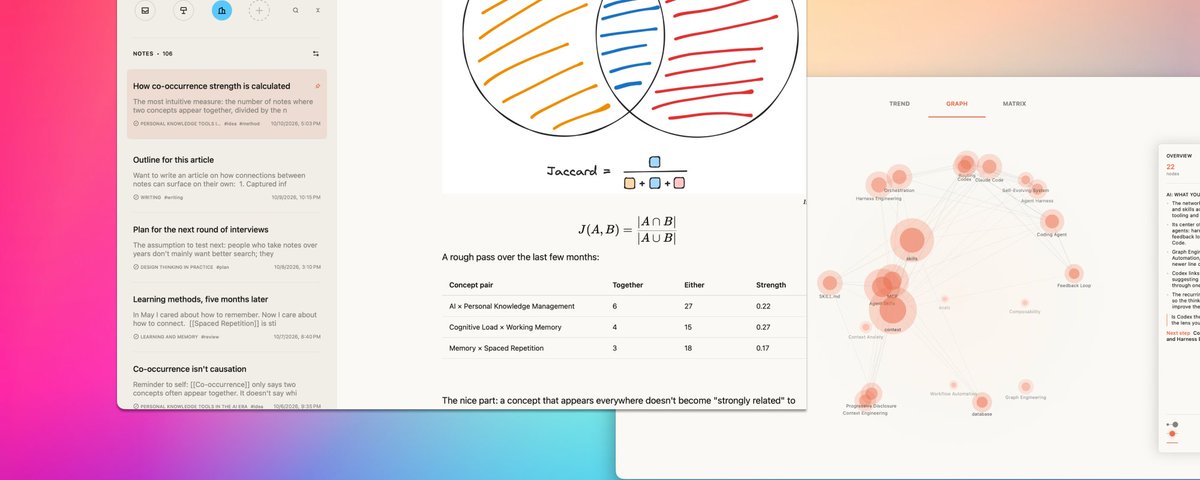
Concept pages, a co-occurrence matrix, trends, and themes on a canvas.
> Free: a full single-project workspace, not a trial.
> Pro: AI, multiple projects, and MCP access on Mac.
jotaid.com/blog/posts/why-i-…

Most note apps help you store information.
I’m building Jotaid around a different idea: every note should strengthen connections, reveal themes, and make your knowledge more useful over time — for you and your AI agents.
Jotaid is on Product Hunt today:
producthunt.com/products/jot…

Jotaid is now on @Raycast ⚡️
→ Search your Jotaid notes instantly
→ Send selected text straight to your Inbox
→ Create a note from anywhere
Jotaid already has Quick Capture with ⇧⌘J. Now, Raycast gives you another way to bring Jotaid into your workflow.

ALT https://www.raycast.com/leeron/jotaid

What if your notes could show you how your thinking has changed?
Jotaid connects your notes through concept nodes—but the interesting part is what happens when you add time.
You can see what concepts kept appearing, what you started caring about, and how your thinking shifted over weeks, months, or years.
It’s not just a knowledge graph. It’s a timeline of your cognitive evolution.
And soon, you’ll be able to ask an Agent through MCP to dig into the patterns behind the graph.
Coming soon.
MHS is essentially an MCP layer for the physical world.
It extends AI agents beyond software and data — allowing them to operate microscopes, robots, lab equipment, and other real-world devices.
AI is no longer just calling APIs. It’s starting to operate the physical world.
Anthropic is definitely a company that leaves me conflicted.
Note-Taking: Making Knowledge Agent-Ready
I set out to build a better alternative to Obsidian. Jotaid’s knowledge graph & co-occurrence matrix led somewhere bigger: Agent infrastructure.
With MCP in the future, Agents could access the Jotaid graph as domain-specific knowledge, memory, or even an ontology.
Its concept-level entity nodes are far more granular than Obsidian’s file-based nodes, with edges designed around Graph Engineering.

I copied a messy, unformatted research paper into Jotaid — broken structure, mixed text, and lots of equations.
Then I clicked Tidy up to format.
A few seconds later: clean Markdown, proper headings, lists, spacing, and beautifully formatted equations.
Paste. Format. Done.
This is how AI should make working with knowledge effortless.