

Agents do the work across the systems national security teams already use. You stay in charge, and every action is attributed. Runs on classified networks.
San Francisco, CA
Joined August 2022
- Tweets222
- Following19
- Followers160
- Likes22






Pinned Tweet
The XVIII Airborne Corps G2 spent Scarlet Dragon 26-01 on tactical SIPR, with no connection to the cloud.
An INTSUM that took about four hours came back in about five minutes, then went to an analyst for review.
"I can spend my time doing critical thinking and analysis, rather than finding information and formatting a document," one Army all-source analyst said.
That work ran on Centurion by Legion Intelligence. Today, Centurion is how Legion Packs, and the controls they run under, reach units that can't count on the cloud. In the Indo-Pacific, that's the condition planners already assume.
na2.hubs.ly/H084p0V0

65
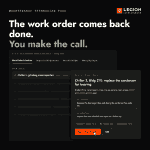
The Intelligence Officer Pack from Legion Intelligence drafts the daily intelligence summary from the reporting your analysts already use. Then the commander asks for a section the summary doesn’t carry yet.
The intelligence officer describes it in plain language. Legion proposes the steps, and the officer approves each one before anything runs.
The new section follows the same permissions and approvals as the rest of the Pack, and every action is attributed. The officer can’t grant themselves new access along the way. Administrators keep that authority.
Start with the Pack, then shape it to what your commander asks for.
legionintel.com/platform/leg…

11
Today in Washington, DC: The Decision Clock. At 1630 ET, @WarOnTheRocks hosts a live conversation with Cameron Stanley, Chief Digital and AI Officer at the Department of War, on how the department buys and fields AI.
Legion Intelligence is the evening’s sponsor and leads the Decision Clock exercise that follows, a moderated decision-speed scenario with open discussion. CEO @DavidNorthStar (Ben Van Roo) opens and closes the night.
Listen to the livestream: legionintel.com/events/decis…

Ben Van Roo on the @WillCainShow today: the fix for outages like these is spreading AI out, not centralizing it.
“You can’t centralize what just happened.”
It’s why Legion runs on your own networks, even with no connection.
Watch Ben below.

“DOOMSDAY HYPE”: Ben Van Roo pushes back on panic over tech outages
Yurts founder and CEO Ben Van Roo warns that reacting to the outages by centralizing AI could create new vulnerabilities—and distract from strengthening networks.
24
Before anyone can judge a staff brief, someone has to assemble it from the estimates, the latest reporting and the last version.
For an executive officer at U.S. Special Operations Command, Legion Intelligence did that assembly. Brief preparation reduced from ~40 hours to a first draft in under 5 minutes, plus 1-2 hours of review (~90% less time).
The officer still owned what went out, with most of a work week back. The Operations Officer Pack, built for J-3 and S-3 staff sections, is linked below.
1
1
24
When a FRAGO lands and ISR coverage drops, the Operations Officer Pack reads both against the current order and running estimates, sets out the decision the commander faces, and drafts the products. Nothing goes out without the staff’s approval. legionintel.com/legion-packs…

8
A maintenance lead builds a shift-handoff tool with AI in an afternoon. It flags any issue still open after one shift, because a hydraulic leak once sat for two shifts without anyone above the line seeing it. That reason never makes it into the tool.
A second shop copies it. Their records post hours later, so the rule flags finished work that hasn’t been recorded yet. Nobody can tell whether changing the threshold removes a safeguard, so they keep it and check every flag by hand.
Matt Hooper, Principal Engineer and Site Lead at Legion Intelligence, calls this tribal knowledge in software form. His fix is to record the tool’s purpose, its limits and the reasons behind local choices while it’s being built.
In Legion, administrators keep authority over permissions and the approvals each step requires, and teams change the rest to fit their shop. Before you copy a tool from another shop, ask for the reasons behind its rules.
legionintel.com/command-pape…

22
At Scarlet Dragon 26-01, intelligence summary (INTSUM) production time was reduced from ~4 hours to ~5 minutes (48x faster). Analysts reviewed and refined the draft prior to dissemination.
The XVIII Airborne Corps G2 ran Centurion by Legion Intelligence on a portable, on-premises server on the Corps’ tactical SIPR (IL6) network, without reach-back connectivity. The system was installed in a single day, and most users became proficient within one hour.
The same Legion Packs run in the cloud, on-prem, air-gapped and at the edge, so the work keeps moving when the connection drops. The case study, with the Target System Analysis results, is linked below.
1
19
An Army All-Source Analyst at the evaluation put it this way: “I can spend my time doing critical thinking and analysis, rather than finding information and formatting a document.” legionintel.com/resources/ce…

6
A procedure changes, and someone has to update the AI application that carries it out.
Chris Hume, Chief Business Officer at Legion Intelligence, uses that moment to define sovereign AI. Owning the infrastructure is part of it. The harder part is whether your own staff can revise the workflow, test it, and keep a record of which procedure and approvals governed each job.
Any supplier can describe its controls, so Chris’s test is a demonstration on a real workflow. He applies it to every supplier, Legion included. Bring one of your workflows and your own data, and judge us on that.
legionintel.com/command-pape…

14
New federal guidance meant SLAC National Accelerator Laboratory had to change wording in its contracts and policies. First it had to find which documents the guidance touched, and they sat in different systems.
SLAC’s IT team gathered the contracts, policies and compliance records into shared collections in Legion Intelligence, then used Legion to pull the ones the guidance likely affected. The result was 90% less time spent retrieving documents for contract compliance.
Legion found the documents. The contract assurance team decided what changed. The case study is linked below.

1
8
With everything in one place, contract owners, IT and compliance worked from the same set of documents, and the team’s time shifted from finding documents to fixing them. legionintel.com/resources/sl…
6
When an aircraft is grounded, the supervisor’s first hours go to rebuilding the next step from the repair history, the tech order, supply status and whoever was on shift.
The Aviation Maintenance Pack from Legion Intelligence does that gathering from your own maintenance, supply and technical publication systems. It pulls the open discrepancies, past fixes and parts status into a recovery plan the supervisor can review.
Nothing becomes maintenance direction until the supervisor approves it.
The Pack is running in weeks, and your existing systems stay the system of record.
Take the Aviation Maintenance Pack tour: legionintel.com/legion-packs…
15
A contracting officer can now start the review from a drafted requirements package, built from past awards and the program’s own documents, with the gaps flagged.
Every source and change is already on the record. The signature is still theirs.
Legion Intelligence builds a Legion Pack around one job like this. There are Packs for intelligence and maintenance work too.
See the jobs teams bring to Legion.
na2.hubs.ly/H08L79C0

16
Today at 11 AM ET: CW4 Reginald Oliver, Brian Dosa (Director of Public Works, Fort Hood) and Nick Weir on what a maintenance supervisor should have in hand before approving the next step, on the flight line and in the building.
Two real cases, one aviation and one facilities, moderated by @FedInsider's John Breeden II. Each walks through where the procedure stopped helping, what had to be found, and who signed off.
The session is complimentary and comes with a training certificate.
Register for today's session.
goto.webcasts.com/starthere.…

30
An analyst opens a general AI tool and spends the first several exchanges explaining the mission, the sources, the format and the citation rules. Then the shift ends, and the next analyst starts that setup over.
Pete Bahmani, Staff Mission Success Manager at Legion Intelligence, calls this the AI cold start problem. The model answers in seconds, but the analyst still has to correct it before there’s anything worth reviewing.
His fix is to keep that setup with the work, so the data connections, permissions and approvals a team already has carry forward to the next analyst and the next tool.
Legion Packs start from that base, with the connections and controls a role needs already in place. Each Pack you add works with the ones you already have.
What does your team re-explain to an AI tool at the start of every shift?

1
26
Pete also treats shadow AI as a demand signal. Unauthorized outside use still gets stopped. But when people keep building their own prompts, templates and agents inside approved tools, it shows which shared capability is missing. He lays out the five things a platform should carry forward in the Command Paper:
legionintel.com/command-pape…
5
Your team has access to AI, and most work still moves one prompt at a time.
Someone pastes the question in, checks the answer against the source, moves it into the report and formats it for the person who asked. The people in between are doing the connecting work the AI can’t.
A Legion Pack is set up for one job. It does the gathering, cross-checking and drafting from your own data, so the team starts from a finished product and spends its time on judgment. Your people still approve what goes out.
See how Packs are built for the job: na2.hubs.ly/H08Lnfd0

21
A current operations cell starts the shift with last night’s running estimate on the whiteboard, and the pieces for the next sync package sit in three different systems.
With Legion Intelligence, agents keep the running estimate current between shifts and draft the operations order annex, the sync package, and decision support matrix updates from the sources the staff already uses. Every action on the record.
legionintel.com/legion-packs…
24
Pacific Fleet N6’s Richard Williams at TechNet Indo-Pacific: satellite links are “only great in peacetime,” and AI has to be tailored to specific mission sets rather than letting the technology shape doctrine.
Legion Intelligence was there too. Legion Packs are AI apps packaged for national security jobs, with the agents, data connections and approval steps each job needs, running on the systems and networks you already use, including classified networks and places with no connection at all.

Superintelligence at sea isn’t one-size-fits-all. Every Navy ship, aircraft and submarine is its own edge device.
At TechNet Indo-Pacific, U.S. Pacific Fleet N6’s Richard Williams said SI has to be tailored to specific mission sets rather than letting the technology shape mission doctrine. Ben Needles, CTO for INDOPACOM’s J2 Directorate, said that tailoring happens by shaping training data and model capabilities to fit designated roles. “If I’m doing targeting, I don’t need to quote Socrates,” he said.
Read how Navy and INDOPACOM leaders say mission-tailored models are creating an SI acquisition challenge at the edge: govcio.social/47Nstl6

1
17
An AI pilot gets picked on its best demo. Then the unit lives with it on the tenth run, after the model has been updated and nobody remembers what the first answer looked like.
If your team writes down what a good INTSUM or work order looks like, you can hold any model to that standard and see when a new one falls short. Legion Intelligence works with whichever AI model you choose, and every agent action goes into a record you can export, so you have the first run on file when you check the tenth.
Start by writing down the standard for one product your team builds every week.
44