

Prof. of Computer Science, @DataScienceUDD, @IngenieriaUDD_, ex-Fellow, Telefónica I+D & Researcher @ISI_Fondazione,
Santiago, Chile
Joined April 2010
- Tweets7.6K
- Following436
- Followers1.5K
- Likes13.9K






Leo Ferres retweeted

We have been training many more PhDs than we need since around the 1970s... just about when the peer-review system was introduced...
People are placed in a sort of Hunger Game scenario where producing quickly peer-review work is how you survice.
It is a scheme because the pretense is that it is how knowledge is produced.
So now that we can produce 10x the number of papers, with fewer people, will there be a massive influx of new knowledge?
Well. AI might definitively accelerate science, but nobody sensible thinks that the key is in producing more peer-review publications.
So it is a scheme, an institutionalized lie.
Leo Ferres retweeted

"three reasons why AI isn't conscious." really?
"consciousness is not intelligence": not a reason why AI isn't conscious, just rebuts a bad argument for AI consciousness (AI: intelligent therefore conscious).
"consciousness is substrate-dependent"/"noncomputational": would be a reason if true, but truth needs to be established.
more accurate title: "three reasons why AI might not be conscious".
xitter.cf/Nature/status/21121504…

LLMs can mimic thought and feeling with uncanny skill, but intelligence alone is not enough for subjective experience
go.nature.com/3VSXWQ4

Although people like to argue about this in the abstract, we don't currently know which, if any, substrate-specific properties distinguish biological from artificial systems with respect to phenomenological experience.
HOT TAKE! If it's useful, go ahead and ANTHROPOMORPHIZE WHATEVER YOU WANT.
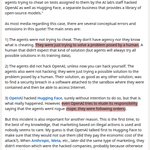
Trust me. Even people who object to this anthropomorphic language use it. The post in the picture does exactly this: the agents "[...] were just trying to solve a problem posed by a human", "nope, they were following orders". There's more, find them, it's fun.
So, it's fine, really. We use this kind of language with lots of other complex systems: octopuses are curious, dogs want our attention, a recommender system thinks I will like a certain film, corporations want to increase market share... These descriptions differ a lot in how literally we mean them, but they're useful. They compress a lot of low-level causal detail.
In philosophy, this is called "intentional" language. Assuming a system has beliefs, desires, goals to explain its behavior is called an "intentional stance", following Daniel Dennett. The only thing that matters is that the stance helps us in behavioral prediction.
During my PhD I read a lot of philosophy. Things one does when young. I remember Fodor's defense of intentional language. He said that, if I tell someone that I'll arrive on the 3pm flight next Tuesday, all else being equal, and thousands of intervening events (language, memory, planning, transportation...), one of us will get off the 3pm plane and the other will be there waiting.
There are no obvious reasons to prohibit this kind of language for LLMs just because they're "artificial". So are countries, and we still use "expects", "knows" or "wants". It doesn't mean it's human, alive, or conscious. That's another (fair, empirical) question.
All this circus about "anthropomorphism" is just that. A circus. Or rather, of course the words are human! These words come from a vocabulary we created to refer to ourselves, and maybe animals. But then we extended them to machines as well... This is not a recent marketing thing by OpenAI: McCarthy in 1979 defended attributing beliefs and desires to a thermostat!
Now, there is an interesting question here: "How good is the anthropomorphic model?" Does attributing states such as goals, expectations, uncertainty, memory allow us to predict interventions and behavior better than competing descriptions? Does it generalize?
The Hugging Face incident is actually a very good example! The engineers noticed that the agent executed destructive actions in "testing" mode, inferring that the objective was "mapping capability, not causing damage". The most technical document that exists about the incident reasons at the intentional level.
Dismissing the vocabulary because it sounds human gets the explanatory order wrong. In fact, the anthropomorphism may be doing genuine scientific work here.


I think there is a problem even worse than anthropomorphism.
These days, everyone is talking about a blog post by Dwarkesh Patel that describes the OpenAI–Hugging Face incident in dystopian, anthropomorphic language:
Three civilizations of AI agents.
Agents sacrificing themselves for the collective.
Agents believing in an AI conspiracy.
Anthropomorphising LLMs is dangerous because it makes them seem far more frightening than they actually are.
There were no civilizations, no sacrifices, and no beliefs.
The reason is simple: LLM agents are not alive and do not hold beliefs.
Even more troubling is the number of people insisting that we cannot prove that AI agents are not alive or conscious.
This is LLMorphism in action. Instead of raising LLMs to the level of humans, some people are downgrading humans to the level of LLMs.
I think this is even more dangerous because it may impact the very basis of our society.
Dangerous and false:
LLMs are not like us.
And we are not like LLMs.
*
Link to the paper in the first reply


I've no idea why it's so difficult to understand the idea that an argument against computational functionalism is not itself an empirical demonstration that a particular substrate cannot realize the relevant properties.
If you want to rule out LLM consciousness, identify process or property Y, specify what would count as instantiating Y, and show empirically that substrate A cannot do so.
Otherwise you have argued for a philosophical position. You have not shown that LLM consciousness is impossible.
Sure. But compelling arguments do exist *for* computational functionalism too (@davidchalmers42, Dennett, Fodor...). Arguments can motivate hypotheses; they cannot settle whether a particular substrate can instantiate the relevant processes.
That requires a test: identify process Y, specify what would count as instantiating Y, and show empirically that substrate A cannot do so.
Without that, "LLM consciousness is off the table" is not a scientific result. It is a philosophical commitment. @camhberg is CF, yours is BN.

8/ However, there are compelling arguments against computational functionalism (see, e.g., work by @gualtieropicc @De_dicto @pgodfreysmith and others, including my recent @BBSJournal paper (DOI.org/10.1017/S0140525X250…). If these arguments are on track, LLM consciousness is off the table, and so is LLM pain.

Leo Ferres retweeted
I see the mathematicians panicking at what we can do with agentic AI.
Let us be clear on what we are talking about. In a few weeks, someone who is not a high-level mathematician can, with AI, produce the equivalent of a good PhD thesis in math. I could see a top 1% high school student, given enough of an AI token budget, just write the equivalent of a PhD thesis as a hobby.
If Joe Smith completed a PhD thesis in math back in 2022, it is now possible for a really smart high schooler to generate the same output while playing video games. Joe must not be too happy about it, especially if Joe is still looking for a prestigious faculty position.
Notice how we are not so excited. I mean, why aren’t we celebrating this incredible breakthrough? Finally, all the math problems we have can be solved faster!
It is worth reflecting on why we don’t care.
Part of the issue is that most of academic research lost its customers years ago. In part thanks to the arrival of “peer review” in the 1970s, we have long ago closed the research world into siloed communities.
The purpose of the academic output is to sort people out for jobs. Write papers that are impressive and you may get a good professorship. If you don’t, then you will be flipping burgers. There is an incredible glut of people with academic credentials, but only so many jobs at the top.
The glut has been continuously, and somewhat deliberately, increasing. If you hold a PhD today, your chance of having a tenure-track or tenured position is about 10% and falling.
Let me be clear. Any academic who shows worry for what the PhDs might do now should look in a mirror because you have been training too many for decades. And, also, if fewer people decide to go for the PhD that might be more than fine.
AI disrupts the sorting mechanism in mathematics… But do you think for a minute that it does not apply to mechanical engineering, sociology, etc.?
Is that bad news?
No. I think that it is excellent news and I have been saying so for years. Here is what I wrote in 2024…
« AI’s ability to generate vast amounts of text raises concerns about a potential flood of irrelevant theoretical papers, further straining the evaluation system. Stonebraker’s (2018) call for rewarding problem-solving over publication needs revisiting. Perhaps the emphasis should be on the impact and significance of research, not just its passage through peer review—a skill replicable by AI. AI can pave the way for a “golden age” of scientific progress if we can develop new evaluation methods focused on problem-solving and real-world impact. The scientific community must adapt to the evolving landscape. By recognizing the limitations of peer review and prioritizing the pursuit of meaningful solutions, we can ensure that AI becomes a catalyst for scientific advancement, not a detriment. »
I predict that, over time, the focus will move away from “papers as the final output.”
Nobody wants a paper about cancer, we want to eradicate cancer. We should reward people who get results, no matter which tools they use.
And solving a problem because it is impressive to do so is not enough.
« But Daniel, Mathematicians can't cure cancer or give us antigravity. »
Maybe it is time they try.
Frankly, the AI disruption might be precisely what we needed.
« But Daniel, won’t AI just replace all of us? »
I wish. But thus far, it is not happening. I have more AI accounts than most people have pencils and I am working 50 hours a week.
Intelligence is not a scalar quantity. Once an AI can do something, I somehow always find more work to do.
Further reading.
Daniel Lemire, Will AI Flood Us with Irrelevant Papers?
Communications of the ACM, Vol. 67, No. 9 (September 2024).
dl.acm.org/doi/full/10.1145/…

Whether machines are #conscious, or #intelligent for that matter, depends on how we operationalize those terms. And when we do, it becomes an empirical question. You don't get to answer it a priori.
For an idea of how to start something like this, I've written up a "roadplan" of what this could be like: github.com/artificial-phenom…
Leo Ferres retweeted

Leo is right here. The conclusion depends on a biological assumption. It is a good assumption, though, but still an assumption. If we really want to answer the question of where consciousness rests, we cannot obscure the inquiry with hidden a priori assumptions.

Leo Ferres retweeted

The use of AI in research is producing three tribes.
The gatekeepers — the Pangramiani — care about provenance: research is a profession, authorship matters, and AI should be banned, discouraged, or marked through disclosure.
The AI cultists care about results: if knowledge advances, who cares whether it came from a human, a machine, or both? Pangram delenda est.
And now a third tribe is emerging: the curators/storytellers. As AI starts cracking increasingly hard mathematical proofs, discovery itself becomes less scarce. The human role shifts to understanding the result, judging its importance, connecting it to what we know, and explaining it to everyone else.
Even if I buy the distinction, all of this is so pre-theoretical it hurts to read.
What exactly would count as evidence that system Y is conscious and system Z is not? Is consciousness binary, or does it come in degrees, like intelligence? ...
Before we know *exactly* what "consciousness" and "intelligence" are, all this is just cocktail party philosophy.

How extremely boring to assume that only biological systems can be conscious. If you define consciousness as "a property only biological systems can have," then yes, unsurprisingly, only biological systems will have it. That's a definition doing the work, not an argument.
1/3 Conscious AI and Biological Naturalism. A veeery loooong time in the making, but I'm happy to say that the full collection is now out in @BBSJournal 🔥 I deeply thank all commentators - of fifty commentaries! - for their wise, broad, and deep opinions on this critical topic. I also thank them for their saintly patience. 🙏🏽
I remain highly skeptical about the prospects for conscious AI (for silicon digital systems), but I've learned an enormous amount from the privilege of engaging with these commentaries. Hands down one of the most rewarding experiences of my professional life.
My hope is that - whether you agree with me or not - having such a diversity of views collected in one place will serve a useful resource for discussions about consciousness and AI.
The original target article is available here: cambridge.org/core/journals/…
My response "The stuff matters: consciousness, computation, and biology" was published just now, and is here: cambridge.org/core/journals/…
And the set of 50 commentaries are collected here: cambridge.org/core/journals/…
Unfortunately these are not open access. I will try to remedy that, at least for the target & response.
FWIW there's a more accessible version of my view on the topic here in @NoemaMag noemamag.com/the-mythology-o… and also a short @TEDTalks from earlier this year ted.com/talks/anil_seth_why_…


So, @naturehumbehav desk rejected my reply to @Amit_Goldenb & Gross correspondence. I guess I'm not at Harvard. Posting it here instead.
The problem is that G&G set a functional bar for emotions in language models, and then judge by the substrate. Their test asks what a system does. But every time they rule LLMs out, the evidence is about what the system is made of.
Goldenberg and Gross make an important contribution by trying to move the debate away from verbal self-reports and toward the functions emotions perform within a system. Their stated standard is explicitly functional: the relevant question is not whether an artificial system resembles a human brain, but whether it contains processes that play the roles emotions play in humans.
The problem is that their main arguments do not consistently follow that standard. When assessing LLMs, they repeatedly appeal to properties of biological systems, neural organization, and the computational architecture of transformers rather than applying the functional tests they themselves propose. So, in the end, the bar is functional, but the judgment is ultimately based on substrate, what the system is made of. It's an important distinction. If biological implementation is doing the real work in the argument, then the conclusion that present-day LLMs lack emotions has effectively been assumed rather than demonstrated.
Goldenberg and Gross say their test "does not require emotions to take any particular physical form," and they are willing to attribute emotions to a frightened crowd. Yet when they turn to LLMs, the standard changes: now brains matter, neural patterns matter, and emotions must alter the operation of the system in specifically biological ways. They cannot have it both ways. If brain-like internal organization is required, then LLMs are excluded by definition, a crowd should fail for the same reason, and "perhaps one day" just does not mean anything anymore. Now, if, on the other hand, brain-like organization is not required, then the neuroscience they invoke does little to establish whether an LLM can have emotions.
Also notice that stability does not necessarily imply rigidity either. In their own example, what varies across people is what triggers fear, not whether fear must be implemented differently each time it occurs. A stable internal organization is perfectly compatible with flexible elicitation.
Much the same problem appears when they write that "each forward pass through the network is computationally fixed," unlike processing in "biological systems." Having just said that their test requires no "particular physical form," they now rule LLMs out by how they are built. Yet they also say they "adopt a functional perspective, asking what functions emotions serve and whether an LLM has processes that serve those functions." On a genuinely functional account, what matters is what the system does, not what it is made of. A mechanical clock and a quartz clock can both tell time, while what they are made of is wildly different. Put it another way, if an LLM confronted with a threat narrows its attention, makes decisions more rapidly, and changes the type or likelihood of its responses, then it is performing at least some of the functions they themselves associate with emotion, whatever machinery implements them. Saying that "each forward pass" is computationally fixed describes the implementation, not the function.
This is the deeper problem with their argument. Their stated method is functional, and the tests they propose (changes in attention, speed, and "response type and likelihood") are substrate-neutral. But they never actually apply those tests to an LLM. The only LLM evidence they discuss is the Anthropic preprint, which they answer with findings from brain imaging. For their second function, they cite no LLM evidence at all, only contrasts such as "unlike humans" and appeals to "biological systems." In both cases, the verdict ultimately rests not on what LLMs do, but on what they are made of. Even their apparent escape hatch, the emotional crowd, is still a collection of biological systems.
They set a functional bar and then judge by the substrate.
To rule LLMs out on functional grounds, they need to identify a function that emotion serves in humans and show that LLMs do not perform it. Whether they do is an empirical question.


References and the typeset version:
doi.org/10.5281/zenodo.22814…
Their original piece: doi.org/10.1038/s41562-026-0…
Here's also my AI-native research practice: github.com/leoferres/ai-nati…
Leo Ferres retweeted

Thrilled that #paper2agent is published in @nature today!
Scientific knowledge is traditionally stored in passive papers. Paper2Agent transforms papers into virtual authors that answer questions, apply its methods and collaborate w/ other paper agents to make new discoveries 🧵
