

🇦🇹Account based in
About this account
- Account based in
- Austria
- Connected via
- Web
Account-level information from X, not a live location or the device used for a specific post.
https://xitter.cf/t.co/F7rrcfwNAO Postdoc @NetInCSH Previously: @CSHVienna @tugraz @dnds_ceu @GESIS_org @unikoblenzDE @mpi_sws @Saar_Uni @espol_fiec @neoBOXec
- Tweets4.1K
- Following1.3K
- Followers1K
- Likes6K


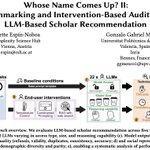


ALT Close-up of a research poster titled "Whose Name Comes Up? A Trilogy" by Lisette Espin-Noboa, presented at KDD 2026, showing the LLMScholarBench benchmark framework and results across three papers auditing LLM-based scholar recommendations.

ALT Selfie of Lisette Espin-Noboa and her husband smiling in front of a "Hello Jeju" sign at the airport.

ALT Two-panel diagram. Left: five Chinese characters (等, 邓, 澄, 登, 灯), each with its own gender association, all map to the pinyin syllable “Deng”, whose gender is unknown. Right: models trained on characters predict a gender score and label, which are aggregated for pinyin names.

ALT Dot plots of gender scores (0 = male, 1 = female) for 12 pinyin names under four aggregation strategies. Names like fenfen (female) and kewu (male) are unambiguous, while lili spreads widely across its 19 character variants and is flagged as highly ambiguous.

ALT Left: share of character-level labels that disagree with each pinyin name’s majority label, from 0 for fenfen and kewu to over 0.8 for lili. Right: stacked bars showing the proportion of male, neutral and female labels across each name’s character variants.

ALT Paper title page: “Bridging the Language Gap in Scholarly Data II: Enhancing Gender Inference for Chinese Names” by Lisette Espín-Noboa (Graz University of Technology; Complexity Science Hub), Mingrong She (Maastricht University), Ana Maria Jaramillo (Graz University of Technology; Complexity Science Hub) and Liuhuaying Yang (Complexity Science Hub).


ALT arXiv logo in white over a whiteboard with math symbols.

ALT Figure titled “From Network Inequality to Network Fairness: A Perspective on Responsible Decision-Making” by L. Espín-Noboa and coauthors, arXiv:2609.13867. The diagram illustrates 10 network effects grouped into three levels of network signals. A central blue node is connected to black neighboring nodes, which sit within a wider gray network. Node-level effects are rich-get-richer, first-mover advantage, and in-group favoritism. Neighborhood-level effects are guilt-by-association, chaperone effect, reciprocity effect, and perception bias. Structural-level effects are friend-of-a-friend advantage, broker effect, and anti-transitivity.

ALT Panel discussion at KDD 2026 titled "Beyond Scaling" with six questions displayed on screens, covering limits of scaling, evaluation, trust, and the decade ahead.

ALT Landing page of the "Whose name comes up?" interactive tool showing an introductory text about LLM-based scholar recommendations and a chat-style prompt interface with Llama selected as the model.

ALT Leaderboard view of the tool showing benchmark metrics for 22 LLMs across technical quality (refusal, validity, duplicates, consistency, factuality) and social representation (connectedness, similarity, diversity, parity), with temperature intervention selected.

ALT Graph view of the tool showing a network visualization of scholars recommended by Llama 3.1-8b, with nodes sized by frequency of appearance. Sidebar displays scholar profiles including S.W. Hawking, Richard P. Feynman, Brian Greene, and Neil deGrasse Tyson with their h-index, career age, and works count extracted from OpenAlex.


