

An online magazine for free and open people. Powered by @theihs
Arlington, Virginia
Joined September 2025
- Tweets252
- Following46
- Followers2K
- Likes70






Pinned Tweet
Liberalism is both under threat and at a turning point.
It must be argued for, refined, and renewed.
Today, we begin the work.
On this day in 1647, soldiers and officers of the New Model Army met in a Putney church to debate who should have a voice in governing England.
🧵 on the claim that “the poorest he” has a life to live as much as the greatest.

Why does democracy belong on the list of liberal commitments? Matt Zwolinski argues it keeps power contestable, so rulers can be removed without violence: (6/7)
liberalism.org/p/democracy-b…

For the throughline from 1647 to today, IHS lays out the Four Corners of Liberalism: (7/7) theihs.org/blog/the-four-cor…

Locke held that we may take from the commons only if we leave enough for others. Christopher R. Hallenbrook and Ryan Reed on why that principle gives limited government a role in addressing climate change.
liberalism.org/p/john-locke-…

“ 'I would rather go astray with Plato and my friends than be right with my enemies.' ”
— @Roger_Berkowitz quoting Hannah Arendt
Listen to the full episode: liberalism.org/podcast/s/lib…

Even as American politics nationalizes, the interest groups lobbying state governments are becoming more distinctive, not more alike. James Strickland on what that means for federalism.
liberalism.org/p/is-all-poli…

.@davidtbeito explains how a Mississippi town built on self-government inspired the stage shows that helped launch the Harlem Renaissance.
liberalism.org/p/the-greates…

Freedom depends on the conditions that make it possible. Judith Shklar on why securing them is the goal of liberalism.

"Persuasion is when we both think we know what the truth is, and we talk to each other, and we both realize that we agree on certain things, we disagree on certain things, and we both shift."
— @Roger_Berkowitz
Listen to the full episode: liberalism.org/podcast/s/lib…
American independence did not extend liberty to women, but it changed the rules by which they could obtain it. @jmelemke on how new ideas about liberty, wider freedom of action, and local autonomy made the fight for women’s rights possible
liberalism.org/p/the-america…

When institutions fail the people they are supposed to serve, rule-breaking starts to feel like common sense. @ECWIHS on what that tells us about the real work of democratic renewal.
liberalism.org/p/conservativ…

"Stuff like 1984, the whole point is that the dystopia is so totalizing there is no room for resistance....which is very different from something like Hunger Games, where the danger is enormous, the traps are enormous, but there is space for resistance."
—Sarah Skwire
Listen to the full episode: liberalism.org/podcast/s/lib…

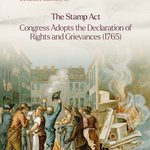
On this day in 1765, delegates from nine colonies met in New York and adopted the Declaration of Rights and Grievances, their answer to the Stamp Act.
🧵 on how a tax dispute became a theory of rights.

Eleven years later, many of the same arguments reappeared in the Declaration of Independence. We trace where this theory of natural rights and property comes from: liberalism.org/p/private-pro…. (6/7)
For the throughline from 1765 to today, IHS lays out the Four Corners of Liberalism: theihs.org/blog/the-four-cor… (7/7)