







Lin Fu retweeted

I'm thrilled that @PhysRevLett has published key laureate papers cited by the @NobelPrize committee for 15 of the last 16 years!

In our latest paper in JSC, we developed a general numerical framework for the six-equation, single-velocity, two-phase flow model based on the diffuse-interface method, that accounts for phase change:
researchgate.net/publication…

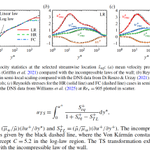
In the lasted JFM paper [Turbulence–chemistry interactions in high-enthalpy hypersonic turbulent boundary layer, doi.org/10.1017/jfm.2026.120…], the superior accuracy of our GFM velocity transformation toward the compressible-law-of-the-wall is demonstrated again:


Lin Fu retweeted

Some thoughts on the Navier-Stokes news from a professor of aerospace engineering:
1) take a deep breath
2) posts indicating we "solved Navier-Stokes" are incorrect and overblown. A very specific mathematical proof involving a niche scenario for Navier-Stokes has *potentially* been shown (that a perfectly smooth incompressible initial condition with finite energy could produce a singularity--note the assumptions here piled on to an equation set that already involves some assumptions).
3) there is no general closed form solution for N-S and that's not what this news is about
4) this is more of a mathematical curiosity than anything else and could matter a lot to mathematicians but basically changes nothing in the way N-S are used in practice
5) there are already very useful exact solutions to Navier-Stokes that greatly simplify the equation set with the right boundary conditions/geometry like laminar flow through a pipe or a 2D Taylor-Green vortex
6) in aerospace, we already treat N-S as an approximation in many instances and are well aware of its limitations. we don't outright solve these equations anyway and regularly chop off terms or simplify parts (at the expense of accuracy) to make them easier to deal with.
7) to be honest I have never found this specific problem to be particularly interesting because we know a core assumption of N-S is a "continuum" fluid where you ignore molecules and assume hydrodynamic scales >>> molecular scales. We know a real fluid cannot have infinite velocity or energy. But clearly you can push equations outside of their bound of validity and make them produce funky results and singularities.

We’re sharing a solution to the Navier-Stokes Millennium Prize Problem, one of the deepest problems at the frontier of mathematics.
The proof was produced by a group of agents, using an OpenAI next-generation model significantly more capable than GPT-6 Astra.
The problem concerns whether the description of smooth three-dimensional fluid motion modeled by the Navier-Stokes equations can break down. It has remained unresolved for roughly 90 years.

We are hiring 2027/28 HKPFS PhD applicant:
1. Generous Annual Stipend: HK$344,400 (~US$44,150)
2. Travel Allowance: HK$14,400 (~US$1,840) per year for conference and research-related travel
3. Duration: Up to 4 years
see my homepage: linfu.people.ust.hk/people.h…
Two droplets of different phases collide in the gas phase, generating complex dynamics due to the interaction of inertial force, surface tension and viscous effects, see our recent JCP paper on three phase flows:
researchgate.net/publication…
In our latest paper in Transport Phenomena, we studied the implications of compressibility on the quiescent thermal and momentum cores. Thermal transport, regardless of flow parameters, exhibits a quiescent core akin to momentum transport:
researchgate.net/publication…

Additional to the law of the wall for velocity and temperature in compressible wall turbulence, in our latest PRFluids paper, we figure out that there exists a law of the wall for total enthalpy:
researchgate.net/publication…

In our new Journal of Computational Physics paper, we proposed a novel, consistent collision-tracking framework for the accurate simulation of immiscible droplets in three-phase droplet-laden flows:
researchgate.net/publication…

I am speaking at The 32nd International Conference on Computational & Experimental Engineering and Sciences (ICCES2026). Please check out my talk if you're attending the event! #ICCES2026 - via #Whova event app

Lin Fu retweeted
20 You normally can’t see a shock wave: they’re only O[100 nm] thick (similar to visible light wavelengths, ~1000x more thin than the avg human hair or a handful of molecular collision mean free paths). They create a temperature jump that VAPORIZES water, eliminating condensation

Lin Fu retweeted
10/n When you have a shock wave on a super/transonic aircraft, there is often an expansion fan somewhere downstream (which in turn will be followed by another shock to return the flow to the original state). You could even conceptually think of it as the opposite of a shock wave.


Lin Fu retweeted
8/n Back to our original question: what do you see in this photo? Quite simply it’s condensation that is the result of a rapid EXPANSION of air. It is this expansion of air that creates a drop in temperature and pressure that can lead to condensation in humid conditions.

We continue our roadmap to develop the law of the wall for temperature profile in turbulent channel flows. In our latest AIAA Journal paper, we introduce a novel temperature transformation tailored for compressible turbulent channel flows:
researchgate.net/publication…

Lin Fu retweeted

We’re celebrating 10 years 🌊 🎉
Thank you to the authors, reviewers, editors, and readers who have helped advance a decade of #FluidDynamics research and discovery.
Explore the journal:
go.aps.org/prf10
I am glad to see that, the Voronoi-based load balancing approach I proposed during my PhD, i.e., the CVP method, was deployed in the production LAVA code of NASA Ames Research Center:
nas.nasa.gov/assets/nas/pdf/…