
Raving about Song Kang and Four hands Two Sonatas
Joined October 2011
- Tweets4.5K
- Following188
- Followers405
- Likes13.1K



Pinned Tweet
Mature (18+). Expect romance, angst, and a new man in the picture, for a Pio who has never known anyone but Jeongyo
Chapter 1:
Part 1 teapawt.net/linlin23b/status/21148…
Part 2
teapawt.net/linlin23b/status/21148…
Chapter 2
teapawt.net/linlin23b/status/21153…
Chapter 3
teapawt.net/linlin23b/status/21153…
Chapter 4
teapawt.net/linlin23b/status/21169…

Three years had passed since the day Pio walked into the church in the Czech countryside and found Jeongyo conducting the children’s choir. In that time, the two of them had made a home.
It was a farmhouse of old stone and weathered timber, set at the edge of a village where the church bell kept the hours more faithfully than any clock. Pio had chosen it in a single afternoon, walking through the rooms with the unhurried gaze of someone who had never had to ask the price of anything. Jeongyo had not needed a second look. He would have agreed to a tent in a field if Pio had stood in the doorway of it with that bright, certain face.
There was a piano room with tall windows that caught the morning light. In it stood the grand Yamaha, the one Jeongyo had bought back for Pio and shipped all the way from Korea. There were two studies. Jeongyo’s was filled with his mother’s scores, brought home from the practice room in Nakwon Arcade. Pio’s was lined floor to ceiling with his books. There was a closet specifically for Pio, because he was incapable of owning fewer than forty coats. There was a living room with a sofa deep enough to sink into, where they watched old films and listened to piano performances, Pio’s head on Jeongyo’s shoulder.
And at the end of the upstairs hall, behind a heavy door, was the bedroom. It was enormous, and beside it was a storage room whose contents would have made a stranger blush and a locksmith weep.
No one who saw Kang Pio at seventeen, twenty-seven or thirty would ever have guessed it. He was the picture of a young master, with a beautiful, composed face, a straight back, immaculate cuffs and an impeccably refined manner. But there was a secret under all that polish, and it was that Pio was a little bit crazy behind that door. He was creative beyond all decency, fierce, adventurous and tenacious, and extremely particular about what he wanted. He brought to love the same fierce discipline he had once brought to Schumann, and he never did anything halfway, with class or nothing at all. Jeongyo, who had survived a great deal in his life, had never been so thoroughly outmatched. The young master the world saw and the monster in the bedroom were one and the same, and it was the contrast, more than anything, that Jeongyo loved.
It had not always been so. Their first night in the farmhouse, it was Jeongyo who led.
He had to. For the first thirty years of his life Pio had known exactly two things: how to practice, and how to search for Jeongyo. He had never watched a film that wasn’t about music. Every free hour had gone to the piano or to finding where Jeongyo had gone. When he sat on the edge of the bed that night, hands resting on his knees as if waiting for a cue, Jeongyo almost laughed.
“You can relax,” Jeongyo said gently. “It isn’t a concerto.”
“I know,” Pio said, with great dignity, and did not relax at all.
He wasn’t afraid. What Jeongyo saw in his face was desire, but a very pure kind, undisguised and unashamed. It was the same look Pio had worn years ago at the piano, when they played four hands and his eyes kept drifting from the keys to the person beside him, like a child at a sweet shop window, wide-eyed and sure the glass would somehow open. In that way he was exactly like his beloved Shin-chan, a little shameless and a little ridiculous, with a heart so innocent it made the shamelessness impossible to resent.
Jeongyo took his hand first, the right one, and turned it over. He was thinking of the recording three years back, and the long day he could not forget. He had made Pio play the same Nemesis twenty-seven times, more than seven hours in all, until Pio’s fingers were swollen and burning and would not obey him anymore. Pio had never once asked him to stop. Jeongyo pressed his lips to each fingertip in turn, slowly, as if he could kiss the memory out of them.
“I’m sorry,” he said against Pio’s knuckles. “For all twenty-seven takes.”
Pio looked at him
#포핸즈 #FourHandsTwoSonatas
linlin23 retweeted

@NAMOOACTORS2004 @songkang_staff can we please get behind the scenes form four hands two sonatas filming of song kang?
#SongKang #fourhandstwosonatas

Song Kang never fails to surprise, we thought he'd play the piano and here he is playing guitar. He's shooting a drama, attended fashion week, went abroad for photoshoot, preparing for fan meetings, and learning a new instrument. Such a hard working person, truly an inspiration

🎼2026 SONG KANG FANMEETING <PLAY, SONG KANG> IN JAPAN
🎶 D-3 🎶
🎹 song-kang.jp/contents/112443…
#ソンガン #ソンピョン
#SONGKANG #송강
#PLAY_SONGKANG


My attempt to continue giving the characters a complete journey of growth and healing.
#포핸즈 #FourHandsTwoSonatas #송강 #SongKang #이준영 #LeeJunYoung


Chapter 4: The Kindest Mistake
A sharp pain tore through his right shoulder, and then the water closed over his head. There was a moment of green dark, and a pressure in his chest, and then nothing at all.
He woke to candle wax and a low white ceiling, and to the sound of men singing somewhere inside the walls. He did not know how long he had been gone. A figure in dark robes sat beside the bed and asked, in slow and careful English, what his name was.
He opened his mouth to answer and found the place, where it should have been, swept perfectly clean. No name, no face, no street. On the blanket his left hand had begun to move of its own accord, pressing silent chords into the wool, as though it, at least, remembered something.
“Luca,” said the man, after a long while. “We shall call you Luca.”
It was the first thing anyone had given him, and he held on to it the way one holds a coin in a dark pocket. In the doorway an old man in an expensive coat stood perfectly still, watching that restless hand with the patience of someone who collected things.
---
Jeongyo woke with a start, drenched in cold sweat, his heart hammering against his ribs, and lay in the dark waiting for the room to prove that it was a room.
The farmhouse was quiet. It was the first cold week of autumn. His right shoulder ached the way it did before rain, and in front of him Pio slept the way he always slept, curled on his side with his knees drawn up and his chin tucked, small as a child, his back fitted into the curve of Jeongyo’s chest like the smaller of two spoons. Even in sleep his whole body seemed to have agreed that it was only safe when something was wrapped around it. In the old days it had been Pio who woke from nightmares and Jeongyo who sat up with him, and neither of them had ever spoken of it afterward.
Jeongyo lay still, with his arm over him, until his own heart slowed. In three years he had never known Pio to sleep past dawn, and it had taken him most of the first winter to understand why. Pio woke before the light, every day, and before he opened his eyes his hand came back across the sheet and found Jeongyo’s arm, and a long, quiet breath went out of him. Only then did he look. A man who has lost the same person twice does not dare to wake late, for fear of waking to a cold sheet.
This morning was no different. The hand arrived, and rested, and the breath went out. Then Pio turned in the circle of his arm and kissed the tear mole, unhurried and without a word, and went down to practice.
Jeongyo lay there a minute longer than he needed to, and then followed him as far as the door of the piano room.
He did not go in. The door stood a few inches open, and through it came Jeongyo’s latest piece, the one he had finished that week and could not play himself. Pio played it as though he had always known where it was going, with the ease of a man who no longer needed anyone to tell him what a piece meant. Jeongyo stood in the corridor with his hand against the wall, listening, like a boy outside a practice room who had never been invited in.
He stood there a good deal longer than he should have. When he caught himself, he went to start the coffee.
---
Jaein arrived that afternoon by taxi, an envelope in her hand. Jeongyo was at choir rehearsal. She found Pio in the garden, kneeling among his herbs with the silver scissors. She stopped at the gate, and forgot for three full seconds why she had come. The sun laid a thin gold over his face, and he looked like a portrait someone had forgotten to hang. Nearly thirty years, and no one had ever warned her that you do not get used to him. A man like that belonged on a stage, or at the very least on a billboard, and here he was frowning at a basil plant.
“Pio. I need you to read this before you say anything.”
“I generally read before I speak.”
“You generally say no before you read.”
He took the envelope and read every page to the last clause. An exclusive three-album contract with Aurelia Classics, the most prestigious label in the world. Representation by Halcyon Artists, who managed the kind of musicians other musicians were frightened of. Forty cities in two years: Vienna, New York, Tokyo, Seoul.
“No,” said Pio.
“They say you’re the one pianist they have never been able to replace. I keep a box of letters in my office, Pio. Hundreds of them. The world is still asking for you.”
“Then I am sorry for the box.”
“You have a church, a garden and a man who cooks for you. I know. Does Jeongyo know about this?”
“No.”
“Why not?”
Pio looked at the basil. “Because the last time Jeongyo decided what was best for me, he disappeared for three years. I would prefer not to give him the opportunity.”
Jaein opened her mouth and closed it again. There was nothing to say to that, and they both knew it.
“All right,” she said at last. “I won’t say a word.”
She sat in the taxi at the end of the lane for some time, looking back at the farmhouse. Then she said, “The church, please,” because she had never been able to keep a promise that cost someone else this much.
---
Jeongyo was stacking music when she came in, and she did not say hello. She put the envelope on the table.
“I promised him I wouldn’t. I’m so sorry. But you’re the only person he listens to.”
He read it standing up, with the afternoon light coming through the high window. Three albums, forty cities, the whole carefully lit staircase, and at the top of it everything anyone had ever wanted for Kang Pio.
“He read every page and said no,” said Jaein. “He didn’t ask for a day to think, and he didn’t want you to know.”
Jeongyo’s eyes had settled on the last page without reading it. He saw a man in a dark coat saying burden. He saw Seonju’s open hand and a podium he would never stand on. He saw his own right hand, curled and stopped halfway.
Pio had been offered the world, and had folded it small and put it where Jeongyo would not find it.
“Thank you for telling me,” he said.
“He’ll never forgive me.”
“He will. I won’t lie to him about this.” He folded the pages into his coat. “I’m not going to tell him what to do. I only want to know what he wants.”
---
Jeongyo made steak that evening, which was what Pio liked best. When the plates were nearly empty, he took the folded pages from his pocket and laid them beside the salt.
“Jaein stopped by the church today. She told me about the offer.”
Pio looked at the pages. “She promised.”
“She did. I think she hates herself for it.” Jeongyo reached across the table and turned Pio’s hand over in his. “I’m not asking you to say yes, and I’m not asking you to say no. I only want to know what you want.”
“I don’t want it. I have everything I want here.”
“Then I believe you.” Jeongyo’s thumb moved once over his knuckles. “And whatever you choose, I’ll accept it. Go anywhere you like. Be anything. Even if it isn’t me.”
He had spent his whole life learning how to hold on, and opening his hand was the hardest thing he had ever done. He did it looking Pio in the eye.
Pio heard a door being opened, politely, from the other side.
He had been held all his life, by his mother’s obsession, by his hunger for his grandfather’s recognition, by his love for Jeongyo and for the piano. No one had ever offered him his freedom. He did not know what to do with it.
The nausea came all at once.
It began as a taste at the back of his throat, then a cold sweat at his hairline, then a slow tilt of the floor. He knew it. It had taken him in Moldova, after the man who had taken Jeongyo told him Jeongyo was dead. It had taken him again in the restroom of a practice room, at the worst of his slump. It was his body’s answer to shock and stress, and it had always arrived before his mind did.
He drew his hand away, as gently as he could. “I need some air.”
“Pio...”
“I won’t be long.”
He took the first coat from the hook, which was too thin, and went out into the dark. The door closed behind him with a small, civil click.
Jeongyo sat for a long time with his hand lying open on the table, where the other had been. He had meant it as a gift. It was only after the door closed that he began to wonder whether it was the right one to give.
Pio walked without thinking, down the lane and along the river path, to the old stone bridge at the edge of the village. He stopped at the railing, and the cold came up through the soles of his shoes. He looked down at the water and felt nothing at all.
He had crossed a good many bridges alone in his life, in many places, at hours when no one was looking, and he had never given the thought that came to him there a name. It slipped in like cold air under a door, and slipped out again: that if he went over, and dissolved into the dark like a bubble, the pain in his chest would finally stop. Every time, it had been one of three things that kept him standing and turned him around. The first was that he would not quit like a coward before his grandfather had looked at him, even once, with approval. The second was that he had to find the one person who mattered most to him. The third he did not like to look at: that the same person had wanted him alive, only to be punished. Each had since been settled, in one way or another. He had stopped looking for reasons the night he realized he no longer needed them. He had Jeongyo asleep at his back, and that was reason enough to wake every morning.
But Jeongyo was the only reason he had left, and tonight Jeongyo had opened his hand. “Even if it isn’t me.” It was the kindest thing anyone had ever said to him, and it had not asked him to stay. He had been held all his life, and now the one pair of arms he had ever wanted to stay in had loosened, politely, for his sake, and he did not know what a man does with that. He did not wish to think about it. He wished only to stand very still and feel the quiet. For the first time in three years, he felt terribly alone.
His stomach turned over.
He bent and was sick over the stones, shaking, and when it was over his knees would not hold him. The bridge swung up to meet him, and he thought, quite clearly, this is ridiculous. Then hands caught him under the arms, strong and unhurried, and lowered him to the stone.
“Pomalu,” said a voice. “Sedněte si. Hlavu dolů.”
Slowly. Sit. Head down.
He did as he was told, which he would think about later. The voice was a man’s, level and unbothered. Pio said, in careful, accented Czech, that he was perfectly well.
“Máte modré rty,” the man said, “a právě jste lhal.”
Your lips are blue, and you just lied.
Pio lifted his head. It took some effort. The man crouching in front of him was perhaps thirty-five, tall and broad through the shoulders, with dark hair damp from the river mist, a tired, attentive face, and warm eyes the color of strong tea. “I’m a doctor,” he said, in Korean now, as if the accent in Pio’s Czech had told him everything he needed. He was already holding two fingers against Pio’s wrist.
“I am quite capable of walking,” Pio said.
“I’m sure. I’m not going to carry you. I’d just like you to sit for five minutes.” He kept his eyes on his watch. “I’m counting. I’m very good at it. It’s my only talent.” He frowned at whatever he was counting, and said nothing about the frown. He had shrugged off his coat while he spoke and settled it around Pio’s shoulders, as one does with a patient, and Pio, who permitted nobody to touch him, was too astonished to object.
“When did you last vomit like this?”
“Not for years.”
“Mm.” He let go of the wrist. “Were you thinking of hurting yourself?”
He asked it plainly, in the voice one uses to ask the time. Nobody had ever asked Pio so directly. It came to him, in the same instant, that he had been lying to that question since the age of seventeen, and that he was tired of it.
“No,” he said. “I was thinking of nothing.”
“I believe you,” said the man. “Nothing is a heavy thing to be thinking about on a bridge, though. I’d like to hear about it sometime, when you’re warmer. I’m a good listener. And I forget everything by morning. It’s a professional skill.”
He took a card from his shirt pocket and put it into Pio’s hand, and closed Pio’s fingers over it. Dr. Han Seojun, it said, and an address, and a clinic’s hours.
“I’m Han Seojun. And you are?”
Pio hesitated. He had spent half his life being recognized before he opened his mouth, and out of long habit he waited for the name to land. “Kang Pio,” he said.
It did not land. “Pio,” said the man, as one repeats the time of day, and nodded. For the first time in years it was a relief. “Come in tomorrow.”
“That won’t be necessary.”
“It wasn’t an offer.” He nodded at the coat. “And bring that back. It’s my good one.”
Pio walked home alone, which was what he insisted on, and Seojun let him, and stayed on the bridge until the figure had turned the corner, in case.
Seojun watched him go. Kang Pio. He turned the name over once, found nothing on the other side of it, and put it away. He had only the vague feeling of having been introduced to someone very expensive.
He could still feel the pulse in his fingertips. It was too fast, and it did not keep time. It was the pulse of a heart that had learned to race when no one was watching.
He had listened to hundreds of hearts, in the clinic and the ward and on kitchen floors at three in the morning. He had never heard one so determined not to trouble anyone. And he had heard that answer before, nothing,said in that voice, at night, by people who were very tired and very polite. It was almost never nothing. He did not intend to let this one go home and be polite alone.
The village is small, he thought. And he put his hands in his pockets, and discovered that he was cold, and walked home.
---
It was nearly midnight when Pio let himself in.
Jeongyo was sitting in the dark kitchen with the pages pushed to one side. He stood when the door opened.
“I walked,” said Pio.
“I know. I was worried.”
“I’m sorry.”
Jeongyo reached for his hand, and Pio let him take it, and they stood like that for a long moment in the small blue light from the window.
Upstairs, Pio kissed the tear mole before the lamp was even out, which was not his habit, and Jeongyo did not remark on it. The borrowed coat hung in the wardrobe behind the others, where it could not be seen.
---
For three days Pio did not go.
He gave his lessons and played for the choir, and the card stayed in the pocket of his own coat. Going meant admitting that something was wrong, and he had been brought up to believe that wrongness was a private matter, to be endured. On the fourth afternoon he drove to Prague to buy strings for the church’s old upright.
On the way back, on the long straight road beside the lake, with the sun low and the poplars flicking light across the windshield, the world narrowed.
It narrowed as it had on the stairs, from the edges inward. The road drew away down a long, bright tunnel, the engine’s sound went thin, and he put one hand on the wheel to be sure of it and thought, calmly, not now. The car went on without him. He could feel it going. He could not make his foot understand.
A horn, long and furious, brought him back.
He came to himself with his foot on the brake and the car sideways across the white line, and in front of the hood, a hand’s breadth from the metal, stood an old woman with a shopping bag and a bicycle. She shouted at him in Czech, magnificently, and then, upon seeing his face, stopped, and asked whether he was ill.
He said he was perfectly well. He apologized, in his best formal Czech, for the inconvenience. The old woman looked at his lips, said something short about young men and breakfast, and wheeled her bicycle on up the road. He sat with the engine ticking and his hands on the wheel, and did not move for a long time.
He had always believed that his body’s rebellions were his own affair. He had been taught to treat his body as a servant, to be overridden when it complained. At the Harmonie competition, with his finger bleeding, his mother had put a strong painkiller in his hand and sent him back to the piano. Years later, while practicing Nemesis, no one had to. He had swallowed the pills himself, and bandaged all ten fingers, and played on, to satisfy Jeongyo. His mother had trained him so well that she was no longer needed. He did it to himself now, in empty rooms, when no one was watching and no one was making him. But there was an old woman with a shopping bag who had stood a hand’s breadth from the metal, and he could not find any way to call that his own business.
---
At seven fifty-five the next morning he stood on the step of the cottage, with the borrowed coat folded over his arm, cleaned and pressed, and a note of thanks pinned to it, in the posture of a man about to open negotiations.
The cottage stood at the end of the lane, whitewashed, with a brass plate by the door that read DR. HAN SEOJUN, VILLAGE CLINIC, and a window in which a lamp was already lit. He had walked past it a hundred times and never read it.
The door opened before he could knock. Seojun stood in shirtsleeves with a dish towel over one shoulder, and his whole face lit. “You came.”
“I have come to consult you on a single matter,” said Pio. “I drive on public roads. Yesterday I came within a hand’s breadth of an elderly woman on a bicycle. I require a clear answer as to whether I can be relied upon not to do so again. I shall pay whatever you charge. I will expect discretion.” He held out the coat. “This was cleaned. It seemed discourteous to return it otherwise.”
“You didn’t have to do that.” Seojun took it, looked at it, and then at him. “And you didn’t come for yourself. You came for her. That’s a better reason than most people bring.” Something moved at the corner of his mouth. “Come in. Left sleeve up, and sit.”
It was a small, warm room on the ground floor, with a window onto the lane and, behind a half-open door, a staircase that smelled of toast. Seojun pulled a stool up to the table, lower than Pio’s.
“I did not give permission,” said Pio, as cold little patches were pressed to his chest.
“You walked in with a speech and a clean coat. I took it as read.” He did not look up from the machine on the table. “This will be cold.”
“How are you this morning?” Seojun asked a moment later. “Honestly, I mean. Not the version for the neighbors.”
Pio considered the question. No one had put it to him in that form before. “Tired,” he said at last.
“Thank you. That’s the first honest thing anyone’s told me this week.”
The machine hummed. A thin strip of paper crept out of it, and Seojun tore it off and held it to the window, and for the first time the ease went out of his face. He read it the way another man reads a face, at once and in order, and said nothing at all for a good while. Pio, who had come in expecting to be told that he was tired and ought to eat more, watched him read, and felt, for the first time that morning, the faint cold touch of something he had not prepared for.
“How long has your life been like this?” Seojun asked at last. “The sleeping, the eating, the worrying. The chest pain. Not only lately.”
“For as long as I can remember,” said Pio. It was out before he could stop it. “It grew worse when I was seventeen. It has been quieter these last three years.”
Somewhere in the church down the lane a bell began to strike eight.
Seojun laid the strip on the table and turned it so that Pio could see. “I’m going to be plain with you, because I think you’d see through anything else. This is your heart, Pio.”
“My heart,” he said, as one repeats a word in a language one is only learning.
“Yes. It’s tired. It has been running without a rest for a very long time, and it’s started to tell us.” Seojun folded the strip into his pocket. “Who else knows about this?”
“No one. I did not know myself.”
“Good. Then I’m the first, and I’ll try to deserve it. Is there someone at home who ought to?”
Pio opened his mouth. Every answer he had ever given was a lie, and the true one was a single name, said once, aloud, in a room that had no door he could close.
“There is one person,” he said. His voice sounded very far away. “He is also the one person who must never know.”
Seojun looked at him for a long moment, not unkindly, and then up at the window.
“Then we have a problem,” he said softly. “Your heart isn’t going to wait until you’ve found a way to tell him.”
---
A mile away, in the farmhouse kitchen, a man in an apron was setting a table for two and humming a piece he had written himself. He had no idea that the person he loved most in the world had just been told he might not have as long as he thought, or that he was about to be kept, with the very best of intentions, from the only thing he had ever wanted to be told.
Pio stood quite still in the doorway of the clinic, with one secret already folded small in a drawer and another now lodged in his chest, and understood, in the thin gold light, that the second would not fold for long.
#포핸즈 #FourHandsTwoSonatas #송강 #SongKang #이준영 #LeeJunYoung

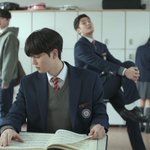
Oh I didn’t notice Pio was left-handed!
Fun fact: Song Kang once replied on his fancafe that he uses his left hand for everyday things like eating, drinking, and applying lip balm, but his right hand for writing and using a computer mouse. I guess he might have been naturally left-handed but was trained to write with his right hand at school, something many teachers and moms in Asian countries used to do, especially back in the day.
Fun fact 2: People who can switch between their left and right hands tend to transfer information more efficiently between the brain’s left and right hemispheres, which is often linked to greater mental adaptability and higher cognitive flexibility
#SongKang #송강


