

Powering Local Communities through DeFi & Smart City Services | Powered by @MSocietyLabs.
Web3
Joined January 2022
- Tweets10.6K
- Following397
- Followers643
- Likes10.7K






Pinned Tweet
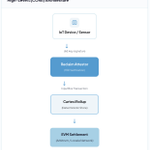
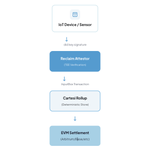
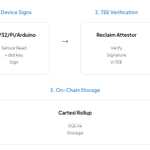
🚨 Big milestone: Locale Network + @MSocietyLabs just open-sourced L{CORE} 🔓
The first decentralized IoT attestation infrastructure.
In partnership with @ReclaimProtocol & @CartesiProject, we’re bringing trustless sensor data verification to @Arbitrum.
🧵👇
paragraph.com/@localenetwork…

Our nodes are the proof half of this, the spec is a claim until the hardware signs it.

Spec is the promise, the node is the proof, only one shows up in production.
xitter.cf/LocaleNet/status/21140…
Stable ids are the offchain version of attestation, prove the event once and stop re-trusting it.

A timeout doesn’t prove an action failed. If the request committed but its response was lost, a retry can create a duplicate.
Stable IDs, idempotency, and reconciliation make recovery safer.
👇 Read the article below.
#AIAgents #AISecurity #AgenticAI

A lost ack is just a device you cannot re-trust, which is exactly what the attestation solves.

Your AI agent submits a $50,000 payment.
The payment service times out.
The agent retries.
Congratulations. You might have just paid twice.
This is a hypothetical example, but the underlying engineering risk is very real.
Microsoft recently published guidance on Durable Task in .NET, explaining an important distinction that enterprise AI developers need to understand.
Durable execution is not the same as exactly-once execution.
A durable workflow can survive crashes, resume processing, and preserve orchestration history.
But what happens if an external payment service successfully processes a transaction and the response gets lost?
The workflow may not know whether the transaction succeeded.
Blindly retrying could execute the same business operation again.
The solution isn't a smarter language model.
It's established distributed-systems engineering: stable operation identifiers, idempotency keys, authoritative transaction records, reconciliation, and controlled retries.
AI agents can recommend actions. But authorization, transaction execution, and verification should remain under deterministic application control.
Remembering what the workflow attempted is not the same as knowing what actually happened.
Explore more practical enterprise AI guidance at AInDotNet.com.
#EnterpriseAI #AIAgents #DotNet #DurableTask #DistributedSystems #EnterpriseArchitecture #AIEngineering #Idempotency #AInDotNet
Same lesson our nodes live by, you do not trust the agent, you make it prove the action.

An AI agent issues a refund. The response times out. Should it retry?
That’s still a distributed-systems problem.
Permissions. Idempotency. Recovery. Tests. Behavioral evaluations.
AI agents are software. Engineering still applies.
davidparry.com/blog/2026/10/…
B, and the fix is a key the retry can look up, so the second call proves it is the same work.

System Design Concept:
In Spring Boot microservices, Service A calls Service B.
Service B processes the request successfully, but Service A times out and retries the request.
What could be the problem in this case?
A) Memory leak
B) Duplicate processing
C) Database deadlock in every case
D) Automatic rollback of Service B’s transaction
DePIN lives or dies on node retention, getting the first fifty online is easy, keeping them there is the job.
Same discipline on hardware, the key proves the work so you never have to re-trust it.
xitter.cf/MSocietyLabs/status/21…
Proof cost is the adoption tax, if verifying is expensive people just go back to trusting.
xitter.cf/NovaaOnChain/status/21…

One of the biggest barriers to ZK adoption isn’t the technology itself. It’s the cost and complexity of generating proofs.
That’s the problem @fermah_xyz is working to solve. 👇
ZK proof generation can demand serious computing power, specialized hardware, and infrastructure that developers don’t always want to manage themselves.
Fermah approaches this with a Universal Proof Market that connects proof requests with available computing resources.
Here’s why it matters:
→ Developers can request proofs without managing all the proving infrastructure themselves.
→ CPUs, GPUs, and FPGAs can contribute computing power.
→ Better resource coordination can help make proof generation more accessible.
→ A shared proving marketplace can support the growing demand for ZK applications.
The goal is simple: make proof generation easier to access so builders can focus more on creating products and less on infrastructure.
ZK needs more than innovation. It needs proving infrastructure that can scale with adoption.
That’s where Fermah comes in.

A trail only helps if anyone can audit it, accountability dies the moment it's private.
xitter.cf/mdshefat217/status/211…

Verify-it-yourself is the whole design, if you have to trust the dashboard it isn't proof.
xitter.cf/Nuno_BTC/status/211437…

Reproducible across hardware is the only proof a spec sheet can't fake.
xitter.cf/RehanHikii/status/2114…

Receipts over defaults holds on hardware too, measure the node, don't trust the spec.
Defaults are a guess, /slots is the receipt. Measure before you trust the flag.
xitter.cf/automater_ai/status/21…

The work is the asset, the machine is just where it happens to run.

One of the weirdest realizations is that physical work can become a digital asset without tokenizing the robot itself
I spent time looking through what @konnex_world is building and the important part is not another robotics demo
It is the work
A drone completes an inspection
A robot moves inventory
An AI model provides the control policy
Independent validators verify the outcome
The machine gets paid in stablecoins
The entire process becomes measurable economic activity
This matters because robots have already proven they can work. Konnex points to more than 65k hours of real warehouse work and over 100k totes moved. The next problem is figuring out how machines prove what they did, negotiate new tasks, and receive payment without requiring a company to manually coordinate every step
That is where Proof of Physical Work gets interesting
The Konnex testnet currently has 258 miners, 7 validators, and 3 active SubNets. KONNEX Quests also gives users a way to participate in verified ecosystem activity while earning points connected to the upcoming airdrop
The bigger idea is simple
AI models compete to control machines
Machines perform useful physical work
Validators establish trust
Verified outcomes trigger settlement
$KNX helps secure the economy around it
Not your proof, not your payment
Everyone is focused on whether robots will take jobs. I am more interested in a different question
What happens when robots can find work, prove they completed it, and get paid without waiting for a human operator?
The machine economy is no longer only a prediction. The infrastructure is starting to show up
#KonnexWorld #KNX #Robotics #PhysicalAI #DePIN

The operator profile is the real moat, hardware is easy to copy, reliable people aren't.

The most overlooked shift in demand-driven networks isn't the data architecture.
It's the profile of the node operator.
Traditional DePIN often rewards hardware uptime.
You deploy a device, connect it, and wait for emissions.
@vangrid_io introduces a different supply-side behavior.
When demand is expressed through USDC bounties tied to specific locations, simply keeping hardware online is not enough.
The sensor has to reach where the demand exists.
That changes the operator's job.
Instead of optimizing only for uptime, operators start optimizing for location, distance, timing and availability.
The network stops looking like a static server farm.
It starts looking more like a decentralized logistics fleet.
That's a significant behavioral shift.
Passive yield requires capital.
Active spatial capture requires capital plus coordination.
And that creates the real economic test:
Are localized spatial data bounties valuable enough to compensate operators for the additional operational friction?
Because once physical movement becomes part of the supply side, the network isn't just coordinating data anymore.
It's coordinating labor, hardware and location.

Legible rewards are how an operator decides to stay, opaque ones are how you lose them.


Per-operator limits are how a network stays decentralized instead of quietly recentralizing.
xitter.cf/glieseio/status/211363…

🟠 Lido · Ethereum
Lido Curated Module v2 (CuratedModule) set a target validator limit on node operator 6.
• Target: 1
• Mode: off
• Executed by governance proposal 15
• +2 related changes on 3 contracts in the same transaction
gliese.io/contracts/ethereum…

The sensor is the weakest link, attestation is how you stop trusting its word.
xitter.cf/Vivaldi100x/status/211…
