
I do not represent the views of any company. Floats | Weights | Based | C++ | C | IO | Latency | SW @ HW Middleman. Reversing Ex SSE at MSFT
India
Joined April 2022
- Tweets1.9K
- Following923
- Followers57
- Likes1.6K


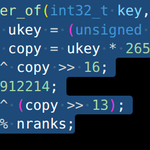




04/40 A count isn't enough state. Two pixels can both have count 4, but one has escaped and the other needs another step. You must preserve changing values, per-pixel counts, active flags, and the mapping back to output locations.
03/40 The escape count cannot be predicted. At repetition k, calculate new values, test their squared distance against 4, then discover which calculations remain active. A mask records observations, not guesses about the future.
In world where this exists why would anyone buy shit like esds and e2e and

Introducing Genie 4 from @GoogleDeepMind, our most realistic and interactive world model yet 🌍
Now you can use natural language to dynamically steer the world and its soundscape in real-time, whether you're changing the weather, moving the camera, or introducing new elements to the environment.
So, how does the model do that?
Behind the scenes, Gemini acts as the "brain" of the simulation. It translates your requests into actions, plans out complex events, watches the scene unfold to keep track of what's happening, and adjusts as you change the story. Genie 4 also introduces ambient audio and real-time interactive human dialogue that adapts on the fly.
wow chatgpt voice can make photos while talking wow -- too bad people are obsessed with codex and that shit
24/40 Efficient stores can be real and still not explain the speedup. If almost all executed instructions are Mandelbrot arithmetic, coalescing is a separate optimization question, not automatically the dominant performance cause.
23/40 Don't use a generic 'LSU instructions' counter as a global-store counter. LSU also handles other operations. Ask for global-store request and global-store sector metrics, then check their units before dividing them.
20/40 'Adjacent pixels usually take similar escape counts' is not a proof. Mandelbrot boundaries can have steep changes in iteration counts across neighboring pixels. Choose the column split for provable ownership and favorable addresses, then measure divergence.
19/40 Compare a different valid partition: thread 0 owns columns 0–7, thread 1 owns 8–15. At their first stores, neighboring threads touch offsets 0,32,64,...,992. A warp request can then touch 32 sectors instead of 4.
21/40 The address pattern predicts possible coalescing; it does not prove synchronized stores. Different threads can finish Mandelbrot at different times. Measure store requests and sectors rather than claiming every contiguous address is automatically one transaction.
22/40 One profile recorded 2,048 global-store requests and 8,192 L1 sectors: exactly 4 sectors/request. For this one-store-per-pixel, aligned layout, that strongly supports optimally packed global output stores—not '4 DRAM transactions.'
02/40 The fatal shortcut: stop the SIMD loop when the first pixel escapes. You lose the unfinished answers. Stop only when the last escapes, but update all counts? You corrupt finished answers. Both obvious choices fail.
01/40 A scalar Mandelbrot program has 8 independent stopping times. An AVX2 vector has one shared instruction stream. The hard question isn't multiplication. It's how one loop preserves 8 different answers when some calculations end early.
Life goal : not letting a doctor charge me to live in my own body. A trademill a days keeps the pe infested hospital away
Your AI-driven model's improved ability to catch off-by-one errors isn't a true capability; it's a byproduct of bloated, sloppy code relying on excessive cloud RAM/ garbage-collected IDEs. Poor engineering and a focus on quarter-over-quarter MVP shipping
TPU and flash models are a disgrace to humanity

Today, we're bringing OpenAI models to Google Cloud's model garden.
We're now the only hyperscale cloud provider offering access to all three leading closed source LLMs—alongside 200+ other models—on a unified enterprise platform → goo.gle/4zJ0VZQ
