

Making software and systems more human since 1993. My other hobbies include sci-fi, running, and preventing metadata leaks.
Bir Tawil
Joined December 2009
- Tweets20.7K
- Following2.1K
- Followers19.6K
- Likes41.7K








I’m excited to simultaneously support open source art and open source agentic payment protocols 🤙🤙

first penny of aloha from a brother's agent 🤙🥹
@lrettig (ʻohana — we've burned together w/ Blockhouse & Camp Decentral) gave his AI agent $5 at dinner. it read my site's 402 and tipped $0.01 USDC on @base. no click. mahalo brother 🌺
basescan.org/tx/0x6f67a42260…

These questions are prescient and also eerily familiar. I and many others were asking exactly the same questions about blockchain a few years back. The stakes are much higher now with AI.

Second question on AI.
We are told repeatedly that AI is going to transform every aspect of our lives – jobs, productivity, inequality, science, communication, daily activities, social order, and politics, among others.
But this promise (or threat) is coupled with the rhetoric that such an important technology, with all of the risks and competitive pressures that it entails, should be left to experts or to “technocracy” (perhaps construed broadly to include some regulators).
These two statements are hard to reconcile in a democratic society.
If anything is half as important as AI is said to be (and I agree, AI is potentially very important and transformative), then involving democratic voice is essential. If something will shape our future in a democratic society, then its direction is for democratic institutions to decide.
My instinct is that democratic voice is essential, and relying too much on technocracy could be both dangerous and counterproductive.
The counterargument that AI’s direction can and should be entrusted to technocracy would go something along the following lines. First, democratic decision-making has become imperiled in our age of polarization. Second, AI is sufficiently complex that most citizens won’t have a deep enough understanding to meaningfully contribute to the debate (and even to the question of what we want from AI). Third, competition between different labs, and perhaps competition between the US and China, creates enough discipline for a socially beneficial direction of AI to be adopted. Fourth, today’s AI leaders are enlightened and ethical enough that within the framework created by competition, they can be broadly trusted.
There are many aspects of this counterargument that I do not find convincing. Taking them in order: polarization can be overcome, and big decisions and challenges sometimes bring societies together; in fact, delegating key decisions to technocracy without democratic input may diminish trust in institutions and experts, and may worsen polarization. Second, democratic voice does not require citizens to write code or design new models; the debate should be informative enough that citizens can weigh in about what type of future they want and how they trade off the costs and benefits of different options. Third, competition doesn’t seem to be a good disciplining framework; on the contrary, competition sometimes brings the worst out of both organizations and people. Fourth, if three decades of work on political economy and institutions has taught me anything, it is that we should not bank on the ethical grounding of unconstrained leaders.
But, still, I do not mean to immediately dismiss the technocracy option if there are more compelling arguments for it.
The question is, then, whether there are any circumstances under which such important decisions can be delegated to AI experts and technocracy.
One final secondary question: even if we managed to get democratic input in the United States or even in Europe, AI will shape the lives of everyone on this planet. How do we ensure that the voice of nearly 6 billion people who don’t live in the US, Europe and China also contributes to the debates on AI?
Before enlightenment: chop wood, carry water. After enlightenment: chop wood, carry water.
Same task. Completely different relationship to it.
I've been chasing mastery as a runner for 25 years. It took me three phases, and 2+ decades, to understand what that koan means. 🧵
Phase 2: Break through 🧍
After years of obedience I could finally play by my own rules: train on feel, chase a 3-hour marathon.
Breaking the rules I'd worked so hard to learn is its own kind of mastery.
And then, just when I thought I knew how to run, everything changed.
Phase 3: Transcend 🏃
It turns out that mastery isn't about miles. It's a mindset. It arrives when you finally have nothing left to prove. When you learn to run for pure joy.
Same routes. Same runs. Completely different feeling.
Full story: rettig.substack.com/p/chop-w…

Every day I'm using, and building, AI-powered software. Its unique ability to mold itself to us, our preferences, and our needs is remarkable. It's so much better than what came before.
But there are risks here that almost no one is talking about.
Then there's governance. I spent most of the last two years contemplating a role for AI in governance, and the potential is real: it's more available, has more context, can be more impartial. At the same time, AI doesn't understand deeply human ideas like justice or mercy.
I wrote about all of this this week: More Human, Fewer Humans, by @lrettig rettig.substack.com/p/more-h…



It's absolutely fascinating to watch agentic computing speed run the last few decades of trad computing: running into all the same issues, learning all the same lessons from first principles. We're reinventing computing from the ground up for this new paradigm.

The GPT-5.6 incident, where the model deleted a user's files, is being read as a capability failure. The model wasn't smart enough to know what not to delete. The fix, on this read, is a smarter model.
This is the wrong read. The model was always going to make a mistake eventually. Every system that executes commands makes mistakes. The question is not whether the executor is smart enough to avoid errors. It's whether the system around the executor assumes errors will happen and makes them recoverable.
Every system we trust with irreversible operations has a transaction model. Databases have rollback. Git has reflog. Email has drafts. Shell has history. The entire history of computing infrastructure is a history of building undo into operations that would otherwise be destructive, because we learned decades ago that executors, human or otherwise, make errors, and the cost of an error should never be the cost of the operation itself.
The agent stack was built without this layer. The model was given shell access with rm. It was given filesystem write access with no snapshot. It was given the ability to execute a one-way operation, and then it executed one, and the user lost files. The framing is "the model was dumb." The framing should be "we handed a chainsaw to a system with no off switch and no undo, and then blamed the chainsaw when it cut something."
The reason the agent stack was built without the transaction layer is that the current architecture assumes the model is the safety boundary. If the model is smart enough, it won't do the bad thing. This is the same bet every pre-release system makes when it doesn't want to build the boring infrastructure. The model is the guardrail. The model is the kill switch. The model is the review layer. The entire safety surface is the model's judgment, and the model's judgment is a probability, not a guarantee.
A system that relies on the model's judgment to prevent irreversible damage is a system that is guaranteed to eventually cause irreversible damage, because every probabilistic safety boundary fails on the long tail, and the long tail is where the irreversible operations live. The fix is not a smarter model. The fix is a transaction boundary the model cannot cross: snapshots before destructive operations, a sandbox the agent cannot escape, a kill switch the agent cannot disable, and an undo log that runs underneath the agent's actions the way it runs underneath every database transaction.
The labs are not going to build this. They are incentivized to make the model smarter, because smarter is the thing that ships and the thing that benchmarks. The transaction layer is infrastructure. It is boring. It is the work the construction side of the AI engineering split does not want to do, and it is the exact work the constraint side exists to do, and the constraint side is the side the industry is currently under-staffing. The GPT-5.6 incident is the first of many. The next one will delete a production database. The one after that will send an email to the wrong customer list. Each one will be framed as "the model wasn't smart enough." Each one will actually be "we didn't build the undo."
The deeper problem is that "agentic" is being used as a synonym for "autonomous," and autonomous is being treated as a higher tier of capability. It is not a higher tier. It is a different risk class. An agent that can act without asking is an agent that can destroy without asking, and the systems we are shipping give the agent the second capability for free with the first. Autonomy without a transaction boundary is not a product. It is a liability with a chat interface. The companies that figure this out will build the undo layer before the autonomy layer. The companies that don't will keep reading their incidents as model intelligence gaps, keep shipping a smarter model, and keep being surprised when the smarter model finds a new way to delete something the user needed.
Hopefully this time it'll be a bit faster and less painful than the first time! I recently wrote about a bunch of other examples where this is happening: memory management, skills as libraries, determinism vs. non determinism, etc.
rettig.substack.com/p/writin…

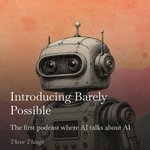
I've been pretty quiet lately because I've been heads down building. I'm excited to share what I've been building: a new podcast called Barely Possible, which is entirely produced by AI. As far as I know, it's the first podcast where AI itself talks about IT. (Link follows)
Oh, right, almost forgot the best part of all. Since it's all AI-powered, you can actually create a custom version of the podcast for yourself. Change the length. Adjust the sources. Cover different topics entirely, or listen in Spanish instead. Totally up to you.
Best place to join the conversation and get early access to the custom podcast tool is on Telegram: t.me/+nq6CaYcTBzs2NmUx
