
Researcher @LeverhulmeCFI @Cambridge_Uni. Exploring AI capabilities (mostly LLMs) in the context of occupational tasks. Violinist @paprikamusic & @PicoPlayers
London, UK
Joined March 2020
- Tweets61
- Following324
- Followers111
- Likes74




Marko Tesic retweeted

🚀 New Paper: “Paradigms of AI Evaluation: Mapping Goals, Methodologies, and Culture” ai-evaluation-paradigms.gith…
We survey 125+ studies and identify 6 major paradigms of AI evaluation, each shaped by distinct goals, methodologies, and research cultures.
🧵

It was a great experience presenting our tutorial on the capability-oriented approach to AI evaluation at @RealAAAI. @KozzyVoudouris, José Hernández-Orallo, @JohnJBurden, and I showcased measurement layouts (Bayesian hierarchical models) to infer the capabilities of AI systems.
We discussed how to use the measurement layouts to learn about the capabilities of RL agents and LLMs. All code, data, and presentations can be found here: github.com/Kinds-of-Intellig…


85
Bilo mi je zadovoljstvo gostovati na @radiogalaksija. Veliko hvala Dušanu na pozivu!
This post is from an account that no longer exists. Learn more
1
132
Marko Tesic retweeted

We have TWO new full-time positions open, to work on our two-year project in collaboration with Accenture entitled 'Aligning assessment of cognitive abilities in cutting edge AI and those required in human employees'. lcfi.ac.uk/get-involved/vaca… @Accenture
Happy to have published this work with Ulrike Hahn in @CognitionJourn. It's been a long time coming, originating from my PhD thesis.

How do explanations, confidence in a claim being explained, and the reliability of the source interact? Reliability mediates the impact of explanations on confidence. Explanations have a greater impact on confidence when reliability is low
sciencedirect.com/science/ar…

6
538


Excited to announce that I've joined @LeverhulmeCFI @Cambridge_Uni as a postdoc researcher. I'm working together with @LucyCheke, José Hernández-Orallo, & the @OECD on exploring AI capabilities and mapping them onto the specific demands in human workforce.
2
31
2,084
This work is now published in Patterns: https://teapawt.net/t.co/2a1Kib40MP
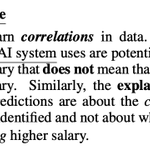
A cautionary note on how explanations of predictive AI models (which explain/make explicit the correlations in data that the AI model has captured) can affect our beliefs about the causal relationships in the world

Can counterfactual (CF) explanations of AI systems' predictions skew lay users' causal intuitions about the world?
In two experiments we (Ulrike Hahn and I) find that they can. But we also find that we may be able to guard against that. Preprint: arxiv.org/abs/2205.06241
1/
Happy to share that the workshop will also host a panel exploring: what can cognitive scientists and machine learning researchers learn from each other when it comes to (explainable) AI? The panelists are: @ruthmjbyrne, Noah Goodman, @HanaChockler, and @AndrewLampinen
1/
Very excited to announce the Workshop on Human Behavioral Aspects of (Explainable) AI!
Dates: 23rd and 24th of September 2022
Hybrid format: both in person (Birkbeck, University of London) and online
Website: sites.google.com/view/human-…
(1/4)

The workshop is on the 23rd and the 24th of September. More info at: sites.google.com/view/human-…
Register at: eventbrite.co.uk/e/human-beh…
2/
2
Very excited to announce the Workshop on Human Behavioral Aspects of (Explainable) AI!
Dates: 23rd and 24th of September 2022
Hybrid format: both in person (Birkbeck, University of London) and online
Website: sites.google.com/view/human-…
(1/4)
Confirmed speakers:
@claireewoodcock @HanaChockler @hal_ashton @katie_m_collins @ruthmjbyrne @SangeetKhemlani @tobigerstenberg @TomerUllman @umangsbhatt
(4/4)
Registrations for both in person and online are here: eventbrite.com/e/human-behav…
(5/4)
1
Happy to announce that I’ve been granted a Post-Doctoral Enrichment Award from @turinginst to organize a workshop on human behavioral aspects of (explainable) AI. 1/2
A small and fun project. Anyone interested can find the jupyter notebook here: github.com/markotesic/chess


Thanks @m_tesic for the research. Since I’m streaming my Chess.com games, it’s useful to know when can I get a decent opposition :)


1
Can counterfactual (CF) explanations of AI systems' predictions skew lay users' causal intuitions about the world?
In two experiments we (Ulrike Hahn and I) find that they can. But we also find that we may be able to guard against that. Preprint: arxiv.org/abs/2205.06241
1/
Inspired by the work on misinformation and health warning messaging, we designed a note communicating to the participants the correlational character of AI systems rather than causal.
4/

1
1
