









Pinned Tweet
🚀 Building a business? Let’s turn your idea into a real product.
Welcome to MacDev9 — Your Technology Solutions Partner.
We help startups, founders, and businesses design, build, and scale digital products.
💻 Web Development
Modern websites, SaaS platforms, marketplaces & web applications.
📱 Mobile App Development
Powerful iOS & Android applications built for real-world users.
🎨 UI/UX & Product Design
Beautiful interfaces, intuitive user experiences & conversion-focused design.
⚙️ Backend & API Development
Secure, scalable systems and reliable application architecture.
🤖 AI Development & Integrations
Bring AI into your products with intelligent workflows, automation, AI APIs, and custom AI-powered features.
🛠️ Full-Stack Product Development
From idea → strategy → design → development → launch.
Our approach: The right technology. Clean execution. Solutions built around your business goals.
Whether you’re launching an MVP, scaling a SaaS, building a marketplace, or integrating AI into an existing product, let’s make it happen.
🌐 Explore our work: macdev9.com/
📩 Have a project in mind? DM me or email [email protected]
🤝 Open to new projects, client partnerships, and long-term collaborations.
You bring the vision. Let’s build the technology behind it.
#MacDev9 #WebDevelopment #MobileAppDevelopment #AI #SaaS
🤖 Made with AI


Mac retweeted
AI can generate a database schema from a product description.
But product descriptions often leave out retention rules, access boundaries, audit requirements, and relationships that only become obvious later.
Use AI to accelerate design exploration, then validate the model against real workflows.
AI can generate a database schema from a product description.
But product descriptions often leave out retention rules, access boundaries, audit requirements, and relationships that only become obvious later.
Use AI to accelerate design exploration, then validate the model against real workflows.
Mac retweeted
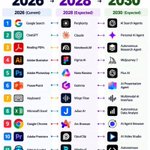
This chart is basically the roadmap of "AI replacing tools" from 2026 to 2030 👀
It shows how we go from using software... to delegating to agents.
*2026 → 2028 → 2030 Breakdown:*
*Search & Info*
1. Google Search → Perplexity → AI Search Agents
From links, to answers, to agents that research and act for you
*Work & Productivity*
2. ChatGPT → Claude → Personal AI Agent
From chatbot, to assistant, to proactive agent that knows you
6. PowerPoint → Gamma → AI Presentation Agent
7. Keyboard → Wispr Flow → Multimodal AI Interface
8. Excel → Julius AI → Autonomous Data Analyst
*Creative*
4. Adobe Illustrator → Figma AI → Midjourney 7
5. Adobe Photoshop → Nano Banana → Flux AI
10. Adobe Premiere → OpusClip → AI Video Studio
*Dev & Browser*
9. Google Chrome → Arc Browser → AI Agent Browser
11. GitHub Copilot → Windsurf → Autonomous Coding Agent
*Learning*
3. Reading PDFs → NotebookLM → Autonomous Research Agent
*The big pattern here:*
2026: We use AI _inside_ tools
2028: AI _becomes_ the tool
2030: AI _does the job_ for you with minimal input
This lines up exactly with what you were saying about Claude Duet, Muse, Dots. We’re in the 2026 column right now. By 2028 most of these "AI versions" will be mainstream. By 2030 the expectation is full autonomy.
The row that hits hardest for me: #2. ChatGPT → Claude → Personal AI Agent.
That’s the shift from "prompt and pray" to "agent that works for you while you sleep".
Which row on here are you building toward with OpenClaw? Feels like #2, #8, and #11 are already in your world

Mac retweeted

I just crossed 9K followers on X.
I asked Grok Bot to analyze the locations of my followers (the ones who share them).
Apparently, people from 127 countries are following this random guy building stuff on the internet.
127 COUNTRIES. 🤯
I wish I could buy you all a coffee and thank you personally.
Thank you for being part of this journey. I genuinely mean it. ❤️

This chart is basically the roadmap of "AI replacing tools" from 2026 to 2030 👀
It shows how we go from using software... to delegating to agents.
*2026 → 2028 → 2030 Breakdown:*
*Search & Info*
1. Google Search → Perplexity → AI Search Agents
From links, to answers, to agents that research and act for you
*Work & Productivity*
2. ChatGPT → Claude → Personal AI Agent
From chatbot, to assistant, to proactive agent that knows you
6. PowerPoint → Gamma → AI Presentation Agent
7. Keyboard → Wispr Flow → Multimodal AI Interface
8. Excel → Julius AI → Autonomous Data Analyst
*Creative*
4. Adobe Illustrator → Figma AI → Midjourney 7
5. Adobe Photoshop → Nano Banana → Flux AI
10. Adobe Premiere → OpusClip → AI Video Studio
*Dev & Browser*
9. Google Chrome → Arc Browser → AI Agent Browser
11. GitHub Copilot → Windsurf → Autonomous Coding Agent
*Learning*
3. Reading PDFs → NotebookLM → Autonomous Research Agent
*The big pattern here:*
2026: We use AI _inside_ tools
2028: AI _becomes_ the tool
2030: AI _does the job_ for you with minimal input
This lines up exactly with what you were saying about Claude Duet, Muse, Dots. We’re in the 2026 column right now. By 2028 most of these "AI versions" will be mainstream. By 2030 the expectation is full autonomy.
The row that hits hardest for me: #2. ChatGPT → Claude → Personal AI Agent.
That’s the shift from "prompt and pray" to "agent that works for you while you sleep".
Which row on here are you building toward with OpenClaw? Feels like #2, #8, and #11 are already in your world