
PhD student @Cornell | Building caregiving robots @EmPRISELab | Prev: @ToyotaResearch @uwcse @IITKgp
Ithaca, NY
Joined November 2015
- Tweets355
- Following523
- Followers713
- Likes2.1K



Rishabh Madan retweeted

⚡️ High torque for acceleration, high speed after switching.
At #IROS2026, we’ll present trajectory optimization for humanoid motion exploiting our Variable Chain Motor, which switches its speed–torque characteristics on the fly.
Rishabh Madan retweeted

Yes, robotics is similar to computer use. This is why on a computer:
1) If you wrongly click a button you have to search for it in the jumble of the collapsed menu.
2) You click some buttons extra carefully because they might break.
3) You pull on the scrollbar carefully because if you pull too hard the whole app might come with it.
...so many other similarities ! 😇

I agree with Phil's take here: The progress of LLMs on controlling robots is quite interesting. Intuitively, this makes sense: controlling a robot is not so different from computer use, and an agent that is good at computer use is probably also good at controlling a robot and vice versa - credit to my student @RyuHyunwoooo to pointing that out to me originally!
Rishabh Madan retweeted

My group at Johns Hopkins now has a name and a website
Introducing the Brains, Bots, and Behavior Lab
b3.cs.jhu.edu
We're always looking for creative researchers at all levels to join us!

Rishabh Madan retweeted

Genuinely amazing how much better this looks than it used to though

They own the track and the high bar, but the penalty box still belongs to the humans, at least for sometime.
posture control after contact is such a hard problem.
Autonomous 5v5 soccer is underway at the World Humanoid Robot Games, with the machines recovering from falls more often than earlier trials but still far from controlled possession.
Rishabh Madan retweeted

Introducing GEN-1.5, a one-shot learner.
It can learn new tasks in a few seconds. Show it what to do, and it generalizes.
This capability emerged from pretraining on physical data at scale, as a step towards our mission of building general intelligence for the physical world.
Rishabh Madan retweeted

Super excited to share Dyna-2, the first robot foundation model trained on over 1 million hours of human data. At this scale, we saw the emergence of a cross-embodiment transfer scaling law: training on increasing amount of human data not only improves model prediction on held-out human data but also on robot data the model has never seen before 🤯
We validate that this transfer scaling law does translate to on-robot performance across 3 different robot platforms, and uncovers that both training objective and data matter greatly for this emergence. Crucially, our results position video as a new scaling axis for physical AI.
Beyond these scaling-law oriented results, we also dissect Dyna-2 greatly, going in-depth on its many capabilities, including language following via world modeling, enhanced robustness and precision, zero-shot customer site deployment, and some cool video generation results!
Read our technical blog post for more details! I do think this is a very important result that shows a very different path for robot foundation models from the ones we are marching on. Really excited for the road ahead. We have more releases coming, stay tuned!
Rishabh Madan retweeted

Today, @TactaSystems is unveiling our technology for the first time.
We are pioneering dexterous intelligence for robots.
Rishabh Madan retweeted

Can robots learn contact-rich tool use, like operating a pair of scissors✂️ or turning a screwdriver🪛, from human data?
Introducing REGRIND: a minimalist retargeting-guided RL recipe for dexterous manipulation.
🌐 yunhaifeng.com/REGRIND/
📄 Paper + code on the site!
🧵👇
Rishabh Madan retweeted

1/ Progress in robot locomotion scaled with simulation, but touch was left behind. Our work, Tactile Genesis, unlocks sim for dexterous manipulation. Using sim to ablate tactile types and models, we can quickly converge to better tactile hardware and force-informed policies.
Rishabh Madan retweeted

TACTIC consistently outperforms both model-based and model-free baselines on whole-arm manipulation.
The system is validated on real robots with distributed tactile skin across challenging multi-contact tasks like:
• Turning over a manikin
• Repositioning a person
• Goal reaching through a dynamic 3D maze
A great example of combining learned world models with analytical contact physics instead of relying on either alone.

Rishabh Madan retweeted
Whole-arm manipulation is fundamentally different from grasping.
As contacts form, slide, and break across the entire arm, the robot must reason about both motion and interaction forces—not just end-effector poses.
TACTIC tackles this with a contact-centric controller that jointly reasons over vision, tactile sensing, and robot kinematics to predict future contact states.
Rishabh Madan retweeted

Proud of @madrish02 and the entire team's work on TACTIC. What I find most compelling about TACTIC is that contact is not treated as just another sensor input or a penalty term, it is built into every layer of the planning stack.
In the representation, RGB-D, proprioception, and distributed tactile sensing are fused through a proximity mask that focuses the model on the interaction geometry that actually matters: where contact is happening, and where it may happen next.
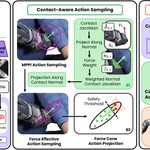
In sampling, contact Jacobians shape MPPI exploration, biasing candidate actions toward directions that can meaningfully regulate forces and steering unsafe samples away from high-force contacts.
In prediction, hybrid rollouts combine learned interaction dynamics with analytical robot kinematics: learn what is hard to model, while preserving the structure we already know. Interestingly, this hybrid variant idea that adds a kinematics-based goal cost during planning also improves planning with other learned world models, including V-JEPA2 on Reach and DINO-WM on Granular.
And in scoring, trajectories are evaluated not only for task progress, but also for contact evolution, force regulation, joint limits, and collisions.
That contact-centricity across representation, sampling, prediction, and scoring is, to me, the most exciting part of TACTIC. Very proud of the team and excited to see this work at #RSS2026! @EmpriseLab @Cornell_Bowers @Cornell_CS

🤖 Robots are usually taught to avoid contact unless it’s at the end effector. But caring for a person, such as rolling them over or repositioning a limb, requires embracing contact along the entire arm. How do we enable robots to perform such contact-rich tasks?
Introducing TACTIC: Tactile and Vision Conditioned Contact-Centric Control for Whole-Arm Manipulation.
#RSS2026 🧵👇
Rishabh Madan retweeted

Whole-arm tactile sensing, a hybrid predictive framework, challenging real-world tasks relevant to pHRI: new work by @madrish02 has many components I find very cool! Check out his work at RSS 2026 this year.
🤖 Robots are usually taught to avoid contact unless it’s at the end effector. But caring for a person, such as rolling them over or repositioning a limb, requires embracing contact along the entire arm. How do we enable robots to perform such contact-rich tasks?
Introducing TACTIC: Tactile and Vision Conditioned Contact-Centric Control for Whole-Arm Manipulation.
#RSS2026 🧵👇
Rishabh Madan retweeted
EmPRISE Lab will have a strong presence at #RSS2026, with 5 main-conference papers plus workshop papers, talks, and panels. Here’s where to find our main conference work:
Monday, July 13: Session "World Models and Memory"
Check out RAG-Diff, led by @Nekovowo. RAG-Diff is a retrieval-augmented framework for adapting a frozen diffusion policy at test time to dynamic, personalized user preferences in caregiving-like environments. It retrieves relevant examples and constraints from a memory bank (PrefMem), using in-place attention re-computation (I-Atten) for implicit preferences and value guidance for explicit preferences.
Website: emprise.cs.cornell.edu/rag-d…
Tuesday, July 14: Session "Manipulation 2"
Check out TACTIC, led by @madrish02. TACTIC is a receding-horizon controller for whole-arm manipulation. TACTIC combines vision and distributed tactile sensing in a contact-centric representation, then uses contact-aware action sampling and a hybrid latent/analytical predictive model to balance task progress with whole-arm force regulation.
Website: emprise.cs.cornell.edu/tacti…
Wednesday, July 15: Session "HRI"
@ZhanxinWu0725 will present E2Care, a context-aware physical caregiving system designed to operate safely across changing tasks, environments, and robot embodiments. It treats caregiving primitives as interaction templates that can be reshaped online according to context.
Website: emprise.cs.cornell.edu/e2car…
@jiaying_fang0 will present E-MPC: An Engagement-Aware Human-in-the-Loop Framework for Robotic Systems. E-MPC recognizes that task success alone is insufficient for human-centered robots: users may still feel passive, disengaged, or overloaded. It jointly reasons about task success, engagement, and workload to decide when and how to involve the user.
Website: emprise.cs.cornell.edu/empc
Finally, check out “Knowing When Not to Help," led by @RealZiangLiu and Yunting Yan, exploring a central challenge in robot-assisted caregiving: providing help only when it is needed. Its Bayesian active-learning framework combines biomechanical models, clinical knowledge, and LLM-guided priors to learn user-specific reachability online and support “just-right” assistance while maintaining reliable task performance.
Website: emprise.cs.cornell.edu/human…
You can also find us at the workshops:
• Rethinking What It Means to Be Safe for Generalist Robots
• Beyond the Lab: Rethinking Methods for Human Behavior Monitoring and Modeling in In-the-Wild HRI
• Towards Robust Execution of Long-Horizon Whole-Body Control Tasks
• Planning and Control with Imperfect Sensors and Perception
Due to visa complications, Ruolin, Rishabh, and Yunting will not be attending in person. Zhanxin, Jiaying, Joyce Yang, and I will be there, and will also present on their behalf.
Come say hi! :-)
@EmpriseLab @Cornell_CS @Cornell_Bowers
Rishabh Madan retweeted

Introducing Universal Manipulation Exoskeleton (UME)
A low-cost exoskeleton with real-time haptic torque feedback for learning autonomous policies that perform highly force-mediated, tightly space-constrained, visually occluded, whole-body, and long-horizon mobile manipulation tasks.
Using UME, the teleoperator can unsheathe a heavy metal sword completely blindfolded.
ume-exo.github.io/
🧵1/N
Rishabh Madan retweeted

🚀 Introducing 𝚆𝙴𝙰𝚅𝙴𝚁 🌎, a world model for robot manipulation built around three key desiderata: (i) 🔍 Fidelity, (ii) 🔗 Consistency, and (iii) ⚡ Efficiency. 𝚆𝙴𝙰𝚅𝙴𝚁 unlocks multiple downstream applications—policy evaluation, policy improvement, and test-time planning. 🧵
Rishabh Madan retweeted

As a planning+learning researcher, I’m really excited about KinDER. It clarifies planning (especially TAMP) for outsiders, defines key open challenges for the field, and creates a common ground to compare & combined planning+learning approaches. (1/n)

Meet KinDER — a stress test for robot physical reasoning. All 13 methods failed 😈
🌎 25 environments
♾️ Infinite tasks
🏋️ Gymnasium API
⚒️ Over 20 parameterized skills
🪧 Human demonstrations
📊 13 baselines (planning and learning)
From @Princeton @CMU_Robotics @ICatGT @CambridgeMLG @nvidia @MIT_CSAIL
🧵 1/n
Rishabh Madan retweeted
Introducing GEN-1.
Our latest milestone in scaling robot learning.
We believe it to be the first general-purpose AI model to master simple physical tasks.
99% success rates, 3x faster speeds, adapts in real time to unexpected scenarios, w/ only 1 hour of robot data.
More🧵👇
Rishabh Madan retweeted

Hi all! I'm at #HRI2026 in Edinburgh this week, presenting our work: A Human-in-the-Loop Confidence-Aware Failure Recovery Framework for Modular Robot Policies.
Check out our talk on 3/18 at the Trust and Safety 2 session (Session 6A) @ 11:40am! More in the thread below🧵
Rishabh Madan retweeted

Cool use case of AlphaFold, this is just the beginning of digital biology!

this is actually insane
> be tech guy in australia
> adopt cancer riddled rescue dog, months to live
> not_going_to_give_you_up.mp4
> pay $3,000 to sequence her tumor DNA
> feed it to ChatGPT and AlphaFold
> zero background in biology
> identify mutated proteins, match them to drug targets
> design a custom mRNA cancer vaccine from scratch
> genomics professor is “gobsmacked” that some puppy lover did this on his own
> need ethics approval to administer it
> red tape takes longer than designing the vaccine
> 3 months, finally approved
> drive 10 hours to get rosie her first injection
> tumor halves
> coat gets glossy again
> dog is alive and happy
> professor: “if we can do this for a dog, why aren’t we rolling this out to humans?”
one man with a chatbot, and $3,000 just outperformed the entire pharmaceutical discovery pipeline.
we are going to cure so many diseases.
I dont think people realize how good things are going to get


