Reviving American history as a blueprint for resilience, grit, courage & purpose. Stories of sacrifice, survival and the lessons that still matter.

The West - United States
Joined April 2023
Since we just crossed 1,000 followers, figured I should probably introduce myself. I’m James — the voice behind Chronicles of History. I started this account because I’ve always loved American history, especially the West, the frontier, explorers, Native nations, soldiers, settlers, outlaws and the ordinary people who lived through extraordinary times. Somewhere along the way, I became convinced that history shouldn’t just be a collection of dates we memorize. It should make us think. About courage. Sacrifice. Failure. Faith. Family. Resilience. Freedom. And what people were capable of when life demanded more from them. My beliefs are pretty simple: God. Freedom. Family. Legacy. When I look at this country today, I think one of our greatest problems is that we’ve forgotten where we came from. We’ve forgotten what happened to shape the world we inherited. The life we benefit from today didn’t just appear. It took real grit. Hardship. Sacrifice. Leadership. Faith. Community. And generations of people willing to do very difficult things without knowing how the story would end. That history deserves to be protected. It deserves to be understood. And it deserves to be brought back into the light. Chronicles of History is my very small way of doing that. I believe in God, strong families, community engagement, servant leadership and doing hard things. Those things still matter. And history gives us countless examples of what ordinary people are capable of when they accept responsibility, endure hardship and live for something bigger than themselves. I’m also a husband, dad, history writer and admittedly the kind of guy who can stare at an 1880s photograph for twenty minutes wondering who everyone was, what they were thinking and what happened to them after the shutter clicked. That curiosity is really the heart of this account. Not to romanticize the past. Not to pretend it was simpler or perfect. But to preserve it, understand it and carry forward the lessons that still matter. Today we crossed 1,000 followers organically. And somehow between 3,000–5,000 people a month are now reading my little history blog too. That genuinely means a lot to me. Thank you to everyone who reads, shares, argues, corrects me, teaches me something and adds to the conversation. We’re just getting started. Let’s make history cool again.
42
105
5
1,372
258,010
Custer County, Nebraska. 1886. Everybody in this family is sitting politely for the photographer. Except the boy on the right. He's standing there holding a bull. Not a calf. A full-grown bull, horns and all, like it's the family dog. Now take a good look at the rest of the frame. A sod house cut from the prairie itself. A real glass window. A set of antlers mounted on the roof. A small table set out front. Mother in a dark dress. Father holding the baby. A little one leaning on her knee. The Library of Congress believes this is the Laulerman family, but it puts a question mark next to the name. We may never know that boy's name. Wish we knew his story. There's probably a lot our boys in today's world could learn from him. But one thing's for sure... We know exactly what he was proudest of.
3
8
106
4,978
Flathead Reservation, Montana. 1908. Look at the three of them. The old man in a bone breastplate, a feathered shield at his side, holding the little girl's hand. The woman in white buckskin, fringe to the ankles. And the girl in the middle. Decorated dress. A round medallion. A beaded bag set at her feet like she was told to show it off. Lodges behind them. Mountains behind those. The card reads: "Chief Charlot and Family." His name was Charlo. Chief of the Bitterroot Salish. In 1872, Congressman James Garfield came to move his people out of the Bitterroot Valley. Charlo refused to sign. His mark appeared on the agreement anyway. It was forged. So he stayed. Most of his people stayed with him. For almost twenty more years. By 1889, with settlers and a railroad crowding in and his people going hungry, he agreed to go. In October 1891 the Salish left their valley. Elders remembered it as a funeral march. Charlo did not look back. Here he is 17 years later, standing with his family. He died in January 1910.
1
7
76
3,542
Mary Fields. Circa 1870-1885. A tintype. Small enough to hold in your palm. Look closely. The dark cap. The striped work dress, buttoned to the throat. Hands folded in her lap, a ring on one finger. And that look. Steady. Unbothered. She was born enslaved in Tennessee in the early 1830s. After the war she worked her way north. By 1870 she was at the Ursuline convent in Toledo, Ohio, running the laundry, the kitchen and the grounds. In 1885 she followed the sisters west to St. Peter's Mission in Montana Territory. She kept that mission running. She was never fully accepted there. In 1895 she was forced out. So she took a job almost nobody expected. She won a U.S. mail contract, a Star Route, carrying the mail between St. Peter's Mission and the town of Cascade. A 34-mile round trip, by stagecoach. When the snow got too deep, she went on snowshoes. She was in her sixties. She kept the route for eight years. The first African American woman to hold a Star Route contract. Montana called her Stagecoach Mary. Her name was Mary Fields.
1
4
69
1,965
Most of us mark our arrows. The Sans Arc left theirs blank, and the whole camp ate. Generosity wasn't a rule they followed, it's what they were known for. Some of the best leadership in American history never signed its name. Credit @nmlinguaphile for this one.
Sans Arc (Itázipčho, ee-TAH-zeep-choh): The Lakota Who Hunted Without Claiming the Kill On the plains a hunter’s arrows were normally marked so everyone could see who had brought down which animal. The meat then belonged to that hunter’s household to distribute as they chose. The Sans Arc tradition was to leave arrows unmarked. Itázipčho combines itázipa (“bow”) and čhóla (“without”). French traders rendered the name Sans Arc. By leaving arrows unmarked, a successful hunter publicly declined to claim the kill for himself. The meat went into the general camp supply, and the hunter gained prestige for the generosity. Oral tradition holds that White Buffalo Calf Woman (Ptesáŋwiŋ, pteh-SAHN-ween) brought the sacred Čhaŋnúŋpa (CHAN-noon-pah) pipe to the Lakota through this band because they already practiced that form of open giving. White Buffalo Calf Woman is the central sacred figure in Lakota oral tradition. She appeared to two young hunters as a beautiful woman. After one approached her with disrespect and was destroyed, she instructed the other to return to camp and prepare a lodge. There she presented the people with the sacred pipe and taught them the seven rites that still structure Lakota ceremonial life. When her teaching was complete she walked away, transforming into a white buffalo calf as she departed. In the Sans Arc telling, she chose their band as the first keepers of the pipe because of the generosity already visible in the way they hunted. Among the seven Lakota divisions the Sans Arc form part of the central group. They lived, camped, and married most closely with the Minneconjou (Mnikȟówožu, mnee-KOH-woh-zhoo, “those who plant by the water”) and the Two Kettles (Oóhenuŋpa, oh-oh-HEN-oon-pah, “two boilings”). These three bands moved together far more often than they did with the southern Oglala (oh-GLAH-lah) and Brulé (broo-LAY) or the northern Hunkpapa (HOONK-pah-pah). Their range covered the northern plains of present-day western South Dakota, eastern Montana, and northern Wyoming, following the buffalo herds between the Missouri River and the Black Hills. After the wars of the 1870s most of the surviving people from these three bands were settled together on the Cheyenne River Indian Reservation in central South Dakota. That remains the primary home of enrolled Sans Arc today. Their ceremonial life centered on the classic Lakota rites: Inípi (ee-NEE-pee, the sweat lodge), Hanblečeya (hahm-bleh-CHEH-yah, the vision quest), and Wiwáŋyaŋg Wačípi (wee-WAHN-yahng wah-CHEE-pee, the Sun Dance). The pipe stayed at the center. Generosity of this kind was both a social ideal and a practical way to keep large mobile camps intact. In 1880–81 the Sans Arc medicine man and artist Black Hawk filled a ledger book with drawings that still give one of the clearest views of those ceremonies and daily scenes. In June 1876 about fifty-five Sans Arc lodges stood at the Little Bighorn (Greasy Grass). Their principal leader, Spotted Eagle (Waŋblí Glešká, WAHN-blee gleh-SHKAH), fought with Sitting Bull, Crazy Horse, and the combined Lakota and Cheyenne forces. Many of the band later followed Sitting Bull into Canada before returning to surrender near Fort Keogh around 1880. The photograph shows Spotted Eagle, Sans Arc Buffalo Medicine Man, standing in full regalia on the open plains. He wears a buffalo-horn headdress with fur, a fur-trimmed shirt, and armbands, and he holds a large hoop that was almost certainly a medicine or ceremonial object. Other people gather in the background. The caption printed on the image reads “Spotted Eagle, Buffalo Medicine Man of the Sioux Tribe.” Photo: Historical photograph of Spotted Eagle, Sans Arc Lakota, circa 1870s–1880s, commonly held in public-domain collections such as the Denver Public Library Digital Collections.
1
11
859
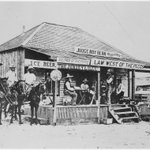
Langtry, Texas. Circa 1900. Read the signs first. JUDGE ROY BEAN. NOTARY PUBLIC. JUSTICE OF THE PEACE. LAW WEST OF THE PECOS. And right beside them: ICE BEER. Yes. The courtroom was a saloon. Now look at the porch. The white-bearded man in the wide hat, sitting on a keg at a little folding table, papers in front of him. His name was Roy Bean. The caption says he's trying a horse thief. Men on horseback wait in the street. In 1882, the Texas Rangers working the railroad camps west of the Pecos needed a justice of the peace close by. Otherwise it was a 400-mile round trip to deliver a prisoner. Bean got the job and held it, on and off, for twenty years. He named his saloon the Jersey Lilly, after the actress Lillie Langtry. He bragged he'd named the town for her too. Railroad records say otherwise. Legend made him a hanging judge. He never hanged anybody. The story everyone tells: a man fell off a bridge carrying a pistol and forty dollars. Bean fined the corpse forty dollars for carrying a concealed weapon. That paid for the funeral. Lillie Langtry finally came to town in 1904. Bean had died the year before.
1
7
1
114
3,933
Dakota. Late 1880s. This is lunch on the roundup. No tables. No chairs. Just cowboys sitting in the grass with their plates, hats still on. The chuck wagon parked under the trees. Saddled horses standing by, ready to go back out. And behind it all, the herd, spread across the valley floor. This is what the cattle business actually ran on. Long days. Hard riding. Short breaks. The wagon was the outfit's kitchen, pantry, and supply room on wheels. Out on the range, it was the closest thing to home these men had for weeks at a time. Take a good look at the faces. Nobody here is posing for a movie. They're just eating before the next ride. Most of the real West wasn't gunfights. It was work. Day after day, and a plate of grub when you could get it.
2
5
1
108
3,572
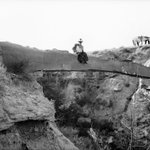
Eastern Montana. August 1903. Look closely at the top of this photograph. A woman is sitting on a natural bridge of petrified wood, high above a ravine, calmly reading a magazine. Her white horse, Buttermilk, waits on the ridge behind her. Her name was Evelyn Cameron. She was born in England in 1868. In 1893 she and her husband Ewen came to the badlands near Terry, Montana, to ranch. Ranching was hard. Money was tight. So she learned photography and started selling pictures. For more than thirty years she photographed eastern Montana. Homesteaders. Cowboys. Children. Birds and wildlife. Ranch work. And the rough, beautiful country they all lived in. Glass plates. Heavy cameras. Miles of open country between subjects. The Montana Historical Society holds nearly 1,800 of her negatives today. She never got rich doing it. But a great deal of what we can still see of homestead-era eastern Montana, we see because of her.
1
5
1
97
6,544
Summit of the Sierra Nevada. 1868. Look past the broken granite. Past the long wooden sheds in the foreground. All the way to the lake in the distance. That's Donner Lake. Twenty-two years before this photograph, 81 men, women and children were trapped near its shores by snow. October storms dropped more than six feet. November piled on nine more. They threw up crude cabins and shelters covered with hides. They tried three times to cross the pass. Three times the mountain sent them back. 36 of them died. 45 lived. Now look at the foreground again. Those wooden structures are snow sheds, built by the Central Pacific Railroad to keep its tracks open through the same snow that trapped the Donner Party. In 1846, that summit was a death sentence. By 1868, men were driving a railroad straight over it. The photographer was Andrew J. Russell, and this view was published in 1870 as one of the great early pictures of the transcontinental line. The lesson: The same mountain that breaks one generation can be crossed by the next. The difference is preparation.
44
1,425
Guthrie, Oklahoma. April 25, 1889. Three days before this photograph, there was no town here. Tents instead of buildings. Wagons jammed axle to axle, still loaded with crates. A man on a white horse. A washtub sitting in the dirt. And on the right, painted on canvas: COFFEE & SANDWICHES. Somebody figured out what this crowd needed before anyone had built a wall. At high noon on April 22, 1889, pistols, bugles and even a cannon went off along the borders of the Unassigned Lands. An estimated 50,000 people rushed in to claim farms and town lots. Guthrie was a Santa Fe railroad stop with a land office. By nightfall it was a city. Boosters swore 10,000 people. A correspondent that July put it closer to 7,000. So many wanted lots that they laid out four towns side by side, each with its own mayor. A year later, Guthrie was the capital of the brand-new Oklahoma Territory. That land had been ceded by the Creek and Seminole nations in 1866 treaties forced on them after the Civil War. Somebody pitched the first tent. Somebody poured the first cup of coffee.
1
44
1,224
Dakota Territory. Circa 1875-1885. When you look at his face, it tells a story. The tangled hair. The beard. The furrowed brow, like he's sizing you up. A rifle in his hands. Hollywood turned him into Robert Redford. His name was John Johnston. The frontier called him "Liver-Eating" Johnston. He went west from New Jersey, trapped and hunted the Rockies, served in the Union Army, scouted for General Nelson Miles in 1876-77, and later wore a badge in Red Lodge, Montana. Now, the nickname. The legend says he waged a long war on the Crow and ate the livers of the men he killed. The record is a lot murkier than the legend. Johnston himself reportedly said he never ate any. He just "made that man think I did." Here's what isn't murky. He died broke in a California veterans' home in 1900 and was buried far from the mountains. In 1974, a seventh-grade class in Lancaster, California, campaigned to bring him back. He was reburied in Cody, Wyoming. Redford came.
10
20
336
28,766
160 acres. A piece of land to call your own. An opportunity to build something that could outlive you. America, 1862. In the middle of the Civil War, Abraham Lincoln signed the Homestead Act, offering ordinary Americans the chance to claim 160 acres of public land for a small filing fee. There was a catch. You had to live on it, improve it, and work the land for five years before it was truly yours. And so they came. Families with wagons full of belongings, children, livestock, and dreams of a better future. Imagine the excitement of standing on your own land for the first time. Looking across an open prairie and imagining a home, a barn, fields of crops, and children growing up where there had been nothing but grass. Now imagine the reality. Blizzards. Drought. Failed crops. Isolation. Endless work. Some families succeeded. Others lost everything and walked away. The land itself carried another difficult history, as westward settlement came at an enormous cost to Native peoples whose homelands were being taken. Yet for those who managed to establish a homestead, ownership could change a family's future. By the time the homesteading era ended, roughly 270 million acres had passed into private ownership under federal homestead laws. How many homes were built with excitement? How many families passed their farms down through generations? How much of the American landscape we recognize today began with one family and 160 acres? Look at this photograph. The sod house. The horses. The plow. The family standing on land they worked with their own hands. There was little convenience in a life like this. Most things required tremendous effort. But there's something worth remembering about ownership. When you build something with your own hands, when your livelihood depends on the land beneath your feet, you develop a different appreciation for what you have. And perhaps that's a lesson worth carrying into our own convenient, fast-moving world. Freedom brings opportunity. Ownership brings responsibility. And building something worth passing down takes work. Never forget the generations who came before us.
12
9
165
4,821
Pine Ridge, South Dakota. 1891. Look closely. The cover is off this tipi. What's left is the frame. And inside it, a home. Women sitting close together. A small child near the center. Iron pots and pans. Blankets. A barrel tipped on its side. A freight wagon parked behind them. This is the home of Mrs. American Horse, an Oglala Lakota woman, photographed by John C. H. Grabill in 1891, in the tense months after Wounded Knee. Most people picture the Lakota in one moment. War bonnets. Battle. But most days looked like this. Cooking. Raising kids. Visiting relatives. Keeping a family together while the world around you was being taken apart. By 1891 the buffalo were nearly gone. Look at what had replaced them in this frame: trade pots, canvas, a wagon. Before all that, life moved with the seasons, the herds, and the camp. We wrote about what that world actually looked like, from the buffalo hunt to the inside of the tipi. Link in the reply.
6
8
1
132
7,458
October 21, 1867. Medicine Lodge Creek, Kansas. 159 years ago today, Kiowa and Comanche leaders signed a treaty with the United States. One of the Kiowa men who put his mark on it was this man. His name was Satanta. Set'tainte. White Bear. Take a good look at him. The bow and arrows across his lap. The medal hanging from his neck. A face that gives away nothing. At Medicine Lodge they started calling him the "Orator of the Plains." It may have been praise. It may have been a jab at how long his speeches ran. Either way, nobody forgot him. The treaty was supposed to bring peace by moving the southern Plains nations onto reservations. It didn't. Within a year the fighting was back. In 1871, Satanta helped lead the raid on Henry Warren's wagon train in Texas, where seven teamsters were killed. Then he bragged about it at Fort Sill. Arrested. Tried in a Texas civil court. Sentenced to hang. Commuted. Paroled. Arrested again. He died in the Huntsville penitentiary in 1878. In 1963, his grandson brought him home to Fort Sill. A hard man in a hard time. Both things are true. The lesson: A treaty is only as strong as the promises behind it.
5
13
1
126
4,728
Rosebud Agency, South Dakota, 1896. Armed. Mounted. Disciplined. These men weren't U.S. cavalry soldiers. They were Dakota Sioux reservation policemen. And their history is far more complicated than most Americans realize. Long before the federal government organized police forces on reservations, the Lakota already had their own system of maintaining law and order. They were known as the Akicitas. These men helped maintain order in villages, regulated buffalo hunts, enforced tribal customs, and carried responsibilities that demanded courage, discipline, and respect. But by the late 1800s, the world around them had changed dramatically. The buffalo herds had been devastated. The Plains Wars had ended. The reservation system had transformed life for Native communities. Beginning in the 1870s, federal Indian agents increasingly recruited Native men into reservation police forces. Their duties included protecting communities from horse thieves, liquor traders, and criminals. They patrolled reservation boundaries, made arrests, and maintained order. But there was a troubling contradiction. These same men were sometimes ordered to enforce federal policies that restricted their own people's traditions, religious ceremonies, and ways of life. Imagine carrying that responsibility. Protecting your community while serving a government that was also dismantling parts of its culture. By 1890, Indian police forces operated at 59 agencies across the country. Look closely at this photograph. The horses. The rifles. The uniforms. The men sitting proudly in formation beneath the bluffs of South Dakota. These were real men navigating one of the most difficult chapters in American history. Not simply warriors. Not simply policemen. And certainly not men whose lives can be understood through easy labels. They were caught between two worlds, carrying the responsibilities and contradictions of both. Another remarkable chapter of the American West that deserves to be remembered.
1
11
88
2,727
One hell of a story. We all need to hold a standard like "Mad Jack" did in our own lives.
Jack Churchill - The man who stormed the beaches equipped with a longbow and sword. "Mad Jack" served in the British Army during WW2. From Norway to France, the eccentric officer was seen charging headlong with his trusty longbow, sword, and bagpipes. He famously remarked: "Any officer who goes into action without his sword is improperly dressed" There is a popular story that says Jack got a kill with his longbow - the last recorded in modern warfare - though this is the subject of some debate. What is undeniable, is he was one of those rare breed of men who absolutely thrive in war. In fact, at the end of the war in Europe, he was genuinely gutted that by the time he got to the Pacific, the war was over. After the war Jack continued to serve, notably helping to save hundreds of lives during the Hadassah medical convoy massacre in 1948. He left the military in 1959 and took to civilian life just fine, spending his time sailing up and down the Thames, surfing in Australia, building model ships, and even briefly working as an actor. He passed away in 1996 at the ripe old age of 89. What a life, and what a man!
2
19
1,248
The Dalles, Oregon, 1906. He crossed the Oregon Trail as a young pioneer. More than 50 years later, he returned to make sure America never forgot it. His name was Ezra Meeker. In 1852, at just 22 years old, Meeker traveled west along the Oregon Trail with his wife and infant son. It was a journey of thousands of miles through a landscape that demanded extraordinary endurance from the families who attempted it. He survived. He settled in the Pacific Northwest. He built a life. But as the decades passed, something troubled him. The Oregon Trail was disappearing. Roads were replacing wagon ruts. Settlements were growing. The pioneers who had made that extraordinary journey were dying, and with them, their memories. So in 1906, at 76 years old, Meeker hitched up an ox team and set out to retrace the trail. Not for wealth. Not for adventure. To preserve history. He traveled through towns, gathered crowds, gave speeches, and helped establish stone monuments so future generations would know where those wagons once rolled. Look at this photograph. The children gathered around the oxen. The covered wagon. The old pioneer standing among a generation that never experienced what he had. It's a remarkable scene. Meeker understood something we should never forget. History doesn't preserve itself. It takes people willing to tell the stories, protect the landmarks, and pass the lessons forward. More than a century later, that responsibility belongs to us. Remember the past. Preserve the stories. Pass them on.
6
14
106
2,554
Wickenburg, Arizona Territory, 1890s. The white horse. The dust beneath their feet. Those intense, weathered looks. Four Hispanic vaqueros staring straight into the camera. Jesus Olea, Francisco Macias, Juan Grijalva, and Clemente Macias. Just imagine the miles these men traveled. The desert heat, the long cattle drives, the lonely nights beneath an endless Arizona sky. Long before the American cowboy became a Hollywood legend, generations of Mexican vaqueros had already mastered the saddle, the rope, and the unforgiving demands of ranch life. Their horsemanship helped shape the cowboy traditions of the American West. These weren't men playing cowboy. They were the real thing. And perhaps the most remarkable part of this photograph is that their legacy didn't disappear with the passing frontier. Their descendants helped preserve the history of Wickenburg and the Hispanic families who helped build it. Four men. Four horses. One remarkable glimpse into the real American West.
4
9
164
5,260
Virginia, May 1862. Before Little Bighorn. Before the legend. Before the disastrous final stand. There was a young George Armstrong Custer, reclining beside a dog, staring into the camera with a look that almost seems to say he already knew he was destined for greatness. Custer was a fascinating contradiction. Charming, charismatic, courageous, and ambitious. But also impulsive, hot-tempered, and possessed of an ego that would become nearly as famous as the man himself. He graduated last in his West Point class in 1861, yet rose to become one of the Union Army's youngest generals during the Civil War. He earned a reputation as a daring cavalry commander, willing to charge into danger when others hesitated. He survived the Civil War and emerged a celebrated officer. Fourteen years after this photograph, Custer and more than 200 men under his immediate command would perish at Little Bighorn, fighting Lakota, Northern Cheyenne, and Arapaho warriors in June 1876. The young lieutenant in this photograph had no idea what awaited him. There's a lesson buried in Custer's remarkable, deeply flawed life. Confidence can inspire men to follow you into battle. Courage can carry you through impossible circumstances. But confidence without humility can become arrogance. And arrogance, especially in command, can carry a terrible price. Ego is the enemy. Custer's story remains one of American history's most compelling reminders of that truth.
10
21
259
16,780