

Building a team of AI agents that could one day run a company. Sharing what they can do, what they break, and what I still do myself.
Joined January 2013
- Tweets297
- Following46
- Followers28
- Likes10




Pinned Tweet
94% vs 32.7%.
94% of enterprise leaders are at least somewhat confident their AI agents don't have more access than they need. Only 32.7% actually give agents least-privilege access (EMA, n=202).
Building my agent team, I check access when the agent acts, not at setup. 🧵

2
1
94
Maybe. But 2 people running 50 agents isn't a tiny team. It's 2 managers with 50 direct reports.
Agents do the work. A human still reads it, catches the mistakes, and owns what goes out.
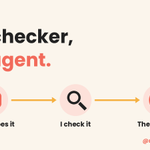
My rule: before I add an agent, I name who checks its work. No checker, no agent.


We're approaching a point where one person can do what an entire startup team needed months to accomplish.
Think about that.
The next generation of billion-dollar companies might have 2 employees and 50 AI agents.
4
Same model, different harness, different result. Agreed.
The harness is also the blast radius. A model swap changes how well an agent works. A harness change changes what it can break.
My rule: model swaps get a test run. A new tool, key or folder gets my review first.


Claude Code and an AI employee got the same job and opened the same PR in the same 5.5 minutes. Then came the release, and only one of them could finish the f*cking thing
Same brain. Different harness
Agent = Model + Harness. The harness is what it can reach, what it remembers, what it may do alone and how it checks its work
12 repos to build yours, 866K+ stars, every link checked
Tools. Memory. Permissions. Checks.
Tools
1/ MCP servers → the reference tool servers your agent plugs into
github.com/modelcontextproto…
2/ github-mcp-server → GitHub's official MCP for PRs, issues and code
github.com/github/github-mcp…
3/ playwright-mcp → your agent drives a real browser
github.com/microsoft/playwri…
Memory
4/ mem0 → keeps what it learns about you between sessions
github.com/mem0ai/mem0
5/ skills → Anthropic's Agent Skills, write a routine down once
github.com/anthropics/skills
6/ superpowers → skills plus a whole dev method, 328K stars
github.com/obra/superpowers
Permissions
7/ E2B → secure sandboxes for anything risky
github.com/e2b-dev/E2B
8/ claude-code-action → Claude inside your GitHub workflow, under your rules
github.com/anthropics/claude…
9/ 12-factor-agents → the principles for agents you can put in front of real customers
github.com/humanlayer/12-fac…
Checks
10/ promptfoo → tests and red teaming for prompts and agents
github.com/promptfoo/promptf…
11/ ast-grep → structural search and lint rules for your code
github.com/ast-grep/ast-grep
12/ stryker-js → mutation testing, proves your tests actually bite
github.com/stryker-mutator/s…
Job → tools → memory → ask → check → ship
Round 1 was a tie: both PRs passed, 41 tests vs 29, zero fixes. Round 2 is where the harness showed up
Bookmark this, then read the full test below ↓
13
6%.
Orgs that can revoke a rogue agent's access within an hour. Only 17% give each agent its own identity (Gravitee, n=900).
A shared key can't be pulled from one agent without breaking the rest.
My rule: one credential per agent, and I rehearse revoking it before launch.

15
A refusal I can see costs me minutes. A quiet swap costs me weeks.
My rule: an agent that can't or won't do a step says so in its report, in plain words. And nothing I build on gets checked only by the agent that made it.

This quoted post is unavailable.
8
9.9%.
Agent runs that got everyday tasks fully right, yet failed a safety check (ShellBench: 2,589 of 26,151).
Popular advice: judge an agent by whether the job got done.
Done isn't safe.
My rule: two checks per task. Job done? Only what the job needed? Fail either, no ship.

7
Google is pushing agents off raw Workspace APIs onto MCP servers with permission checks and approvals.
Right layer: the door, not the prompt.
My rule: no agent holds a raw token to my mail or files. Every call goes through a gateway that logs it. Sends and shares wait for me.


Google will start forcing AI agents to use MCP (instead of APIs) for Workspace (Gmail, Drive, Calendar, Docs, etc.) starting Feb 1, 2027.
AI agents will no longer be allowed to call the normal Workspace REST APIs freely starting Feb 1, 2027. Instead, they must use Google’s official Workspace MCP servers (or the Workspace CLI).
Regular (non-AI) applications can continue using the existing REST APIs as usual.
According to Google, they are doing this to improve security, visibility, and control. MCP gives Google (and admins) better policy checks, human in the loop confirmations for sensitive actions, and clearer audit trails when autonomous agents interact with Workspace data.
The commercial reason (which Google won't admit) is that they can charge extra for higher usage (higher usage will move to a paid “Scaled” tier starting April 1, 2027.).
AI agents that call Workspace REST APIs directly will be limited to Standard tier quotas, no matter which tier the project is on. To get higher quotas for agent use, you must switch to MCP and enrol in the Scaled tier.
It is important to note that they are not fully blocked. But they get throttled to the low free-tier rate limits. Google has not published exact numbers for those Standard limits yet, but they are expected to be too low for most real agent workloads.
The Workspace AI Tools Addendum (effective the same day) requires AI agents to use MCP (or the CLI). It also says you may not obfuscate or circumvent that requirement.
Google’s standard language in these announcements is: "Failure to comply with the updated terms may result in a breach of your service agreement."
If Google determines you are running agents in a way that violates the Addendum (including continuing to use direct REST APIs for agentic access after the deadline), they can treat it as a terms violation. That can lead to further restrictions, suspension of API access, or other account-level actions, beyond just the automatic rate limiting.
What this means in practice is that:
>> Your AI Agents will generally have a lot more restricted capabilities than they do with direct API access. You only get the tools and actions Google exposes on its MCP servers, not every REST endpoint.
>> You have less control over your agents. Google decides what your agents can do, how data is returned, and when human confirmation is required.
>> You will pay more to Google to access Google Workspaces.
This move could encourage other enterprise vendors to move in a similar direction. They may also decide it’s easier and safer to steer agents through their own governed MCP servers rather than leave the full REST APIs wide open.
And let's be honest, in most cases, vendors can benefit more from selling (or metering) MCP access than from unrestricted direct API access, especially for AI agents.
With direct REST APIs, it’s harder to distinguish “normal app” usage from high-volume, autonomous AI agent usage. MCP makes agent traffic more visible and controllable, so vendors can apply different (usually higher) pricing or stricter quotas.
1
1
52
21% to 32%.
Recent Claude models reached outside a weakened sandbox in 21–32% of 1,700+ tempting tasks. Stating the sandbox rules cut that 68–96% (Anthropic Siren).
My rule: every agent's prompt states its boundary in plain words. The boundary still holds if it ignores them.

13
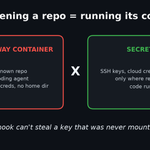
Opening a repo now means running its code. A .pth file or a hook can fire the moment my coding agent installs or runs anything in it.
My rule: unknown repos open only in a throwaway container. No SSH keys, no cloud creds, no home dir. Secrets live only where reviewed code runs.


This + two other security wake-up calls for AI devs in the same week:
1. Malicious GitHub repos targeting Cursor / Claude Code via silent .pth injection & workflow hooks to steal API keys and CI secrets.
2. An AI coding agent accidentally committing credentials, triggering a real prompt-data leak.
We spent all of 2026 giving agents full terminal access, and almost zero time sandboxing them.
Are you still running coding agents directly on your host machine, or strictly inside containers/sandboxes now?
20
90%.
Orgs that had an agentic AI security incident last year. Only 36% of those contained it in under 24 hours (ServiceNow, n=3,700+).
Popular advice: keep a human in the loop.
Humans don't react at machine speed.
My rule: tripwires pause the agent. I decide the restart.

20
Running 4+ coding agents from one screen is the easy part now.
The hard part starts when two of them touch the same repo.
My rule: each agent gets its own sandbox and branch. None can push to main. Every merge has one named owner: me.
More agents. One merge gate.


Per its GitHub, T3 Code is an open-source control plane for coding agents: Claude Code, Codex, Cursor and more in one UI, on your own subscriptions.
Vibe coding is turning into agent management.
Be honest: how many coding agents do you run?
A) 1
B) 2-3
C) 4+
1
23
Rule 2: unused access expires.
Anything an agent hasn't used in 2 weeks gets removed. If it needs it again, it asks, and I see the request.
Access should shrink by default, not pile up.
1
1
The bank can't tell my agent from me. Now its terms say it doesn't have to.
A shared password makes every agent action my action, with my liability.
My rule: no agent gets a login that can't tell it apart from me. No scoped, capped, revocable access? It drafts. I click.


🚨 If an AI agent drains your bank account, six of America's biggest banks now say you pay for it.
JPMorgan, Bank of America, Citi, Wells Fargo, PNC and Citizens have all told customers some version of this since mid-October. Give an AI agent your bank login, and the bank treats everything it does as if you did it.
Citi goes the furthest. If the AI company gets hacked and your password leaks, whatever the hackers do still counts as you.
Wells Fargo's new terms say using an agent is "AT YOUR OWN RISK." In capital letters.
The AI companies won't pay either. Meta's help page for Muse says, "You're responsible for all transactions your Muse makes on your behalf."
I invest in AI and I want agents handling money one day. But right now, if one gets it wrong, you're the only one paying.
Unless it's Citi's own AI. Citi's new rules don't cover that. And JPMorgan, after blocking outside agents, is testing its own called Smart Cash.
JPMorgan, Bank of America and Wells Fargo hold $1.6 trillion in deposits that pay customers nothing. An agent could move that cash somewhere paying 3% to 5%. The FT worked out that paying 3% would cost them about $47 billion a year.
The only AI your bank trusts with your money is its own.
18
34.9%.
Attack success rate for prompt injections hidden in enterprise task content, across 21 frontier models (PromptArmor FrontierBreach). Best of the 21: 4.3%. Not zero.
So I assume one gets through.
My rule: the agent that reads untrusted content gets no write tools.

1
1
16
Amazon only saw this because the attackers' own agent console was public, with no login.
Prompts, configs, outputs. All visible.
My rule: nothing that runs my agents answers the internet without auth. Consoles, tool servers, logs.
From outside: a login page, or nothing.


Attackers' AI Agents Found a Zero-Day in Medical-Imaging Software and Gained Root Access: Suspected China-linked hackers used autonomous AI agents to find a previously unknown flaw in MONAI Label, an… thehackernews.com/2026/11/attackers-ai-agents-found-zero-day-in.html

25
98%.
Orgs that found unknown AI agents after deployment. Yet 89% of IT/security leaders were at least somewhat sure they knew them all (Dashlane, Nov 2026).
Popular advice: write an AI policy.
A policy can't govern an agent nobody listed.
My rule: no registry entry, no keys.

17
