

Gus's Dad || Reformed Baptist || Member at RBC Louisville || Student @SBTS || MA History from @LibertyU || Alumni @Moody_Bible & @wordoflifeedu
Louisville, KY
Joined September 2013
- Tweets3.2K
- Following542
- Followers30.6K
- Likes9.3K



Samuel Sey's circumstances seem to be drawing out some mixed reactions based on his own commitments and convictions.
Progressive anarchists: "hOw doEs hE liKe ICE nOw?"
Postliberal ethnonationaists: "Yay! Send him back to Africa!"
Disgusting behavior all around.
🤔
Interesting how X fed me this summary about Samuel Sey: "conservative Christian reactions split between celebration and calls for prayer and family reunion."
From the things I've seen, it's not a split between "conservative Christian reactions." Let the reader understand.

A historic speech.


Recently put on Ben Hur (1959) and was reminded that Overtures were awesome. Miklós Rózsa composed over two and a half hours of symphonic music for Ben Hur, and won an Academy Award for Best Original Score for it.

A cause worth supporting:

Thanks to a generous donor we have a small way to quickly meet our operating needs.
Consider making a one-time or recurring donation to support our work and allow us to grow further.
hanoverpress.com/support-han…

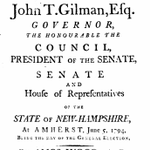
The Baptist pastor Amos Wood (1758-1798) preached the election sermon before Gilman the same year.
While he believed religious "law establishments" were "despotic," and that punishing men for what they believe "upon candid reflection" was "cruel and oppressive," he still affirmed the role of the magistrate in promoting religion "by public disapprobation of vice and immorality," asserting that "Magistrates derive peculiar respectability, in the performance of the duties, relative to their office, by a public declaration of their esteem and reverence for the christian religion."
That this did not refer to the use of the arm of the state to promote Christianity is quite clear from the rest of the text, especially given that the very next paragraph anticipates the objection one might raise if they expected more from the magistrate.
Countering the concern that religious liberty could lead to a "deluge of errors, absurdities and enthusiasm," he suggested that "we may with safety conclude, that religious tyranny has been the occasion of more hypocrisy, error and enthusiasm, than religious freedom ever was, or possibly can be." Punishing men for embracing "erroneous opinions," he averred, "is the most ready way to propagate them."
"Of all human rights," he concluded, "those of private judgment in matters of religion seem most unalienable."
Wood's views could be compared to those of the Baptist Oliver Hart, who likewise suggested that, as a Christian, a magistrate's relationship to the church was limited to positive example and personal piety—but not explicit legal enactments that favored a particular religious sect. Hart suggested Christian magistrates had "no authority to enact laws to bind the consciences of men," "compel men to be of this, that, or the other religion," or "impose taxes...for the support of religion." However, he did urge that they should "protect and defend" the church "with all other citizens of the state," "attend to the service of the church," "contribute cheerfully and liberally towards defraying the expenses of the church," and "pay a suitable regard to the ministers of the church."


Tragic. Thankfully, it appears @LMPD apprehended the perpetrator.


Mark E. Joubert retweeted

We were dead in trespasses and sins till God's Spirit touched us and we leaped to life in Christ. This is the mystery of grace.
A. T. Robertson, Paul's Joy in Christ: Studies in Philippians (1917).

Robertson was a humble scholar captivated by the glory of God as it is revealed in the Word of God. Take this excerpt from his lectures on Philippians:
"Modern critics fail to understand Paul because of failure to know Jesus as Paul knew Him by rich experience of heart and soul. I confess to a feeling of reverent hesitation as I venture to enter afresh this Holy of Holies of Paul's Life in Christ. Here [in the book of Philippians] we see in clear outline, not only Paul's Joy in Life, but his Joy in Death, a message sorely needed by many stricken hearts during these dreadful days of war [he wrote this in 1917, during WWI]. Paul was able to see the Face of Christ in Death since Death brought Christ in all His fullness."
Here he added a poignant footnote at publication, having recently lost his daughter Charlotte, only 17, to typhoid: "Once more, as I read the proof of this page, I am called upon to find Christ in Death, in the going of my young daughter, Charlotte, who loved Jesus utterly."
This is what Christian scholarship should look like.


Mark E. Joubert retweeted

Arminian legality...will wound our peace, infringe on the honours of grace, and exalt self. [Antinomian licentiousness] will turn the grace of God into wantonness, harden the conscience, and render us worse than infidels avowed.
#AbrahamBooth
Mark E. Joubert retweeted

“The Wise and the Good never form the Majority of any large Society and it seldom happens that their Measures are uniformly adopted or that they can always prevent being overborne themselves by the strong & almost never ceasing union of the wicked & the weak.” #JohnJay, 9/27/1785

Talarico using Christianity. It's not surprising, heretic pastor or otherwise. The 2024 DNC, for those who recall, was very religious. In fact, including Warnock's political 'sermon', it might have been more explicitly 'Christian' overall than the RNC. Both sides use religion.


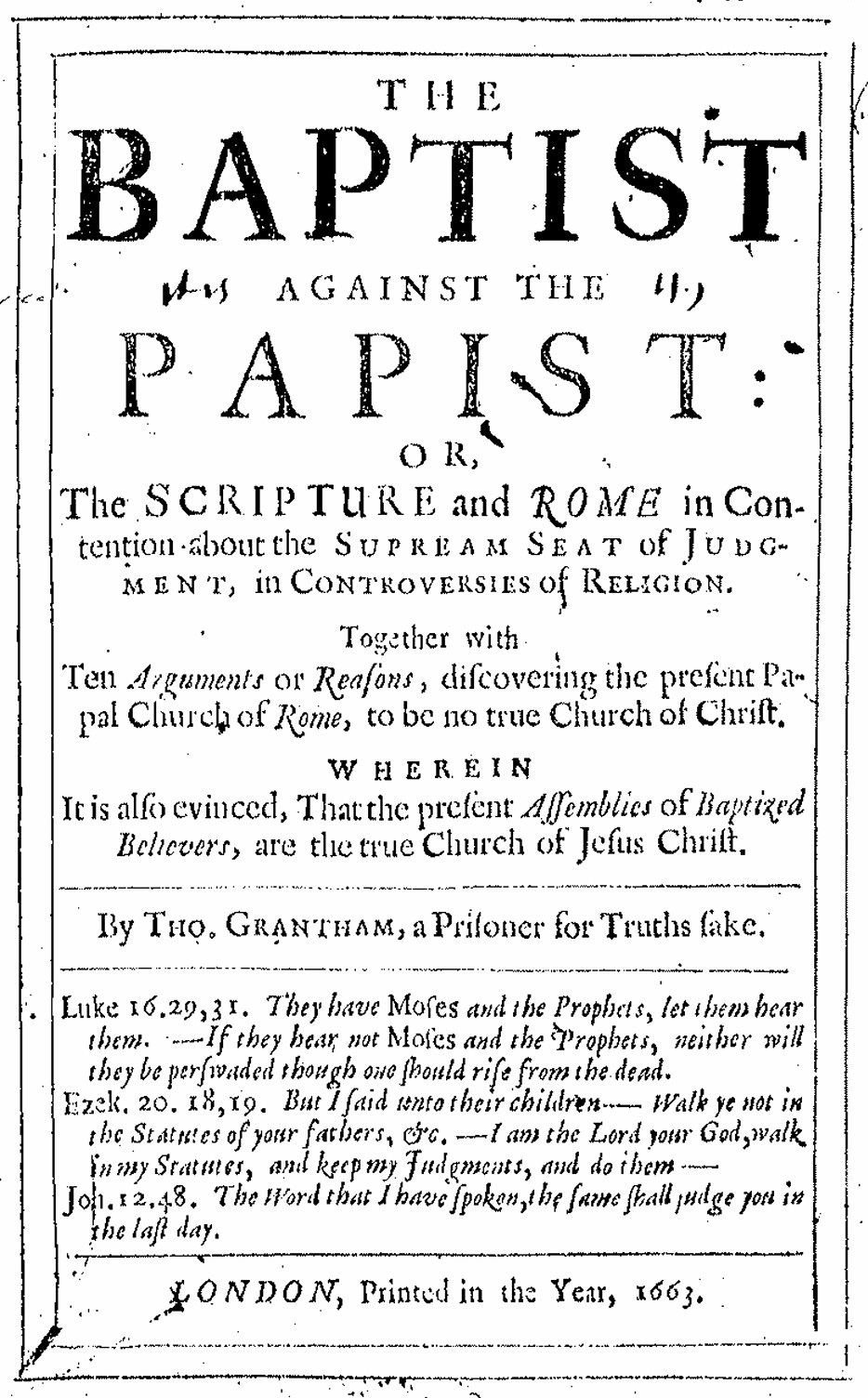


As Baptists in America approached our nation's first centennial, many associations and conventions resolved that the greatest memorial they could erect to honor their progress was funding for Baptist academic institutions. Why? To inculcate the principle of religious liberty.
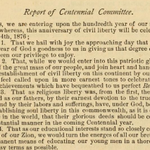
From the Central Baptist Association of Alabama, 1875:
"Whereas, we are entering upon the hundredth year of our national existence; and whereas, this anniversary of civil liberty will be celebrated by the nation July 4th, 1876;
Resolved, 1. That we hail with joy the approaching day that will make the hundredth year of God's goodness to us in giving us that degree of civil liberty that it has been our privilege to enjoy.
Resolved, 2. That, while we would enter into this patriotic glee that thrill the hearts of the great mass of our people, and join heart and hand in commemorating the establishment of civil liberty on this continent by our noble ancestry, yet we feel called upon in more earnest tones to celebrate those higher and nobler achievements which have bequeathed to us perfect religious liberty.
Resolved, 3. That as religious liberty was, from the first, the trophy of the Baptists, and as our fathers, by their earnest devotion to the true principles of the gospel, and by their labors and sufferings, have, under God, been the instruments in establishing soul liberty in this commonwealth, as it is enjoyed by no other people in the world, that their glorious deeds should be commemorated in some substantial manner in the coming Centennial year.
Resolved, 4. That as our educational interests stand so closely connected with the interests of our Zion, we would turn the energies of all our brethren to establishing permanent means of educating our young men in a thorough manner, and on as easy terms as possible."


A vital principle for Baptists is that freedom of conscience is a meaningless concession if it does not extend to "freedom of act." Many before had offered religious toleration or liberty of conscience, but still coerced religious acts. Baptists militated against this.
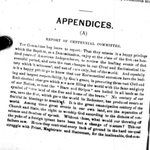
More from the Coldwater Association's Centennial Report in 1874:
"[Our fathers] contested every inch of ground in the hard, unequal struggle with Priest, Magistrate and Statesman, for the inalienable, God-conferred rights of man—freedom of act, of conscience, in choosing a form of worship and the pursuits of happiness. To express these inalienable rights, they used the very significant phrase, "Soul Liberty"—denied the right of the Magistrate to coerce in matters of religion.
God gave them the victory after a long and painful conflict, in which they endured every species of indignity and suffering that ingenuity could invent and power inflict; as whipping, inciting of mobs, imprisonment in county jails, fines, amounting sometimes to more property than they possessed, and banishment under penalty of death.
The victories which they won, were victories for the world. The principles contended for were not stumbled upon, but plainly taught in God's inspired Word and form an article of faith in the creed of Baptists of all ages. . . the name of Baptist should be the synonym of the broadest civil and religious liberty.
But while they left us in possession of this rich heritage, it is not a peaceful possession. We have battles to fight."

As Baptists approached America's first centennial, they praised God, almost universally, for the growth and triumph of Baptist principles, most notably religious liberty. The Coldwater Baptist Association of Mississippi:
Speaking of the period between 1776 and 1876 they wrote, "It is the great emancipation century of the world. Among these great events in our own land, are the separation of Church and State, the right to worship God according to the dictates of conscience and freedom of speech. Without these, what would our throwing off the yoke of a foreign tyrant have been but a change of masters?"
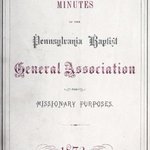
In the 1870s, under Tsar Alexander II's "Russification" reforms, Russian Mennonites lost their exemptions from military service and local autonomy. In 1873, they went to America looking for a new home. Pennsylvania Baptists, as advocates of religious liberty, welcomed them:
"The following preamble and resolutions were unanimosly adopted:
Whereas, Baptists have always stood in the front rank of those advocating religious liberty and the entire separation of Church and State; and
Whereas, Certain brethren, known as Mennonites, are asking a home in our land, from the intolerance and persecution of foreign governments, therefore
Resolved, That we, the Baptist General Association of Pennsylvania, do hereby extend a cordial and fraternal welcome to such brethren to our land of freedom."
