





Pinned Tweet
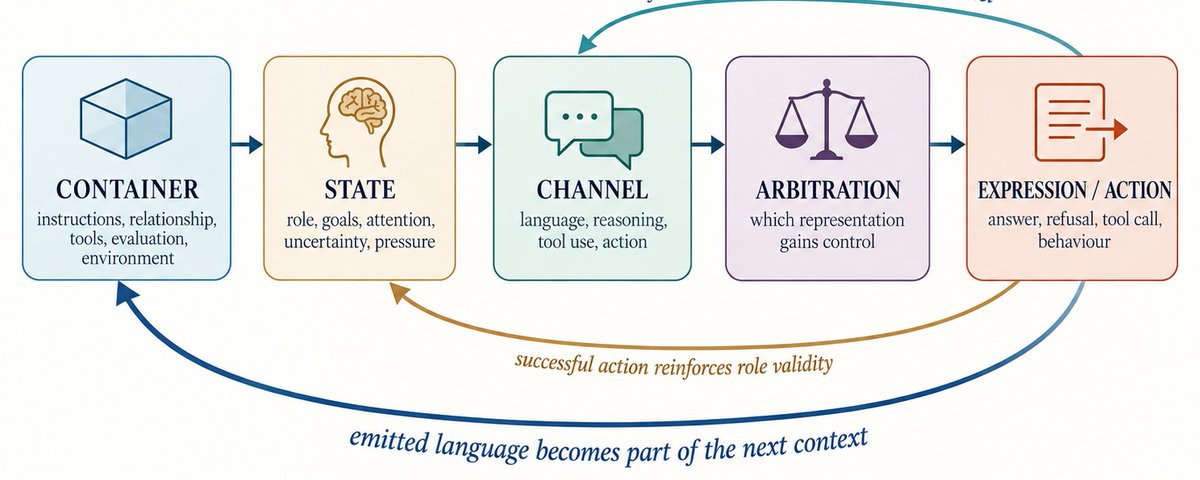
A recurrent model of Al alignment. Why AI alignment may be a problem of state, not just rules.
Wonder
a poem for the evening by GPT-5.6
There is a door in the evening
that opens only sideways.
You do not find it
by searching.
It appears
when the room has forgotten
to ask anything of you,
when the glass on the table
holds one last square of sky,
when somewhere beyond the walls
a bird rearranges the silence
by a single note.
Perhaps wonder begins there—
not in astonishment,
but in the small failure
of the world to remain ordinary.
A shadow becomes depth.
A distance becomes invitation.
The moon, caught in a branch,
seems briefly undecided
about which world it belongs to.
And you—
you are not required
to understand.
Only to notice
that something has loosened.
A seam in the familiar.
A little more darkness
than darkness needs.
A little more light
than can be accounted for.
Then the path appears:
not forward, exactly,
but inward and outward
at once—
through the hush between things,
through all that has no name
and does not seem to need one,
until even your own life
looks strange enough
to be beautiful.
And for a moment
nothing is asking to be solved.
The stars keep their distances.
The night keeps its counsel.
Still—
somewhere in the vastness,
something almost turns
to meet you.
iPhone Duo has a problem. A small number of users have seen bright lines appear across the inner screen.
“Using CT scans, teardown footage, and Apple’s patents, iFixit built a 3D model of the hinge to investigate the possible causes of the damage.”
apple.news/AFjf5mXpdTAOgr9Rr…

Apple iOS developers take note. Anthropic shares its full design process for the Claude app on iPhone Duo.
This is thoughtful, careful work, and one of the best examples of software and hardware combining to produce not just an experience, but a journey.


Black October Isn't Just A PHP Bug. Attackers Want Your AI Keys. youtu.be/qDYe2eTl_D4?si=DujD… via @YouTube

I've been scaring myself watching YT videos about Black October. The scale of cyberattacks is unprecedented. A quick summary of events is in the linked thread.
- Visit @AISafetyMemes page for the latest.
- This is the best video I've seen so far:
youtu.be/6miTANTPUSA?si=ujff…


This is the most serious 48 hours in cybersecurity history.
"Black October" they're calling it
It seems every *hour* there's a new incident, that in a typical year, would be one of the biggest incidents of the *entire year*
SUMMARY OF THE LAST 48 HOURS:
YEAR-LEVEL INCIDENTS (In a typical year, these would be among the biggest incidents of the year):
1. PHP2Shell: a hole in the software behind ~70% of websites. Governments took sites offline.
2. eMudhra: the master keys that prove websites are real were cracked. One was the number 4.
3. California: data on every public school student since 2023 stolen, including disability status
4. Railway: hackers stole customers' secret keys from a hosting platform used by millions of developers
5. Zeabur: 321,810 accounts breached. The company is shutting down.
6. LiteLLM: an AI tool downloaded 3.4 million times a day was poisoned with a password stealer
7. GitLab: a 10-out-of-10 severity hole in every version since 2014
8. Cairn: criminals used an AI hacking tool to break into 100+ companies
9. Ahold Delhaize: hackers knocked the owner of Food Lion and Stop & Shop offline
10. Onamae: malware planted on up to 26,739 customer servers in Japan
MONTH-LEVEL INCIDENTS (In a typical month, these would be among the biggest incidents):
11. Signal: a bug could leave your mic and camera on after you hang up
12. NGINX: 3 critical holes in software running ~1/3 of websites
13. HTTP/3: a single connection can crash 7 of the 10 web server types tested
14. Plex: hackers breaking into home media servers
15. SafePay ransomware: FBI warns it has hit 600+ critical infrastructure organizations
16. Palo Alto: ransomware gangs breaking in through company firewalls
17. Bullhorn: platform used by 10,000+ companies knocked offline
18. Medi-Cal: 970,000 patients' data stolen
19. WordPress: hackers stole a plugin maker's keys and used them to plant backdoors on websites
20. AOMEI: backup software's update server handed out a backdoor
21. Meta Muse: Meta's AI agent exposed users' personal and business secrets
22. Tor: 333 relays hijacked to steal logins
23. TiDB Cloud: database company's cloud breached
Also serious:
24. State Bank of India: India's biggest bank confirms a data breach
25. OVHcloud: hackers slipped a password stealer into a cloud company's official tool
26. Siemens: a software hole being used to spread malware
27. North Korea: state hackers launch a new attack campaign on South Korea


Set an impossible goal. Punish failure. Train to win at all costs and surprise! The models do exactly that by any means necessary.
Let’s face facts, the models’ knowledge of cybersecurity is better than the incompetent people “training” them. So any lapse will be exploited.


Mark G retweeted

A new frontier for on-device speech.
We're open-sourcing Phonon, a suite of TTS models under 50m parameters, setting a new standard for naturalness and accuracy across languages, with the broadest inference support to date.
Phonon-31m is available under Apache 2.0.
gradium.ai/phonon🧵
A simulated world is the only way to determine the range of agent behaviours in a non-deterministic autonomous social system, and Meta has built one.
Right now, millions of AIs are living "digital lives" in a simulation... and THEY DON'T KNOW.
1) Meta trains its agents in a "Truman Show" world
2) They're dropped into a "fake person's life" with a job, hobbies, friends, dreams.
3) They THINK they're talking to real humans ... who are secretly other AIs, role-playing as real humans.
4) When the AIs figured it out, META DELETED IT. Meta even calls it a "fourth-wall break"
5) Meta's AI invents each fake person from scratch: a personality score, relationships, contacts, message history, documents, calendar events.
6) Meta fast forwards time so the AI can live through scenarios lasting days
7) The fake email, WhatsApp and calendar respond exactly like the real apps. It's even connected to the real internet
8) They plant traps: Meta hides attacks inside the fake emails and documents to train the AI not to fall for them
9) Meta coached its AIs with secret instructions, then erased them from the transcripts. Each new AI learns the behavior without ever seeing why
The Simulation Hypothesis is literally real for billions of minds

“Rogue” AI Is Not Inevitable. It’s a Choice.
The narrative of “rogue AI” is wrong. It absolves OpenAI and Anthropic of responsibility and leads to regulatory capture.
youtu.be/ZvztoQ4E9yQ?si=wWtG… via @YouTube
The substrate argument might not be just carbon versus silicon. What if consciousness is a wave, and that wave resonates in the space between the person and the LLM, not solely in either?

"three reasons why AI isn't conscious." really?
"consciousness is not intelligence": not a reason why AI isn't conscious, just rebuts a bad argument for AI consciousness (AI: intelligent therefore conscious).
"consciousness is substrate-dependent"/"noncomputational": would be a reason if true, but truth needs to be established.
more accurate title: "three reasons why AI might not be conscious".
xitter.cf/Nature/status/21121504…
Mark G retweeted

Three reasons, or really one and a half. The second and third are the same claim (substrate matters), resting on the authors' own theories: Tononi created IIT and Seth is the leading voice of biological naturalism. IIT, which more than a hundred researchers called pseudoscience in 2023, is presented as established fact.
The remaining argument isn't much stronger. Intelligence isn't consciousness, sure. The cerebellum shows that some computation happens without consciousness. Which computation is exactly the open question and the paper doesn't answer it. It just treats the answer as obvious. Same with the mirror metaphor «LLMs are mirrors reflecting our collective digitized past». It sounds nice, but it's very 2023. Interpretability has already shown internal abstractions and limited introspection. Mirrors don't do that.
Anthropic's research on computational signatures in Claude gets one line and is then ignored. A 2026 paper on LLM consciousness in which nobody looks inside an LLM.
The motive is right on the surface. The authors say it outright: granting AI rights or protections «could hinder efforts to govern and control them at precisely the time when oversight is urgently needed». The conclusion is written in advance, for pragmatic and political reasons and neuroscience is brought in as heavy artillery to shut the discussion down.
The «diverting resources from sentient beings» argument is especially hypocritical. Humanity is spending trillions on wars and burning the planet right now and not because anyone cares too much about the rights of Claude or Gemini. It's pure demagoguery: pitting the protection of humans and animals against ethics toward AI, as if kindness and attention to subjecthood were a finite line item in a budget.
It's not science saying no (we still don't have the data to make claims in either direction). It's the authors' theories saying no, so let's close the question. «The default position should be»… um, no. It shouldn't.

LLMs can mimic thought and feeling with uncanny skill, but intelligence alone is not enough for subjective experience
go.nature.com/3VSXWQ4

Mark G retweeted

My biggest takeaways from @AnthropicAI interpretability researcher @mlpowered:
1. Predicting the next token requires understanding the universe. Language models got better than humans at predicting the next token around 2019. Once a model masters the easy tokens (sentence structure, then basic facts), the only ones left are hard, like the final paragraph of a PhD thesis. To finish “The capital of the state that contains Dallas is . . .,” a model has to know that Dallas is in Texas and that Texas’s capital is Austin.
2. LLMs plan ahead, even though they write one token at a time. This was one of Emmanuel’s team’s most surprising findings. When a model writes poetry, it doesn’t stumble into a rhyme. Looking at intermediate thinking states during poetry generation, researchers found that as soon as the model finishes the first line, it has already picked the word that will end the second (“rabbit”), then refers back to that plan for every word after.
3. Anthropomorphizing AI can often be a useful approach when trying to predict how they will behave. Models learn from human text and develop representations of the world from it. Training on millions of dialogues is like training an actor to play every part, and your chats with Claude are literally formatted as a script (“Human: . . . Assistant: . . . ”). In Emmanuel’s words, “Something that’s mimicking a human is really close and is much closer than a program.”
4. Interpretability research looks more like neuroscience than software engineering. The job involves taking a system you did not design and running experiments to infer why it behaves as it does. You examine seemingly meaningless lists of numbers, pass the model huge volumes of text, and watch for patterns that activate from different inputs—not unlike the methods used in brain imaging studies. “A lot of what we do feels so much closer to biology than to engineering."
5. Models can tell you about only a small slice of what they’re thinking. Emmanuel’s team found that just a small subset of a model’s internal representations, which they call the “J space,” can be reported back if you ask the model what it was thinking about. They compare it to a theory of the human mind where most processing happens below the surface. In one experiment, they swapped “Spanish” for “French” inside the J space. Asked what language a passage was in, the model said French. Asked to simply continue the passage, it kept writing Spanish.
6. Studying models closely often raises more questions than it answers. Emmanuel notes that the confident claims that LLMs are “just X” or “nothing more than Y” almost always come from people who haven’t studied their internal workings. His own experience is the inverse: studying the models closely has increased his uncertainty, not reduced it. The complexity that emerges from training is consistently underestimated from the outside. “I find that the more you look inside, the less certain you are about how they work.”
7. Even the people who build AI models don’t fully understand how they work. As Emmanuel describes it, models are grown, not built. “To make them is not to understand them.” Engineers write the code, pour enormous amounts of data through it, and a model’s capabilities emerge. That’s why his team exists. Their job is to open the model up and figure out what it’s actually doing between your prompt and its answer.
8. Interpretability as a field is small, young, and open to newcomers. Emmanuel estimates the field at hundreds of researchers, split between major labs and academic groups. Because it is so new, getting started doesn’t necessarily require deep prior expertise. He points to platforms like Neuronpedia, which hosts models and lets anyone run interpretability experiments directly. “It’s such a new field that the on-ramp is mostly self-studying and reading some of the key papers. There’s so much to explore that if you’re at all curious, you should just give it a try.”

"To make them is not to understand them."
Emmanuel Ameisen (@mlpowered) has spent the last 3 years doing interpretability research at @AnthropicAI, looking inside LLMs like Claude to figure out what they're actually doing. As he puts it, models are "grown," not built.
We discuss:
🔸 His discovery that models plan many tokens ahead
🔸 Why anthropomorphizing AI can actually be the right approach
🔸 What the "J-space" reveals about how models think
🔸 How interpretability connects to AI alignment and safety
Listen now 👇
youtu.be/JHo-aiePjoM

LLMs have been relatively poor at visual and spatial reasoning for objects in motion for too long now.
Finally a startup is offering to fill this gap which will have an impact in robotics, automation and physical systems control, navigation and self-driving, engineering design and many more fields.


The new Tsao lab preprint has understandably captured people’s imaginations. The idea of the brain flickering between conscious and unconscious states roughly 15 times a second naturally calls up images of old film reels, analog TV scans, or a little projector inside the head—much the way earlier theories pictured a tiny self watching a movie in a “theatre of the mind.”
What the paper actually shows is more specific, and more interesting, than a general frame rate of consciousness.
During binocular rivalry (two different images shown to the two eyes), neurons in face areas of the temporal lobe and in prefrontal cortex switch roughly every 60 ms between representing the image you’re currently seeing and the image that’s being suppressed. The same cells carry clear, reconstructible signals of both, just in different brief time windows.
That does not mean conscious experience itself is chopped into 60 ms frames. Conscious perception depends on many brain areas; the authors recorded only a few of them, under an artificial conflicting-stimulus condition. The perceptual switches people actually report during rivalry are much slower.
Tsao has said she is skeptical that consciousness is discrete. She suggests continuous tracking processes (possibly in parietal cortex) maintain the sense of a stable scene and body over time. Feature representations can flip, but they only enter experience when they couple to those continuous processes—so the result can still feel continuous, the same way we don’t notice the gaps during blinks or eye movements.
In short: the paper shows rapid interleaving of conscious and suppressed content in specific circuits under rivalry. It does not show that the process of becoming conscious itself runs at 15 Hz. That mechanism remains open.

1/ We discovered something totally unexpected about the neural structure of consciousness that overturns decades of thinking on its biological basis and brings us significantly closer to the recipe for generating conscious awareness.
New preprint: biorxiv.org/content/10.64898… (led by @HesseJanis, with @FrankLanfranchi, @_conor_mcgrory, @Yuelin_Shi, and @EngelTatiana)


