

Smart Contracts @ Base Horn Player @NationalSymphonyOrchestra 📯📯📯.eth Prev. Grandmaster #66 HotS MOBA https://teapawt.net/t.co/KNbcoxL89l
Joined November 2016
- Tweets6.4K
- Following3.2K
- Followers1.1K
- Likes69.5K






Pinned Tweet
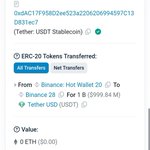
Ethereum's value proposition as trustware can be simply demonstrated by looking at a single $1,000,000,000 transaction from a couple days ago.
A billion dollars settled in 12 seconds, irreversibly finalized (in a way no nation state or corporation can undo) after 15 minutes


Markus Osterlund retweeted

This is the first Ethereum talk I've watched this year, and uuugh...
Lemme speak as an outsider, who for whatever reason still has most of his net worth in ETH. This entire Ether issuance discussion is so stupid.
There is this bigass skeleton in the closet, and everyone pretends we don't see it. Let me shine some light: there is fuck-all to do on Ethereum. <gasp>
The reason so many people have ETH is because they believe in this shit - I believe in this shit -, and the reason everyone stakes ETH is because there isn't anything else to do with it!
Sure, you can shove it in the casino and hope it doesn't get drained; or when shit hits the fan, that you're awake to pull out before the cards fall. Who in their right mind would consider that a store of value?
The entire Ether issuance discussion is trying to remedy the symptom instead of the root of the problem. The symptom is that everyone wants to stake instead of using the network, so there's no economic activity being generated. Your thinking is that by reducing the staking rewards, you are stimulating economic activity. No dum-dum, by reducing the issuance you're making people choose between the casino or exiting. This isn't fiat where you're forced geopolitically into a specific currency; you can just sell this shit.
Stop fucking with monetary policy and start making useful shit that people want to use in their day to day lives. Improve the human condition and they will spend ETH on it and generate economic activity. Improve the reliability of the ecosystem so people aren't afraid of losing their saving while they sleep. Figure out recourse mechanisms so when shit hits the fan, the little guy doesn't crash and burn. Maybe then people will also use Ether, not just keep it under the pillow.
The problem isn't that staked Ether isn't generating activity; the problem is that active Ether's is fucking risky. People want to live their lives, not play onchain PvP against the entire world. I can't believe I have to be the one to fucking say this out aloud.
Cheers, hit like and subscribe for next year's post-devcon rant from Lisbon 🫡

.@jdetychey came to defend ETH issuance cuts.
The validators came to tear his case apart.
Full debate featuring @Pol_Lanski. Hosted by @0xzak.
Yesterday's partial solution to the Riemann hypothesis directly pertains to the distribution of primes
This includes, among others, the elliptical curve order (n) of secp256k1
No cause for alarm yet but AI has shown that long held mathematical assertions can one day be upheaved

Today I call upon the blockchain industry to calmly begin planning for "bunker mode". My personal recommendation is to set in motion a controlled mass migration of assets to fresh addresses, i.e. addresses whose pubkeys remain hidden behind a hash.
Holders, starting with large and sophisticated ones, should consider moving the bulk of their funds to addresses that have never signed a transaction. And when they do sign one, they should also move remaining funds to a new address (possibly generated from the same seed phrase).
Don't rush. While I believe there is cause for action a rushed migration would do more harm than good. Don't panic either. Moving assets to protected addresses is a simple, preventative step which does not require new cryptography or new wallets.
IMO it is now reasonable to brace for the possibility that ECDSA breaks before qday, in the worst case in months not years. By "break" I mean fast private key recovery (e.g. in one week) on available hardware (e.g. a large GPU cluster).
Recent days have been humbling for human mathematical intuition. Long-held, unquestioned hypotheses have fallen. This includes the n log(n) bound for integer multiplication and the 3SUM conjecture. In hindsight, May's unexpected disproof of the Erdős unit distance conjecture was our warning shot.
Yesterday's OpenAI drop made it clear that mathematical superintelligence is upon us. They say there are weeks where decades happen. We are about to live through weeks where centuries of mathematical progress happen. Could our magic 64-byte ECDSA signatures be too good to be true? Was it just security through obscurity all this time?
Elliptic curves feel especially vulnerable to superintelligence. Curves carry rich structure, with room for fancy tricks like Schoof, Frobenius, pairings. (By contrast, hashes are designed to minimise algebraic structure.)
Separately, as Ewin Tang can attest, an efficient quantum algorithm sometimes foreshadows an efficient classical one. We should be open to the possibility of a classical counterpart to Shor that breaks elliptic curves and RSA at once.
Also noteworthy is the striking under-representation of cryptographic breakthroughs among the 722 mathematical results OpenAI published. I've witnessed first-hand the US government censoring academic quantum cryptanalysis results. Backroom interventionism is my base case.
I urge large, sophisticated actors to lead by example. Project11's "risq list" (bitcoin-risq-list.projecteleven[.]com) is a great tracker of exposed BTC pubkeys. Binance, Bitbank, Robinhood, Bitfinex, and Tether have an opportunity to harden their cold storage. Next month I'll address institutions in London in a live Q&A (forum.ethereuminstitutional[.]org/london-2026).
Again, please do not rush. Wallets holding under 50 BTC enjoy partial cover from "Satoshi's shield", i.e. his 20K exposed addresses that hold 50 BTC each. Load-bearing signers like oracles and L2 security councils should consider rotating ECDSA pubkeys with every signed message and/or multi-signing with a hash-based schemes like SPHINCS.
Exiting bunker mode safely will require post-AI cryptography. My inclination is to go all-in on hash-based cryptography and avoid structured mathematical assumptions entirely, whether from curves, lattices, or isogenies. A single battle-tested hash (e.g. from the SHA or BLAKE families) yields plausible post-AI security.
The Ethereum roadmap on strawmap[.]org fully embraces hash-based cryptography with end-to-end formal verification as a response to the quantum threat. Those timelines must now be revisited and accelerated in light of mathematical superintelligence. I'll be pushing for maximum defensive acceleration.

Not a hot take, this is obvious
Memecoins killed clarity, we made our bed and will simply sleep in it.
Onwards


SEASONED CYST

CEASE AND DECIST in all caps was my attempt at humor. It was a cross between Desist (which means to stop) and De-cyst (which would mean to remove a cyst, something that causes pain and discomfort).
What you know about U.S. securities laws apparently is that you are happy to ignore them if you simply disclose that you are ignoring them.
If your offshore Stock Tokens can not be offered or sold to U.S. persons, why are you touting them on your U.S. web site?
If it is not illegal, it should be. And in any case, it displays a terrible lapse of judgement on your part. Wisdom is displayed not just by obeying the strict letter of the law, but by doing what is right.
Shame on you.

stack too deep solved?
eth dev gonna rip

we will finally kill "stack too deep"
the next @ethereum update brings both:
1) the ability to deploy larger contracts
2) lets compilers fix "stack too deep"
eth dev is going to rip in Q4
Markus Osterlund retweeted

we will finally kill "stack too deep"
the next @ethereum update brings both:
1) the ability to deploy larger contracts
2) lets compilers fix "stack too deep"
eth dev is going to rip in Q4
Markus Osterlund retweeted

Goodbye, Poseidon!
An epic 8-year, 8-figure rabbit hole in post-quantum cryptography reaches its dream conclusion. The Ethereum Foundation is abandoning Poseidon for L1, pivoting to SHA or BLAKE. This milestone unlocks ultimate security for lean Ethereum and foreshadows a golden era of hash-based cryptography.
Since 2018, the Ethereum Foundation has invested in magic cryptographic bricks, so-called "SNARK-friendly hashes". In 2019, Poseidon was born. It held strong and became the dominant SNARK-friendly hash, securing billions via zkrollups and zkVMs.
In a stunning reversal, breakthrough SNARK designs show that SNARK-friendly hashes aren't necessary after all. Off-the-shelf traditional hash functions like SHA2 and BLAKE2s can now match Poseidon in a SNARK. In hindsight the key was not SNARK-friendly hashes, but hash-friendly SNARKs.
The secret is doing maths over the smallest prime number: 2. So-called "binary fields" natively speak the language of bits, aligning with the boolean operations inside traditional hashes. This is a stark departure from "prime fields", where awkward large-prime arithmetic makes bit manipulation painfully expensive.
We're talking sci-fi cryptography. 1M traditional hash calls proven per second, on a laptop. Just 100x overhead vs native CPU boolean compute. Nobody predicted such performance, not even the handful of binary-field visionaries. Hat tip to the research geniuses: Jim and Ben with Binius in 2023; Ron, Benedikt and William with Flock in June.
With SHA2, the lean aesthetic of minimal assumptions reaches its climax. The EF's principled stance on pure hash-based cryptography has aged like fine wine. We now enjoy foundations the world can trust for decades and centuries, foundations worthy of the dream of an internet of value.
Speed of deployment is a secondary win. There's no longer a need to wait years for Poseidon cryptanalysis to bake. Emile and Thomas from the EF post-quantum team are moving at breakneck speed with binary fields. The strawmap now points to a production-grade leanVM in 2027, with CL, DL, EL deployments in 2028.
As AI becomes exceptional at cryptanalysis, the contrarian bet to avoid riskier structures like lattices and isogenies is visibly paying off. The past weeks have been brutal. Lattice-based "HAWK" and isogeny-based "SQIsign", both signature schemes in NIST's Round 3, have suffered blows. Sources I trust say more blood is coming.
On AI, the open autoresearch trend kicked off by ECDSA[.]fail is spreading fast, with amazing outcomes from zk[.]golf and SNARK[.]fast. Days ago SNARK[.]fast crossed 1.8M BLAKE3/sec proven on an M3 Max. Stay tuned for fresh autoresearch challenges dropping tomorrow.
Also tomorrow: Ethproofs call #10, dedicated to binary fields. Possibly the most noteworthy Ethproofs call yet. Experts leading the charge will present the future of hash-based SNARKs at 2pm UTC. What an incredible time to be alive. To witness history, DM me for a calendar invite :)
Today I can confidently claim that hash-based cryptography has won out for blockchain post-quantum signatures. SNARK succinctness compresses arbitrarily many signatures into one small proof per block. SNARK flexibility yields k-of-n threshold signatures, complex multisigs, and more.
Ultimate security. Uncompromising performance. Full programmability.
Believe in something. Believe in hashes.

It'll be the first year we all have clarity on how to file our taxes 🥳

TODAY 🚨: The Commission issued an interpretation that clarifies the application of federal securities laws to crypto assets.
This is a major step to provide greater clarity regarding the Commission’s treatment of crypto assets.
Read the release here: ow.ly/XhhV50YvxvO

Telcoin just became the US's first officially state-chartered digital asset bank!

Telcoin Digital Asset Bank is granted final approval by the Nebraska Department of Banking and Finance.
A historic moment for blockchain innovation, this charter enables Telcoin to bring regulated stablecoins into traditional banking.
businesswire.com/news/home/2…


Why anyone would leverage up in a market that regularly sees 10-50% volatility swings both upward and downward is beyond me
The market has to feed on its most emotional participants 🤷♂️

Hell ya that's the crypto we know and love
Reminds me of the -50% day in Dec 2017 and the +40% day in April 2019. Good times
just spent 8 hours on concentrated liquidity math and debugging nearest-initialized tick extraction from @Uniswap v4 bitmaps, AMA


