
Prof @NorditaSweden + Professor in Complex Systems in @Stockholm_Uni math dept. External Prof @sfiscience. Still part of @SomervilleOx & @OxUniMath families.
Stockholm, Sweden
Joined January 2008
- Tweets1.5K
- Following0
- Followers6.5K
- Likes4.8K




Pinned Tweet
It seems like many pure mathematicians are going to accept AI before they accept applied mathematics.
Mathematics is so much broader than what I continue to see expressed in these discussions.

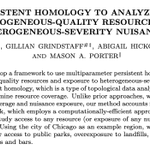
New paper: "DeGroot Dynamics on Multiplex Networks with Directed and Acyclic Interlayer Connectivities" (by Mia Zender, Kye Shi, Abigail Hickok, Weiqi Chu, Mason A. Porter): arxiv.org/abs/2610.27198
We examine opinions that depend on "more fundamental" opinions in a belief system

Dynamics Daze 2027: ddays.org/2027/index.html
It takes place 4–6 January 2027 in La Jolla, CA, USA.

ALT Invited Speakers at Dynamics Days 2027
Amidst all the upheaval and stress (especially on students & postdocs), the end of so-called “mathematical heroes” (to the extent that that's even an accurate depiction of this era) is one of the things that I most look forward to!
The hero worship was always nonsense (at best)!
I have now populated my Nordita webpage: nordita.org/about/people/nor…
I wonder if a certain longstanding mentor of mine would consider this to be a proper example of a "boring, professional webpage", which he once advised me to make. (See a comment in my longstanding webpage.)


I'm still bitter that I once lost a point on a high-school mathematics exam for misspelling "ellipse".

May I ask: what point is there to teaching and testing children in elementary school on the *names* of mathematical properties (“associate property of multiplication”, “identity property of addition”)? To me, these are so lame and boring and suck all the fun out. Is there any good reason to insist on learning the names? There are much better ways to test their understanding that a property is true, usually found in fun “contest” problems, like:
What is 10x9x8x…x(-8)x(-9)x(-10)?
(Vs “zero property of multiplication”)
What is 1/2 x 2/3 x 3/4 x 4/5 x … x 99/100?
Quick, what is 34x3 +34x7? (Vs “distributive”)
There’s a whole slew of such really fun problems, completely standard. I don’t care if you know what grownups call it. Do you understand how to use it as a “backdoor” to answer a problem immediately?

Beyond explaining and predicting, a key purpose of theoretical research is to sharpen the questions that we're asking in the first place (and to develop methods to do all of these things better).
This Thursday, I'll be hopping over to KTH to give a 'Distinguished Lecture' at Digital Futures: digitalfutures.kth.se/event/…
I'll be talking about modeling opinion dynamics. One can also see it virtually on Zoom. My talk is at noon Stockholm time.

Tersely, but not doing it justice:
(1) Inherit major problems from applications
(2) Formulate these problems mathematically
(3) Study these problems with math & computational approaches, including developing new ones
(4) Also study those math problems for their intrinsic math

You can also see various discussions on the companion LinkedIn post (which allows longer comments and hence is easier to deal with): lnkd.in/p/d45YwimX

A few years ago, an applied mathematician was telling me about a recent discussion in which a theoretical mathematician (i.e., "pure mathematician") asked him something like "What are the major open conjectures in your area of applied mathematics?".
[1/2]
A mathematician sat up so high
And he just kept on asking 'Why?"
A proof no longer sketching
'Cause instead he was kvetching
"Damnit! This bloody AI!"
The final word in the talk "How and why the Nobel Prize in Physiology or Medicine is Awarded – with some highlights from neuroscience" by Sten Grillner in Digital Futures on the KTH campus on 8 October 2026.

ALT quote by Santiago Ramón y Cajal
Actual picture of mathematicians rushing to read/post AI proofs.

ALT Far Side of Scientists rushing to ice-cream truck
Until AI mathematics starts including snarky remarks and pop-culture references, why would anybody want to spend time reading it anyway? ;P