

building the future of ai @typesafeai
San Francisco
Joined November 2015
- Tweets606
- Following391
- Followers2K
- Likes17.8K




Eugene Shvarts retweeted

You’re probably paying a frontier model to read 100K tokens to find 500.
The default for evaluating long-horizon agents is to point the biggest model you have at the whole trajectory, but most of it is noise for the question you’re asking. Take a judge that checks whether a user got frustrated. It doesn’t need 180 tool calls, it needs the user turns. Finding those is a code problem, not an intelligence problem.
At @JudgmentLabs, the Judgment Agent writes preprocessing code for each judge, and @TypeSafe’s Jev makes the call on just that evidence. It matched a frontier model reading everything at ~600x lower cost.
I think evaluating every trajectory, not just a sample, is about to get a lot easier. When each eval costs this little, there’s no reason not to go looking for every insight in your data.
Great work by @Unhingexd, and thanks to the @typesafeai team!

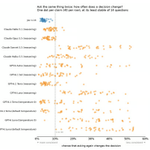
Most eval questions are narrow. Did the user get frustrated? The answer sits in a few hundred tokens, buried in 100K+.
We extract just that evidence with code and let @typesafeai Jev decide, matching GPT-6 Luna on the full trajectory at ~600x lower cost.

Eugene Shvarts retweeted

how many of your agent's runs did anyone actually read last week?
what if you could say, "all of them!"
@JudgmentLabs does, using Jev to answer each eval question in 0.15s, so you stop sampling and grade every run
and presto ✨ your evals are a search index
Most eval questions are narrow. Did the user get frustrated? The answer sits in a few hundred tokens, buried in 100K+.
We extract just that evidence with code and let @typesafeai Jev decide, matching GPT-6 Luna on the full trajectory at ~600x lower cost.
Eugene Shvarts retweeted

It was such an honor to speak to @sydneyrunkle from @LangChain. Back in the hackathon days, I was truly disappointed at the behavior of the models wrt shipping in prod. I am so glad we finally got to share Jev and its philosophy with the community.
@typesafeai is on the journey to make an intelligence that is easier to build with. Join us!

.@sydneyrunkle + @typesafeAI co-founder @hackgoofer sat down for a chat on:
✅ How Jev differs from an LLM
✅ Where it fits inside of LangChain agents
✅ Using Jev-as-a-judge in LangSmith
And so much more!
⏯️ Watch the full conversation: youtu.be/0vz5slHWAp8

Eugene Shvarts retweeted
sure AI can solve Millenium math problems, but can it solve the hardest problem in computer science


Eugene Shvarts retweeted
Jev gives @stralagroup the 9s of reliability they need to power decision-making for insurance, where quantifying risk is as critical as it gets.
check out @EGafni in conversation with @armandostrala and @flohop_dev
Eugene Shvarts retweeted

i caught up with @CompleteSkeptic last week to cover a few important things:
- the pink coat and hair and everything
- the AI bubble
- SF's crisis of purpose
00:00 - What’s up with the pink?
01:48 - Posting on X dot com
04:51 - AI has been a bubble for a while now
07:55 - Why are labs IPOing now?
10:21 - A lab, a neolab or a third thing
13:28 - The lab revenue problem
17:42 - SF’s crisis of purpose
25:37 - Not worrying about the macroeconomic climate
30:24 - The labs make a lot of bad bets
34:59 - Innovating on financial engineering
37:05 - Making employees arms bigger
38:23 - Pushing the frontier of craziness and bravery
Eugene Shvarts retweeted

quick tip we learned the hard way @ rivet:
jev does not reason
...which is by design
...and we should have rtfm first
~
we started by prompt-engineer to ask something like:
```
𝚜𝚎𝚟𝚎𝚛𝚒𝚝𝚢 = 𝚊𝚜𝚔(
"𝚐𝚒𝚟𝚎 𝚖𝚎 𝚝𝚑𝚎 𝚜𝚎𝚟𝚎𝚛𝚒𝚝𝚢 𝚘𝚏 𝚝𝚑𝚒𝚜 𝚒𝚜𝚜𝚞𝚎. 𝚏𝚘𝚛 𝚎𝚡𝚊𝚖𝚙𝚕𝚎, 𝚜𝚎𝚟-𝟷 𝚒𝚜 𝚇, 𝚜𝚎𝚟-𝟸 𝚒𝚜 𝚈, 𝚜𝚎𝚟-𝟹 𝚒𝚜 𝚉, 𝚎𝚝𝚌",
𝚘𝚞𝚝𝚙𝚞𝚝𝚜=[𝚂𝙴𝚅𝟷, 𝚂𝙴𝚅𝟸, 𝚂𝙴𝚅𝟹, 𝚂𝙴𝚅𝟺]
)
𝚛𝚎𝚝𝚞𝚛𝚗 𝚜𝚎𝚟𝚎𝚛𝚒𝚝𝚢
```
normally, an llm would spend reasoning tokens to come to a descent conclusion
but doing this with jev gives meh results, and defeats what makes jev awesome
~
after rtfm, we split it up in to tiny prompts like this:
```
𝚒𝚜_𝚍𝚘𝚠𝚗 = 𝚊𝚜𝚔("𝙳𝚒𝚍 𝚝𝚑𝚎𝚒𝚛 𝚙𝚛𝚘𝚍𝚞𝚌𝚝𝚒𝚘𝚗 𝚜𝚎𝚛𝚟𝚒𝚌𝚎 𝚐𝚘 𝚍𝚘𝚠𝚗 𝚘𝚛 𝚋𝚎𝚌𝚘𝚖𝚎 𝚞𝚗𝚞𝚜𝚊𝚋𝚕𝚎?")
𝚒𝚜_𝚋𝚕𝚘𝚌𝚔𝚎𝚍 = 𝚊𝚜𝚔("𝙰𝚛𝚎 𝚝𝚑𝚎𝚢 𝚋𝚕𝚘𝚌𝚔𝚎𝚍 𝚠𝚒𝚝𝚑 𝚗𝚘 𝚠𝚘𝚛𝚔𝚊𝚛𝚘𝚞𝚗𝚍?")
𝚒𝚜_𝚋𝚛𝚘𝚔𝚎𝚗 = 𝚊𝚜𝚔("𝙸𝚜 𝚜𝚘𝚖𝚎𝚝𝚑𝚒𝚗𝚐 𝚒𝚗 𝚁𝚒𝚟𝚎𝚝 𝚋𝚛𝚘𝚔𝚎𝚗 𝚘𝚛 𝚏𝚊𝚒𝚕𝚒𝚗𝚐?")
𝚒𝚏 (𝚒𝚜_𝚋𝚕𝚘𝚌𝚔𝚎𝚍) 𝚛𝚎𝚝𝚞𝚛𝚗 𝚂𝙴𝚅𝟷
𝚒𝚏 (𝚒𝚜_𝚍𝚘𝚠𝚗) 𝚛𝚎𝚝𝚞𝚛𝚗 𝚂𝙴𝚅𝟸
𝚒𝚏 (𝚒𝚜_𝚋𝚛𝚘𝚔𝚎𝚗) 𝚛𝚎𝚝𝚞𝚛𝚗 𝚂𝙴𝚅𝟹
𝚛𝚎𝚝𝚞𝚛𝚗 𝚂𝙴𝚅𝟺
```
which works like a charm
(example screenshot of real-world classifier below)
~
any time we find a ticket that isn't weighted well:
- we give the ticket to an llm with what we expected
- llm adds it to a test suite
- llm adjusts decision logic
- backtests new decision logic on old issues
within a few tickets the classifier logic was really solid
~
this is a feature of jev, not a limitation
in practice, it gives more control over how each decision is weighed than a generic llm
which makes it easier to reason about, monitor, and back test how agents will behave
~
for reference, this is how many jev questions we ask for a few of our classifiers in our internal support tool:
support classification and customer status: 13
severity: 6
team replies and problem identification: 6
follow-up timing: 6
linked dependencies and later conversations: 4
addressed teammate: 2
conversation grouping: 2
~
all that to say, jev is awesome

Eugene Shvarts retweeted

Introducing Jev @typesafeai powered jobs-api
Try it at treg.to/jobs-api
- One API to any jobs data
- $0.03 to run a full job hunt
- Real salary & Hiring manager data
- Plugin to any agent for your dream job
Fully open source, 0% markup
Git Repo below 👇
Eugene Shvarts retweeted

Why I am sick of the status games around researchers in San Francisco
“I am so sick of the status games, especially in SF, where ML researchers are a higher tier than ML engineers, which are a higher tier than software engineers.
I think that is completely messed up.
My hope is that we can create a new type of role: a software researcher, someone who actually pushes the boundaries of software.” @CompleteSkeptic
Love to hear your thoughts @vboykis @eugeneyan @sh_reya @jeremyphoward

So Diogo Almeida is one of the most fascinating CEOs I have ever interviewed.
born in the Philippines
2008: wins bronze for the Philippines at the International Mathematical Olympiad
2013: starts his career as a software engineer at Amazon
2017: joins Google Brain, working on cutting-edge deep learning research
2018: leaves Google Brain and takes roughly 18 months off to figure out what makes him happy
travels the world, experiments with improv, art and meditation
becomes a top-30 League of Legends player
discovers that none of it makes him particularly happy
2020: joins OpenAI when it's still a relatively obscure research laboratory
helps develop reinforcement learning from human feedback (RLHF), the technique that transforms how people interact with AI
2022: co-authors the landmark InstructGPT paper
the work becomes foundational to ChatGPT
November 2022: ChatGPT launches and becomes one of the fastest-growing consumer products in history
2023: contributes to GPT-4, one of the most important model releases in AI history
but starts questioning the fundamental assumptions behind the technology he helped build
2024: leaves OpenAI while ChatGPT is exploding in popularity
people think he's crazy for walking away
co-founds TypeSafe AI with Erik Gafni and Sasha Sheng
spends two years in stealth developing an entirely new class of AI models
September 15, 2026: launches Jev, TypeSafe's first System One model
Company makes $100M in revenue in the first 7 days of launch
raises a reported $40M seed round led by DCVC
October 2026: a reported $870M Series A at a $7.5B valuation, backed by a16z
argues that the next breakthrough in AI will come from making intelligence cheap, reliable and autonomous
My notes from my discussion with @CompleteSkeptic below:
1. Why Jevons' Paradox Does Not Cut It. We Are Going to 10x That
Diogo expects a "mega Jevons paradox", with usage that dwarfs the token consumption of LLMs and AI running in the background everywhere. He expects people to stop seeing AI as something that "slops crap at them" and start seeing it as something that makes life better.
2. Why SaaS Incumbents Are Better Positioned Than OpenAI and Anthropic in Many Application Spaces
SaaS companies know their customers' workflows and have the scale to fund the upfront engineering that real automation requires. Diogo argues their edge comes from being closest to the problems, not from distribution. Teams inside products like TurboTax know where to improve the interface, while OpenAI and Anthropic are "still living in their ivory tower."
3. Why We Do Not Hire From OpenAI
Diogo sees getting into OpenAI as an anti-signal and says its researchers love algorithms and scaling but hate data. Data is a low-status topic at most labs, and the few people focused on the right task would want to pursue their own. That leaves researchers obsessed with algorithms, which he likens to throwing money in the furnace.
4. How the AI Bubble Could Burst and Where the Demand Shock Could Be
Part of today's AI demand is driven by FOMO, from people believing they are getting good results. Diogo finds many buyers miscalibrated and overestimating what AI can do. Once they face the realities of its capabilities, demand could fall quickly.
5. What Metric Did ChatGPT Optimize for in the Early Days?
Before Claude Code, ChatGPT was optimized for monthly active users rather than the best chatbot experience, which is how sycophancy emerged. Companies are now optimizing for the MAU equivalent in coding agents. Without a dedicated model, Diogo doubts they will produce a comparable one soon.
6. Why the Talent Market Is Not Crazy for Us and We Don't Pay for Mercenaries
TypeSafe pays people good amounts but not the highest, which filters out hired guns. Diogo says Anthropic is suffering from mercenaries because it pays more than anyone else, and an entire market now exists to prepare candidates for Anthropic culture interviews.
7. We Wanted Sonya Huang More Than We Wanted Sequoia
Diogo did not want Sequoia's money and brought the firm in because of Sonya. He values her particular shape of brilliance, which offers a perspective no other advisor gives him. One TypeSafe value is to make great decisions slowly, and he sees her as a valuable thought partner for that.
(links in comments)
Eugene Shvarts retweeted
how to Jev
• you pay for the `state` part of your request once, no matter how many questions you ask about it
• so it's usually cheaper to ask every question you might want answered, even before you know if you need the answer
• then use code to sort it out
take in all the information you might need, and filter down to what's important! reliable automation means covering all your bases

The answer has nuance!
The way Jev charges for input tokens is:
(state+(sum of all questions))
The important bit here is that you only get charged once for your state tokens no matter how many questions you run in parallel.
Within a single call, two questions do cost more than one. But if you ask those two questions as separate requests with the same state, you pay more overall, because you pay for the state again in the second request.
In cases where you are more cost-sensitive than speed-sensitive, it makes sense to do analysis on how often the follow-up questions are used in your use-case. If some follow-ups are needed very rarely, then you can save on cost by running them only when actually needed.
But in cases where speed is more important than cost, then batching pretty much always wins (although there's some nuance there as well, such as a single super-huge follow-up question slowing down the call, so shunting it to its own call could make sense, depending on the frequency that that answer is needed!)
Eugene Shvarts retweeted
surprisingly few people realize state is shared and asking a lot of Qs is very efficient
The answer has nuance!
The way Jev charges for input tokens is:
(state+(sum of all questions))
The important bit here is that you only get charged once for your state tokens no matter how many questions you run in parallel.
Within a single call, two questions do cost more than one. But if you ask those two questions as separate requests with the same state, you pay more overall, because you pay for the state again in the second request.
In cases where you are more cost-sensitive than speed-sensitive, it makes sense to do analysis on how often the follow-up questions are used in your use-case. If some follow-ups are needed very rarely, then you can save on cost by running them only when actually needed.
But in cases where speed is more important than cost, then batching pretty much always wins (although there's some nuance there as well, such as a single super-huge follow-up question slowing down the call, so shunting it to its own call could make sense, depending on the frequency that that answer is needed!)
Eugene Shvarts retweeted

using pointer velocities to predict which button the user is going to click on
Eugene Shvarts retweeted

Nice unlock from jev: we can show you what parts of your codebase are relevant to a vuln scan and let you fine-tune the targeting.
The classifications are fast enough and cheap enough that you can support "insert common sense here" functionality inside of a UX that needs to be snappy. This works for repos with 100k+ files.

Eugene Shvarts retweeted

What if we could manipulate UI at the speed of thought?
Built this voice coffee ordering system with @typesafeai Jev. The drink and any updates show up while I’m still mid-sentence, ~200 ms from word to screen.
Feels pretty magical!
Eugene Shvarts retweeted

What happens when you combine embedding models with System 1 decision models? You get the intersection, which is VENN —> Vector Decision Models, a very cool OSS research project from Mark Russinovich that I was fortunate to review early and am excited to support.
Eugene Shvarts retweeted

Leading up to launch, I tried to come up with a demo vid that would appeal to Excel nerds, as we know Jev has a lot of potential in the BI/data analysis world. I wasn't able to come up with an idea that presented visually enough.
@phil_renaud has done it! This so SO COOL

Hi! I've built a Chrome extension that uses a decision model to turn every table on the web into a data visualization, so you can see patterns at a glance.
The decision model (@typesafeai's Jev) is perfect for solving a big hiccup with doing this: sometimes implied order of a column isn't "big numbers = good, small numbers = bad". Consider Earthquake deaths, or cost of a GPU, or Pitcher ERA. Jev is REALLY good and fast at figuring this stuff out.
