

Nassim Nicholas Taleb, Fooled by Randomness: "Don't cross a river if it is, on average, four feet deep." https://teapawt.net/t.co/gWvCyerHbv
Joined November 2019
- Tweets3K
- Following666
- Followers1.7K
- Likes4.5K




A peace deal was generally “within reach” just hours before the first major combat operation commenced against Iran back in February. As significant and meaningful as Iranian engagement sounds, it may be moot given the agenda of the Israeli PM and the US Department of War.
cbsnews.com/news/full-transc…


Significant development and the most meaningful regional engagement seen during the war thus far.
That said, the generally enthusiastic tone from Iranian officials (while not surprising--a regional order that does not include the US has been an Iranian ambition for decades) serves to obscure one of the likely motives behind this trip: Saudi communicating that attacks on its territory are likely to bring more serious repercussions than in the past.
The post-1945 order was held together by credibility. Credibility, once spent, cannot be repurchased at any price.
———

"America as the guarantor to the world, for the last 80 years, it is no longer there."
Trump envoy Tom Barrack, Doha, Tuesday. The same week a third US carrier heads for the Gulf.
Part 5 of 85 Years of Fuel: visiblefist.substack.com/p/e…


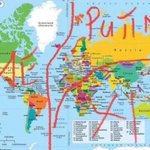
In March, we wrote about the concept of a "Grand Bargain" or a settlement of the Iran war involving the surrender of Ukraine to Russia and conceding Taiwan to China as a condition of both countries revoking their support for Iran in weapons, trade and intelligence. It was a theory that most everyone scoffed at. Today, we have the president on record describing the Ukraine/Russian leg of that settlement, himself on social media.
It is time to revisit 85 Years of Fuel and what that means for American allies. This should be required reading for leaders of every nation bound by treaty with the United States. Therefore, it will remain paywall-free at the link below in perpetuity.
visiblefist.substack.com/p/e…

Trump: "Russia, frankly, has been fine on Ukraine. They haven't been doing much."
Readers added context they thought people might want to know
Trump's remarks were made the same day Russia conducted a drone strike killing six civilians including children in a Kharkiv region park, plus missile and energy infrastructure attacks leaving hundreds of thousands without power.
kyivindependent.com/what-russias-d…
kyivindependent.com/russian-drone-…
kyivindependent.com/russia-strikes…
The Flattened Depression is a depression hidden from the metrics that would normally identify one.
Today's economic morass isn't called a depression because governments around the world are suppressing the physical losses with paper methods. Those interventions change how fast different clocks run. They slow the fastest clock, which is price, and speed up the slowest ones, which are the long-term stores kept for emergencies.
In effect, governments are saving today's price by sacrificing emergency storage. The depression bites hardest when those long clocks finally run out.
The Russia sanctions waiver shows the mechanism in one act. On the night of October 16, President Trump signed an executive order halting most of a bipartisan sanctions law he had signed in September.
That law allowed tariffs of up to 100 percent on the five largest buyers of Russian oil. The Wall Street Journal reported the move as part of an effort to keep energy prices under control before the midterm elections.
By that account, the order is a paper act aimed at the fast clock: keep Russian barrels moving and hold this autumn's fuel prices down. The Journal's own analysis says the related diesel deal won't ease prices much. The cost lands on the slower clocks. The threat Congress built into the law is set aside before it was ever used. The penalties can still be imposed later, but a threat waived once carries less weight the next time.
Meanwhile the war the pivot is meant to end keeps burning physical capacity. Moscow had already broken the energy ceasefire, and Ukraine resumed strikes on Russian refineries the same week. Ukraine's president said the waiver "only encourages him to keep attacking." Every refinery knocked offline, and every barrel drawn from storage to cover it, comes off the long clocks.
wsj.com/politics/policy/trum…


Two weeks ago NVIDIA was asking insurers to cover what happens when a neocloud customer defaults and the chips behind its lease are worth less than the loan.
On October 14, CoreWeave's unsecured bonds due 2032 fell below 80 cents on the dollar, which means a yield above 15%.
Its credit default swaps hit a record that implies a better than even chance of default within five years. The stock is still up 60% since the IPO and worth about $36.5 billion.
Gil Luria of D.A. Davidson put our whole thesis on the shortcomings of the AI business model in one sentence: "If CoreWeave is borrowing at 9% and the best return they can get off of that is a 5% return, it doesn't matter how much they scale."
The collateral side makes it worse:
• Resale value: an H100 system drops to about $30,000 after six years, on Barkr's numbers.
• Supersession: Vera Rubin's measured 10x tokens per megawatt over Blackwell shortens the useful life the debt was sized on.
The other side of the case: this is one day's move in a thin bond, and distressed pricing isn't a default. CoreWeave has a large backlog of contracts with investment-grade customers, and much of its debt is secured at the asset level. CDS-implied odds also overstate real default risk.
What to watch next: CoreWeave's next financing cost, whether NVIDIA's insurer program gets written and at what premium, and whether the stress spreads to Lambda, Nebius, Crusoe and Fluidstack paper.

“.. the bonds yield more than 15% ..
.. that led Musk to respond ‘yikes’ on his social media platform.”
@business $CRWV
bloomberg.com/news/articles/…

It’s a brave new world. The hyperscalers are shifting their deal structures from balance-sheet debt to off-balance-sheet debt-like obligations to deploy leverage for the endless buildout for a yet-to-be-proven business model of frontier AI.
Meta’s Hyperion is a perfect example:
•A joint venture called Beignet Investor issued $27bn of bonds due 2049. Blue Owl owns 80% of the venture and Meta 20%.
•A Meta subsidiary leases each of the 11 data centres. The first term is only 4 years, with renewal options in 4-year steps that only Meta controls, out to about 20 years.
•Meta guarantees enough of the campus's value to cover the debt payments for the first 16 years. So if Meta walks away, it still owes the bondholders. The financial risk stays with Meta while the accounting debt shrinks.
Why the 4-year term matters: under US lease accounting, a company only books renewals it is "reasonably certain" to use. A short first term puts a small slice of the 20-year obligation on the balance sheet, while the guarantee keeps Meta liable for the full debt.
Meta pays extra for this. The bonds reportedly carry a 6.58% coupon, more than Meta pays on its own AA bonds. Paying above your own borrowing cost to keep debt off the books tells you how much they value
the cleaner balance sheet.
Here's what's going on underneath:
The commitment is the same; only where it's booked has changed. Meta still owes the money (the guarantee keeps it liable), but the accounting debt is smaller. The idea is that the risk stays put while the reported debt moves somewhere else.
It's legal and disclosed, but it shows up late and in pieces. Short lease terms, joint-venture vehicles and once-a-year disclosure mean the full obligation reaches the balance sheet later and in fragments.
They're paying for it. The higher coupon on the joint-venture bonds shows Meta values the cleaner balance sheet above the cheaper funding.
The structure of the deals demonstrates that Meta, itself is unsure of whether the business model produces the economic value to repay the leverage:
It paid about 6.58% for the right to walk away every 4 years, with the guarantee capping what leaving would cost. A company confident in 20 years of value wouldn't pay for that exit. Meta's own contract treats the payoff as uncertain.
The repayment periods don't line up. The bonds run to 2049, and the buildings will last that long. But the chips that would generate any return turn over much faster, so the debt depends on several rounds of new hardware, and each round has to earn its own return.
What happens if the return doesn't come: Sell-side estimates show Meta’s capex above $500bn through 2028, more than their projected operating cash flow. If AI revenue falls short, the gap gets filled with more debt and leases, not earnings. That's the scenario where debt that shows up on the books late meets returns that never arrive.
The dated board milestones are already being decided from “The Silence of Inconvenience”
Every major fuel exporter is now pulling back at once:
Russia: its diesel export ban runs through October.
India: MRPL pulled its diesel and jet fuel cargoes.
The Gulf: fuel exports are at 58% of pre-war.
The US: export curbs are under discussion.
China: now shut in.
That's fuel nationalism: each country is protecting its own supply, and the global market for refined fuel is splitting into national pools. Asian and African buyers who relied on Chinese and Indian cargoes now have to bid for Atlantic barrels.
visiblefist.substack.com/p/t…


Chinese refiners suspend October fuel exports, one cancels cargoes, sources say reut.rs/4hxKAzQ reut.rs/4hxKAzQ


We are at the phase of the war where it runs on its own momentum, through a distributed command that no one who has stepped forward yet, in person, has the authority to stop.
In Apocalypse Now, Captain Willard's boat passes the Do Lung Bridge, the last American outpost on the river, where the bridge is blown up every night and rebuilt every day and no one can say who is in charge.
The same disorder hangs over the Strait of Hormuz, where attacks on ships keep coming despite the Islamabad memorandum and every attempt to negotiate a new settlement.
The US Navy is escorting tankers at its highest tempo in six months, on with us personnel on ships and munitions its own commanders say are running short, at a cost the Pentagon already puts above $43 billion.
That can only go on so long.
Meanwhile, the blockade is succeeding at strangling Iran's exports, and that success is what raises the threat to Gulf ports, refineries and pipelines.
Read the entire argument on Substack, with no paywall for a limited time.

Trump couldn’t even get Soybeans this round. All of that performative loyalty for nothing.

China to cut tariffs on US farm goods, but list excludes soybeans reuters.com/world/china/chin…


The bottom line for the AI buildout is changing because the major input costs keep going up while token prices are in a race to the bottom. In the knowledge work marketplace, it continues to produce deflation, but it’s driving inflation up for every other part of the inputs it needs to deflate the knowledge economy.
Taken together, the two numbers cancel each other out or look like modest inflation, modest aggregate growth. Look at them separately and the economy is going in two different directions at the same time. The Fed is being forced to respond to the one that’s running hot at the expense of the other. The chances for a major policy error continue to grow as a result.

Our Latest Report from the Deflation Machine is now available at Substack.
Read it with no pay-wall for a limited time.
visiblefist.substack.com/p/t…

Our Latest Report from the Deflation Machine is now available at Substack.
Read it with no pay-wall for a limited time.
visiblefist.substack.com/p/t…
Trump would’ve handed over Taiwan yesterday if it would’ve meant China stopped supporting Iran. Now we have it on the record with implicit reciprocal compensation by China.
Watch the arms package for Taiwan. That is the mechanism for the entire bargain.

China's ambassador to the US warned on Wednesday that the country has "red lines" on Taiwan, human rights and other issues that cannot be crossed, ahead of this week's meeting in Washington between the two countries' leaders. reuters.com/world/china/chin…

More soybeans inbound

Today in Washington, Vice Premier He Lifeng and I held substantive discussions on the U.S.-China economic relationship ahead of President Trump’s meeting with President Xi. Our discussions continued to focus on securing meaningful commitments that protect American workers, farmers, and businesses while advancing U.S. economic and national security interests.
