




The software factory discourse is super interesting.
I think really seeing the need for really good tooling and team structure here is hugely dependent on two factors:
1. You need to be actually shipping a large volume of work relative to you team size.
(IMO test here is: "Could we prioritize the our work using traditional means without being overwhelmed?" - if no, then you're not there yet. Work is becoming much more abstract.)
2. Said work needs to be intentional and impactful.
#2 is what really makes it tricky. You begin to experience the human attention bottleneck and why facilitating massive queues of work across different areas is so difficult.
The second you introduce that factor and need to solve for human decision bandwidth, alongside the facilitation of the actual pipeline.
Most of these factory tools are solving for the actual implementation, which is mostly complete at this point.
The next step is moving back to solving WHAT to do and creating both the right tooling and team structure around it.
We've been working on figuring out internally at AppSumo. The team has already nearly 10x'd the amount of PRs we're shipping, but the decision/prioritization is becoming a big challenge at scale.
The chart below is volume as we've figured out better loops, pipelines, and work management - all while having less than half the amount of engineers we started with.
Goal right now to solve with our factory is to keep this chart trending up, while reducing the amount of context/overload you experience trying to manage it.

1
75
Matt Bean retweeted

you want both systems
the agent swarm should use the software factory to deliver its work.
the software factory provides an environment for producing high quality code in a repeatable way.
both human and agent benefit from strong coding infra

After two years of rapid change in software development, we are again at a crossroads, with two competing visions for what the future might hold.
Vision one is software factories (e.g. Warp Factories), code-defined, closed-loop systems for continuously measuring and improving cloud coding agents. Software factories are developer infrastructure. Platform teams do “factory engineering” on them to optimize development across an entire product, getting the most productivity from agents while minimizing cost and improving quality. It’s a system design mindset for deploying agents.
Vision two is agent teams (e.g. Devin Bots). In this approach, individuals manage agents to orchestrate complex tasks. For example, you might have a “chief of staff” agent and ask that agent to do a coding project. It decomposes the project into subtasks that different agents take on (e.g. a designer, an implementer), reports on progress, and eventually ships. These teams can also have “always on” agents that proactively fix things, respond to events, and so on. Unlike with software factories, the user experience is more about “managing” agents, akin to how you might manage a person or a team.
Which one is better depends on how you conceive of the problem.
I view the problem as: how do you securely deploy coding agents to maximize product throughput and quality, while minimizing cost? I believe this is what businesses care about – there is this magical new technology for building software at scale and they want to make sure they are using it to get the biggest possible competitive advantage.
Put simply: this is an optimization problem. We have a new engineering primitive, the coding agent, and we want to use that primitive as well as we can.
Framing it in terms of optimization immediately leads to a need for measurement; after all, you can only optimize what you can measure. In order to get to measurement, you need reliable, standardized data. In order to get data, you need some amount of centralization and standardization, otherwise that data would be too noisy and heterogenous to do anything with. In order to centralize, you need to move to the cloud and define what a factory is in code. Your factory needs to be open and flexible so you have degrees of freedom for testing different models, harnesses and skills. You need ways of experimenting to see if different configurations perform better. And then you need to be able to feed those learnings back into the system, so it improves over time.
When you frame the problem clearly, the shape of the solution becomes much more obvious. Compared to agent teams, the factory engineering approach is much better suited to solving the optimization problem because it puts measurement, repeatability, and standardization at the center. It allows for a principled approach to improvement in the long run that is missing with agent teams. You want your factory to scale like an engineered system, not like an increasingly large organization (don’t make your agents work in a big company!).
The engineering approach is possible precisely because agents are not people; for the first time in the history of software development we can directly measure, grade and improve how code and products are shipped. We shouldn’t waste this opportunity by anthropomorphizing the technology and treating it like a teammate.
Also, wouldn’t you rather engineer an agent system than manage a team of agents? I’ve been both a builder and a manager for most of my career. You can guess which I prefer.
Matt Bean retweeted

pretty sure PMs and engineers are converging into the same role from different starting points.
writing code is basically free now. the job now is deciding what to build and thinking through every edge case.
Matt Bean retweeted

“good software is a set of strong opinions”
My apps are in quite possibly the most crowded and played out markets (calorie tracking, todo, budgeting, personal crm)
But that sentence alone is why people still pay for my apps and why there is always still space for a new competitor
People aren’t paying me for a calorie tracking app, they are paying for my (sometimes strong) opinions on what a calorie tracking app should be


Matt Bean retweeted

I think the best early product team right now is two people.
A founder who knows the market. And one person who can take an idea from brief to shipped screen without a handover.
That second seat used to be three hires.
Matt Bean retweeted

If I was hiring today, I’d hire 2x fewer people and pay them 2x as much.
One person can do much more today. You need people that have agency and can make the right decisions with higher probability.
But I never had a company, so this might be a stupid take, who knows.


Matt Bean retweeted

I think of engineering these days as divided into two parts:
1/ Product engineering: directly building the product and making sure it solves a user problem. This is as crucial as ever.
2/ Factory engineering: bringing a new set of skills to bear to engineer your software factory using evals, benchmarks, and self-improvement loops so that it becomes more productive and ships better software over time.
The important part about (2) is that it's still engineering, not vibes.
The challenges that teams are seeing with better, faster models will be 10x’d with factories + large orchestration systems.
There’s going to be a really interesting shift in how we manage and prioritize work as volume increases and human attention becomes bottleneck.
Traditional methods will not work anymore and it’ll be overwhelming for one person to manage the scale of the work they’re going to be orchestrating.
The tooling around this will be interesting because it’ll have to focus on how models will be making massive trains of micro-decisions on days long tasks (which can drift from desired output) and decide what decisions fit into the attention capacity that the human can handle.
software factories feel like a temporary problem. the models will learn to build them for you
the more interesting question to me is how to build a workspace where agents can collaborate with you
21
AppSumo is THE place for distribution in a world full of software :)

I know @AppSumo was good for product distribution, but I was lowkey expecting no sales (maybe 1 in 30 days). This is what I've made in 2 hours:
@noahkagan

1
1
27
We've found that AppSumo partners who do a limited-quantity giveaway or coupon at launch tend to get sales and reviews faster which = better overall performance.
You're now able to run your own giveaways/limited-time promotions + track progress towards your next level.


1
29
This is interesting because our data is nearly identical for MCP-submitted listings on AppSumo.
MCP submissions are a fraction of the total, but absolutely dominate on approval ratings.

Product Hunt insider tip (I'm the CEO):
Launches submitted via MCP are 3 times more likely to be featured than manual launches.
Our MCP actually helps you create a better launch.
1
112


Matt Bean retweeted

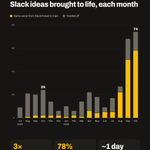
October 2025 - 24
October 2026 - 74
Ideas that went from Slack to live at AppSumo. 📈
About 20 people. None of it was on the project list.
Everyone says AI isn't making teams more productive. Ayman on our team saw this chart and said one word: "Bullshit."
What changed:
1- One owner, start to finish.
78% of ideas now go from Slack thread to live with the same person. A year ago: 8%.
No more "oh, you should do this." Whoever posts the idea ships it.
2- About 1 day.
That's the typical time from Slack thread to live.
Ship it before the thread goes cold.
3- Fast reviews.
Two of our engineers cut the friction in code review and deploys, and kept things safe and stable.
Faster builders need faster reviewers.
4- No permission.
Nobody waits for a ticket or a planning meeting.
If you see it, ship it.
Steal the measurement. Paste this into Claude with Slack and GitHub connected:
"Find every idea posted in our Slack in the last 12 months. Match each one to the code change that shipped it. By month, show: ideas shipped, whether the person who posted it also shipped it, and days from thread to live. Show me where ideas die."
Props to the team. 3x in a year.

ALT AppSumo bar chart titled 'Slack ideas brought to life, each month', Jul 2025 to Oct 2026, stacked bars: yellow = same owner from Slack thread to main, gray = handed off. Labeled totals: Oct 2025 = 24, Oct 2026 = 74. Approximate unlabeled totals: Jul 9, Aug 21, Sep 20, Nov 14, Dec 6, Jan 10, Feb 6, Mar 14, Apr 22, May 18, Jun 9, Jul 17, Aug 27, Sep 68. The yellow share is tiny until Apr 2026, then dominates Aug to Oct 2026 (about 22, 50 and 58). Stat cards: 3x more Slack ideas live each month (Oct '26 vs Oct '25); 78% had the same owner from Slack to main (was 8%); ~1 day typical time from Slack thread to main.