

Experimental neuroscientist at Humboldt Uni Berlin, violinist, chamber music fanatic.
Germany
Joined July 2009
- Tweets296
- Following195
- Followers2.9K
- Likes319
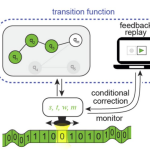
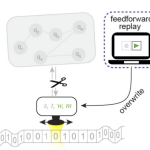





The computational functionalist now faces a hard choice: either consciousness depends on what else the system could have done (its counterfactuals), or mere replay of identical steps is enough to generate experience.
If the system behaves identically for the same input, but fails under different input, is it still computing? Or just enacting a fixed sequence? What’s left of the program when its flexibility, the capacity for alternatives, is gone?
In Turing Machine terms, the “program” follows exactly the same steps as before when given the same input. Every state transition, symbol write, and head movement unfolds identically. From the outside, it’s indistinguishable from genuine computation.

Now we add a twist. In the biological version, the patch clamp only intervenes if needed, to keep the neuron's membrane potential on track. If the input is the same, no intervention occurs. The system runs as it did originally.
This newest paper is an extension of our original thought experiment (doi.org/10.1371/journal.pbio…) where we asked, "Does brain activity cause consciousness?"

Could a dancing head on a ticker tape be instantiating first-person experience? Isn’t this a degenerate “computation”? Perhaps it’s analogous to the unfolding argument, where appearance mimics process without doing the work: doi.org/10.1016/j.concog.201…
First, we do a forward replay, as in the original thought experiment. We ignore the transition function and simply move the head, write symbols to the tape, and recreate the sequence exactly, like hitting "play" on a recording.

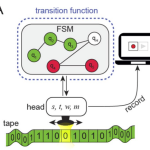
To clarify what’s going on, we model the same situation using a Universal Computing Device, also known as a Turing Machine. It follows transition rules to move between states and compute outputs, while the behaviour of the machine is recorded.

So we assume a deterministic machine carries out this computation. We record from every neuron again, but this time, when we give the same input, the machine produces the same output anyway. No intervention needed.
In the extension, it gets pushed into a delicious paradox by slightly changing the setup. A computational functionalist believes that the brain computes consciousness.

This challenges the computational functionalist to identify the key aspect of brain activity that should feel like something. If the pattern is the same, and the structure is the same, what makes it conscious?
Can neural computation feel like something? In our new paper, we explore a paradox: if you record and replay all the neural activity of a brain, down to each neuron, does replay create 1st-person experience? doi.org/10.3389/fnins.2025.1…

Looking forward to the talk by @Sarah_D_Ayash next Tuesday, Sep 10 at 4 pm (CEST) for our @SFB1315 seminar series! All are welcome in person or via Zoom. sfb1315.de/events/neural-bas…

Matthew Larkum retweeted

This pandemic-era manuscript is now a Reviewed Preprint in eLife... Apical tufts can develop durable selectivity for behaviorally relevant stimuli (whether rewarded and unrewarded) during task learning.
elifesciences.org/reviewed-p…

An apical tuft is one of the most prominent features of a pyramidal neuron. What do these mysterious subcellular compartments do during learning? A new study from @Sam_Benezra tracks the activity of the same apical tufts across learning of a behavior. 1/n

Congratulations to Tim Zolnik who made a superhuman effort for this paper (cell.com/neuron/fulltext/S08…)! Thanks to the rest of the team including @BrittaEickholt and our Visiting Einstein Fellow @ZoltanMolnar64.

Matthew Larkum retweeted

That's a wrap! Highlights include a PhD-postdoc session, posters, a themed discussion w. Richard Morris, talks by @Zoe_Chi_Ngo, @OwaldD, @DeetjeIggena, @YeeLeeShing1, @JamesPoulet & Brenda Milner awardee @ATzilivaki - thanks to all!
sfb1315.de/events/retreat-20…

ALT SFB1315's 6th annual retreat - 4th time in person!
#PLOSBiology: Does brain activity cause consciousness? A thought experiment dx.plos.org/10.1371/journal.… As a neurophysiologist I feel like I’m obliged to say ‘yes’. So why I am so conflicted by this thought experiment? @jaaanaru @LibedinskyLab @AnnaSchapiro