Max Gaspari (@max_gasp) header
Max Gaspari (@max_gasp) profile picture

Full Professor in Astrophysics @UNIMORE_univ. 2M Eur @ERC_Research COG Grantee. Previously @Princeton, INAF, MPA. Former @NASA Einstein and PU Spitzer Fellow.

Joined June 2018
Photo by Max Gaspari (@max_gasp)Photo by Max Gaspari (@max_gasp)Photo by Max Gaspari (@max_gasp)Photo by Max Gaspari (@max_gasp)Photo by Max Gaspari (@max_gasp)Photo by Max Gaspari (@max_gasp)Photo by Max Gaspari (@max_gasp)Photo by Max Gaspari (@max_gasp)Photo by Max Gaspari (@max_gasp)Photo by Max Gaspari (@max_gasp)
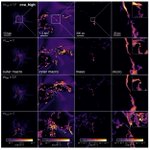
1/4 🚨🌌 The first #BlackHoleWeather paper wave has landed on arXiv! Six coordinated papers (thread below) explore #ChaoticColdAccretion across the meso-scale, from turbulence-driven multiphase rain to jet regulation and SMBH spin coupling. Huge congratulations to the BHW team, especially Fil, Vieri and Olmo! 🌪️🕳️✨ Time to read, celebrate, cite, and let the cosmic storm begin! #Astrophysics #Astronomy #BlackHoles
1
2
6
645
Max Gaspari retweeted
Meet NGC 4631— the “Whale Galaxy” — drifting through the cosmos instead of the sea. 🐋 This edge-on view of this spiral galaxy allows astronomers to study how flat the stellar disk is and provide the clearest views of material located above or below the disk.
75
1,373
206
5,999
233,274
Max Gaspari retweeted
Take a journey through space into a cosmic vista 🚀 featuring the latest Hubble image of the nebula LHA 120-N44! Read more here: ow.ly/Bceg50ZLM3V 📷 @esa / @HUBBLE_space & @NASA , ESO, Digitized Sky Survey 2, NOIRLab/NSF/AURA, D. Gouliermis, P. Horálek, E. Slawik, N. Risinger, N. Bartmann (ESA/Hubble) 🎶 Tonelabs – The Red North (ow.ly/FrX150ZLM3W)
16
131
10
688
37,074
Max Gaspari retweeted
We’re sharing a solution to the Navier-Stokes Millennium Prize Problem, one of the deepest problems at the frontier of mathematics. The proof was produced by a group of agents, using an OpenAI next-generation model significantly more capable than GPT-6 Astra. The problem concerns whether the description of smooth three-dimensional fluid motion modeled by the Navier-Stokes equations can break down. It has remained unresolved for roughly 90 years.
5,639
19,980
14,812
119,708
75,445,468
Max Gaspari retweeted
Our ESA/Hubble Picture of the Month visits a superbubble scene! The Large Magellanic Cloud is the largest of the small galaxies that orbit the Milky Way. At just 160,000 light-years away, it offers a close look at nebulae like this one, LHA 120-N44, or N44 for short. 1/3
18
178
3
1,126
31,641
Over 150 hours of Chandra observations compressed into 19 seconds. Explore how this timelapse of Centaurus A X-ray data was made at: chandra.si.edu/blog/node/970
11
159
5
965
35,099
My favorite capture of the night: The moment the moon's shadow split the sunset in half, leaving a diamond ring in the sky and a breathtaking view. I call it "Shadows on the Balearic Sea". I'll have prints available for this one linked in my bio for a few days only.
931
9,423
482
61,642
1,074,543
Un. Real.
770
5,257
374
45,461
1,390,136
Like a collage made of layered sheets of colored cellophane, a vibrant new image layers observations of the Tarantula Nebula from NASA's Chandra (blue), Hubble (green), and Webb (red). More: s.si.edu/tarantula26
14
97
3
545
65,381
Max Gaspari retweeted
Will @OpenAI and @AnthropicAI ever crack this one? Behind this beautiful turbulence cascade lies a Millennium Prize Problem: For the 3D Navier-Stokes equations, nobody has proved whether every smooth flow remains smooth forever or whether a singularity can form in finite time.
44
51
5
378
15,685
Max Gaspari retweeted
Some serious star power 🤩 The star cluster NGC 6791 is one of the oldest and largest open clusters known to exist. At about 10 times larger than most open clusters, it's home to roughly 10,000 stars. NGC 6791 resides about 13,300 light-years away: go.nasa.gov/4wV6Rhr
62
574
29
3,322
152,803
Max Gaspari retweeted
Fascinating zoom into the surface of the sun at unprecedented resolution. For the first time we can see the turbulence at the borders of convection cells! Video credit: NSF/NSO/AURA/MPS Press release: mpg.de/26900660/tiny-vortice…
71
160
14
1,435
60,429
Max Gaspari retweeted
What you're seeing here is a simulation of a solar-wind pressure interacting with Earth's magnetosphere. Computations are based on the equations of resistive magnetohydrodynamics (MHD). In the model, the plasma is treated as an electrically conducting fluid whose motion is coupled to the evolution of the magnetic field.
29
120
8
685
34,025
Max Gaspari retweeted
An internal version of Astra, @OpenAI’s next major model family, solved 10 major open problems in mathematics, quantum complexity, and theoretical computer science. We believe it will be a major step for scientific reasoning. openai.com/index/ten-advance…
10 proofs from our next major model Astra on long-standing open problems in mathematics and theoretical computer science (also including new circuit lower bounds for computing the permanent!) GPT-5.6 has already enabled so much exciting work in math and science. Can’t wait to see what comes next!
826
2,508
1,517
17,405
13,378,706
Intelligence is the ability to rewire your brain faster. It is not about knowing more.
The smartest people I know are willing to change their minds when presented with new evidence.
113
1,601
81
11,553
394,653
Max Gaspari retweeted
This @NASAWebb image shows just a small portion of one of the Orion Molecular Clouds, a massive filament of cold gas and dust beyond the Orion Nebula. Every stage of star formation is contained within this scene, which stretches 150 light-years across! 🔗 go.nasa.gov/4pfeFHH
39
260
9
1,312
42,935
Max Gaspari retweeted
This is what the AI brain looks like.
286
1,755
244
11,230
1,202,217
3/4 🕳️ Spin-coupled chaotic cold accretion across the meso-scale P26a: Morphology and thermodynamics arxiv.org/abs/2605.27502 P26b: Variability and kinematics arxiv.org/abs/2605.27508
1
1
102
4/4 🌫️ Chaotic cold accretion across the meso-scale B26a: Morphology and thermodynamics arxiv.org/abs/2605.27507 B26b: Variability and kinematics arxiv.org/abs/2605.27504
1
65